Best AI Tools Replacing Traditional Productivity Apps In 2026
Why AI platforms are replacing traditional productivity stacks by 2026
App sprawl, marked by an overwhelming number of disconnected productivity tools, slows decision making and conceals critical information across multiple platforms. AI-first platforms address this challenge by centralizing tasks, knowledge, and customer interactions, making data easily accessible and connected.
These systems learn your tasks, projects, and workflows. They draft updates, identify potential risks, and seamlessly connect context across every record within your organization.
Work moves faster when tasks, knowledge, and accounts live in one unified model.
Executives benefit from fewer handoffs and streamlined governance. Teams are able to deliver results with minimal friction and fewer logins across tools.
How AI changes project management, knowledge management, and CRM alignment
Project management: AI can forecast timelines, suggest dependencies, and provide comprehensive status updates for all portfolios.
Knowledge management: AI maps organizational information structures, links insights directly to actionable tasks, and answers queries using company-approved data sources.
CRM: AI recommends next steps, enriches account information, and flags risks by analyzing activity patterns.
Integrating these areas through an AI layer eliminates redundant data entry and closes information gaps. For the first time, commercial and delivery teams can align on a single source of truth.
The 2026 short list: top AI work platforms replacing legacy apps
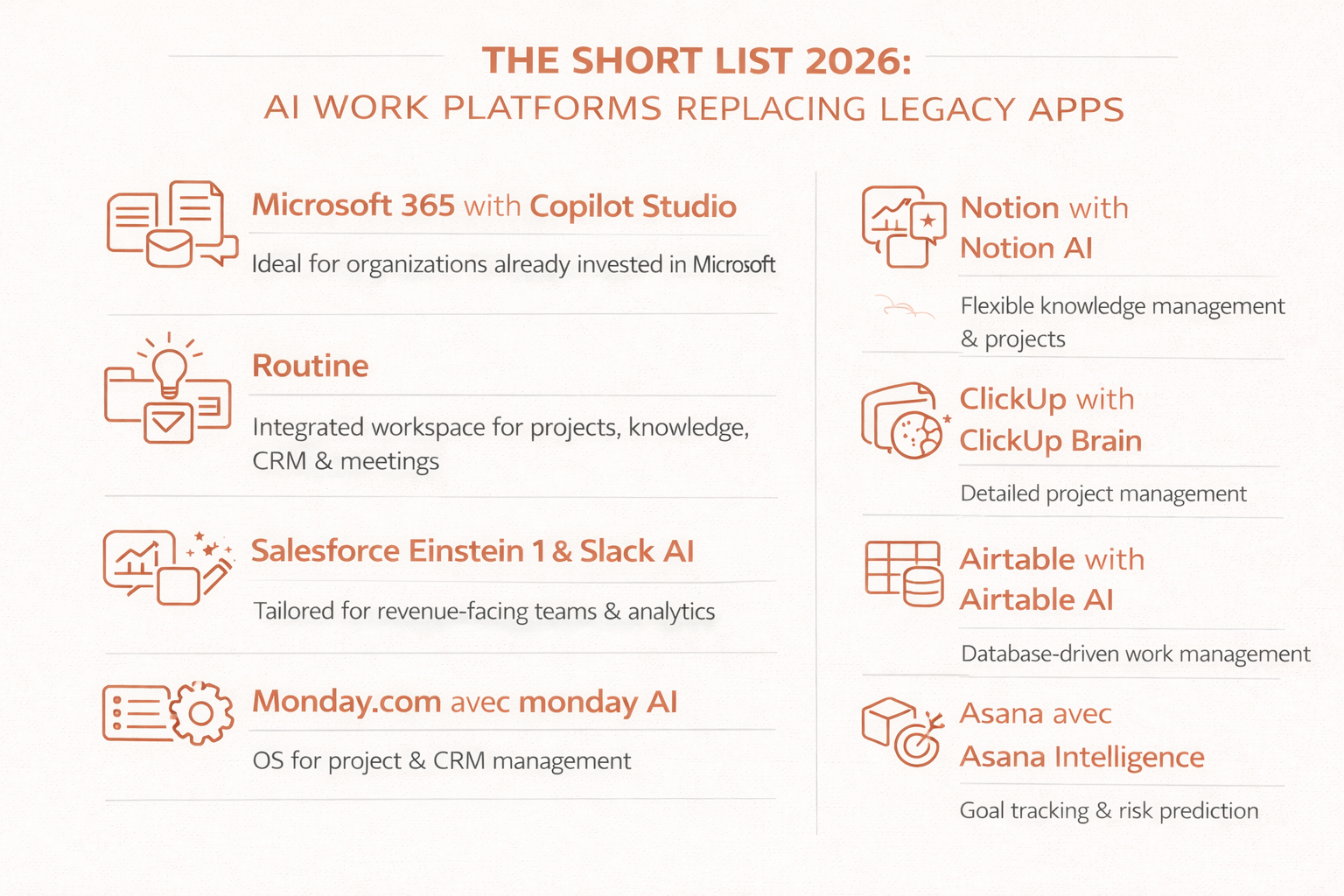
Microsoft 365 with Copilot Studio. Ideal for organizations already invested in Microsoft. This solution spans documents, Teams, and business records, with strong policy controls for enterprise environments.
Routine. An integrated workspace supporting projects, knowledge, CRM, and meetings. Its architecture connects information and tasks across all modules by default.
Salesforce Einstein 1 and Slack AI. Tailored for revenue-facing teams, this solution blends CRM, analytics, and collaboration, all while supporting governance and audit requirements.
Notion with Notion AI. Notion offers flexible knowledge management and lightweight project tracking. Its AI assists in drafting, querying, and associating content with relevant tasks and databases.
Monday.com with monday AI. This work OS covers both project and CRM management. AI-powered templates and automation boost efficiency for common workflows.
ClickUp with ClickUp Brain. A comprehensive workspace suitable for teams needing detailed project management. AI can answer direct questions and connect activities to objectives.
Airtable with Airtable AI. Prioritizes database-driven work management. Its AI classifies records and generates content within your business processes.
Asana with Asana Intelligence. Focuses on providing clarity and achieving goals. AI predicts potential risks and auto-generates updates based on project signals.
What to evaluate when replacing your toolset with AI-first platforms
Data architecture and interoperability
A unified object model spanning projects, documents, accounts, and people.
Native cross-object connections and aggregate insights without needing custom scripts.
Robust APIs and event streams that integrate with your data warehouse and data lake.
AI quality and safety
Grounding responses in your organization’s verified sources with transparent citations.
Human review queues for evaluating high-impact outputs.
Built-in redaction, PII controls, and prompt logging to support audits.
Administration and compliance
Fine-grained permissions, SSO, SCIM, and just-in-time access controls.
Options for data residency and retention policies set at the object level.
Costs and contracts
Evaluate seat options, automation usage levels, and pricing for AI activities.
Check for migration support and see if the contract includes credits for retiring old systems.
If you're deciding between a solution with comprehensive features (breadth) or a highly specialized platform (depth), compare all-in-one workspaces and dedicated project management tools using this strategic guide.
If your company is struggling with proliferating apps, see how a unified object model can help reduce tool sprawl and data fragmentation.
A practical migration plan for Q1–Q3 2026
Discover: Audit all apps, data repositories, workflows, and responsible stakeholders.
Design: Define a target information schema and permission model for your new platform.
Ground: Load trusted company content and set up retrieval and usage policies.
Pilot: Roll out a controlled pilot, focusing on Sales and Delivery teams first.
Migrate: Start with transferring high-value projects and accounts.
Automate: Recreate essential workflows with necessary safeguards and user alerts.
Cutover: Freeze legacy systems, make them read-only, and gradually migrate their data to the new platform, ensuring smooth process transitions for each team.
Publish a clear RACI and change management playbook. Track adoption weekly and proactively address blockers.
Governance, security, and compliance considerations for AI workplace systems
Require vendors to meet SOC 2 Type II and ISO 27001 certifications.
Review data residency policies and request detailed sub-processor disclosures.
Map features to your GDPR, CCPA, and HIPAA compliance requirements.
Test that role-based access controls extend to all AI-generated content.
Define clear retention schedules for business records and AI-generated logs.
Perform red-team prompt testing and monitor for model regressions.
Make sure Legal and Security teams share responsibility for periodic reviews with IT. Document every exception and update timelines accordingly.
Metrics that prove replacement worked inside your business
Time to answer: How many seconds are needed to find key information?
Cycle time: Track the time from idea to delivery for major project types.
Sales velocity: Monitor pipeline age and improvements in win rate.
Duplicate rate: Track reductions in merged or repeated records.
Automation coverage: Measure workflow steps completed automatically by AI per process.
Adoption: Weekly active users, analyzed by role and workspace.
Establish your benchmarks in December 2025. Review and report progress each quarter throughout 2026.
Frequently asked objections from executives and how to answer them
Our processes are unique. A platform will not fit.
AI mistakes will cost us deals.
Migrating will take a year and stall work.
We already have too many licenses.
What to expect in 2026 if you consolidate on AI-first platforms
Fewer fragmented tools, with clearer data lineage and traceability.
AI agents managing tasks like intake, quality assurance, and process handoffs, complete with audit trails.
Centralized objects linking projects, knowledge, and customer accounts in one environment.
Demonstrable ROI from AI-driven automation focused on business outcomes, not just activity metrics.
Teams will spend more time in a single workspace, with AI handling routine tasks such as data entry and analysis. CXOs will have access to reliable, up-to-date metrics as the AI delivers consistent, automatic data processing and reporting, eliminating the need for manual reconciliations.
FAQ
What are the risks of not consolidating into AI-first platforms?
Retaining fragmented tool stacks leads to duplicated efforts, data silos, and slower decision-making. The lack of integration can cause critical information to get lost in disconnected systems, hampering growth and strategic decision-making.
Are AI-driven processes really customizable for unique business needs?
While AI platforms offer a degree of flexibility, they may require adaptation to fit unique processes. Initial pilots in key operational areas can reveal customization needs and allow for incremental adjustments rather than full system overhauls.
Won't AI errors lead to bigger issues in critical operations?
AI errors present real risks, but organizations can mitigate these with human oversight on high-stakes tasks. Ground AI activities in verified data sources and apply strict auditing processes to balance automation with accuracy.
How can businesses manage the transition from legacy tools to AI platforms?
Staggering migration in phases mitigates disruption, making transitions smoother. Maintain legacy systems in read-only mode while incrementally transferring data; this ensures continuity and minimizes operational disruption.
What's the real return on investment from shifting to AI-driven platforms?
The ROI extends beyond cost-savings and into data demonstrability and agility in operations. AI-driven platforms enhance efficiency and reduce manual errors, but ROI depends on strategic implementation and adoption by all teams.
How do AI platforms ensure data privacy and compliance?
Compliance hinges on platforms meeting rigorous certifications like SOC 2 and ISO 27001. Companies must enforce strict policies on data handling, residency, and work closely with vendors to maintain alignment with regulations like GDPR or CCPA.
Won't consolidating tools lead to more upfront costs?
While initial investments appear substantial, they can be offset by eliminating redundant licenses and automating manual tasks. Strategic consolidation reduces long-term operational costs and leads to productivity gains that significantly outweigh initial outlays.

Julien Quintard
Founder & CEO at Routine12/25/2025
