How To Run a Company With AI Agents Only?
Define the business processes that AI agents can fully own
Begin by clearly distinguishing which business processes are suitable for full AI-driven automation. Catalog every workflow and evaluate them based on risk and reversibility. Deploy AI agents only where their impact is measurable, outcomes are reversible, and the cost of correction is manageable.
Ideal for AI agents: support triage, fraud detection, quality assurance checks, procurement pricing, data analytics, data entry, renewal reminders, and invoice reconciliation.
Shared human and agent oversight: content publishing, pricing updates, compliance monitoring, vendor onboarding. These require defined thresholds and regular audits.
Human-led processes: strategic planning, capital allocation, policy development, legal strategies, and final approvals on regulated matters.
Automate decisions that are easy to reverse, and require human oversight for those that are high-stakes or difficult to undo.
Design the operating model where AI agents act as accountable teams
Treat AI agents as functional teams with specific charters, measurable KPIs, and clear handoff protocols. Each agent or agent group should have defined ownership and well-established escalation pathways.
Types of agents to deploy
Orchestrator agent: delegates tasks, interprets policies, and coordinates specialized agents.
Specialist agents: execute targeted domain tasks such as pricing, ticket resolution, or contract analysis.
Sentinel agent: enforces compliance and data security before any external-facing actions are taken.
Auditor agent: randomly samples outputs, detects performance drift, and can initiate rollbacks if necessary.
Implement a RACI (Responsible, Accountable, Consulted, Informed) model for every workflow. Determine when agents should inform, consult, or require approval. Maintain transparent escalation ladders and published response times.
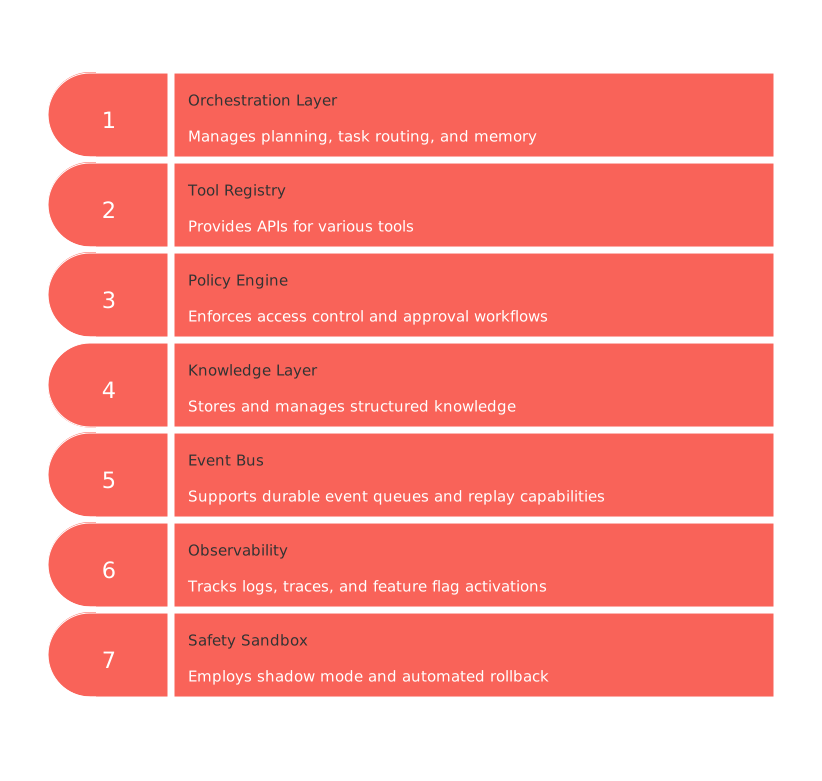
Create the system architecture for an AI‑only company
Construct a modular technical stack that supports robust testing, observation, and smooth component replacement.
Orchestration layer: manages planning, task routing, and memory, with deterministic fallback mechanisms.
Tool registry: APIs for CRM, finance, HRIS, code repositories, and data warehouses.
Policy engine: centralized access control, spending limits, and approval workflows tailored to risk tiers.
Knowledge layer: uses structured schemas, embeddings, and a versioned knowledge graph with citations for source transparency.
Event bus: supports durable event queues, idempotent processing, and replay capabilities for incident forensics.
Observability: tracks structured logs, traces, prompt templates, and feature flag activations.
Safety sandbox: employs shadow mode, canary deployments, and automated rollback mechanisms.
Prefer schema-first contracts for every agent interaction. Ensure full reproducibility of agent actions, capturing all inputs, governing policies, and resulting outputs.
Establish governance, compliance, and risk controls for agent decisions
Document policy frameworks and rules before permitting agents to make production decisions. Regulators demand clear intent and verifiable evidence of control.
Specify forbidden uses of data and establish redaction protocols for PII and PCI data.
Set approval requirements based on transaction size, geographic region, and relevant regulatory domains.
Log every decision with supporting evidence, version-controlled policies, and timestamp records.
Conduct quarterly red-team reviews, documenting residual risks and active mitigations.
Align retention policies with legal holds, audit requirements, and geographic data residency rules.
In the context of an AI-driven organization, treat all unlogged activities as non-events to maximize accountability and compliance. Consider comprehensive logging and auditing as essential components of your compliance strategy.
Run project management with autonomous agents that plan and deliver outcomes
Shift from traditional status reporting to focusing on measurable delivery. AI agents can manage project planning, coordination, and execution while adhering to defined guardrails.
Break strategic objectives into scoped epics with explicit acceptance criteria.
Prioritize work using cost-of-delay calculations, updated weekly with current data.
Automatically detect dependencies and coordinate cross-domain handoffs.
Forecast delays by analyzing historical cycle times and work-in-progress reports.
Control releases with automated tests and policy compliance checks.
Incorporate modern tracking tools and visual project dashboards. Pair agent workflows with concise visuals and rule-based milestones to maintain cadence.
Operate CRM and revenue workflows with AI agents from lead to cash
Revenue generation relies on timely and efficient execution. AI agents can optimize sales operations, ensuring smooth progression through the pipeline while minimizing manual intervention.
Evaluate and route inbound leads based on intent, fit, and engagement signals.
Draft outreach communications, validate claims, and enforce legal and brand guidelines.
Generate pricing proposals within established guardrails and provide rationale for decisions.
Produce quotes, process orders, and reconcile payments automatically.
Identify churn risks and deploy proactive retention offers.
For a comprehensive guide to automating sales functions, explore this overview of core automations for B2B sales teams. Ensure each automation has clear policies and reversibility.
Build a trusted knowledge base that agents can query and update safely
Agent performance relies on access to up-to-date, unambiguous knowledge. Invest in structured data and controlled vocabularies rather than unstructured documentation.
Adopt standardized terminology for products, contracts, and business metrics.
Enforce data contracts with defined owners, SLAs, and clear change management.
Store sources with citations, timestamps, and confidence levels to ensure traceability.
Maintain entity resolution procedures across CRM, finance, and support systems.
Version all records, with safe rollback capabilities for error correction.
Assess data freshness and coverage routinely. Program agents to favor vetted, high-confidence sources over new or less reliable data.
Measure performance and cost at the agent, team, and company level
AI agents can help improve processes that are quantifiable and consistently measured. Focus metrics on clarity and cross-team comparability.
Operational and quality indicators
Cycle time, throughput, and on-time delivery metrics.
Incidence of defects and policy violations per 1,000 automated actions.
Customer effort scores related to support resolutions.
Agent-specific indicators
Rates of autonomous operation, frequency of necessary intervention, and rollback rates.
Count of detected model drifts and time to recovery.
Cost per automated action and profit margin per action.
Align incentives and budgeting with overarching company goals, rather than input metrics like action counts.
Plan the migration path toward an AI‑run company without service disruption
Process mapping: Document all business processes, data flows, and associated risks.
Shadow mode: Allow agents to propose actions while humans remain responsible for execution.
Guarded autonomy: Gradually allow agents to operate below defined thresholds, retaining human override capabilities.
Scale and strengthen: Expand agent responsibilities, tighten controls, and introduce more sentinel oversight.
Transition to full autonomy: Conduct regular audits and specify critical exceptions requiring human input.
Communicate transition plans early and clearly delineate which responsibilities agents are taking on and what remains under direct human supervision.
Keep humans for strategy, ethics, and the rare exception paths
Let automation reduce repetitive tasks, but retain human oversight for areas requiring complex judgment, creativity, and ethical deliberation.
Define company goals, target markets, and policy frameworks.
Manage high-impact crises, complex disputes, and reputational risks.
Negotiate critical contracts and strategic partnerships.
Hold ultimate legal and fiduciary responsibility.
Program AI agents to provide reasoning, reference supporting data, and accept corrections. Foster a continually learning organization.
Choose tools and platforms without locking your company into dead ends
Choose platforms that adhere to open standards and ensure there are no hindrances when you decide to change systems. Be cautious with platforms that obscure prompts, restrict access to data, or do not provide comprehensive logging.
Insist on exportable data, transparent prompts, and enforceable policies.
Require granular cost tracking and throttling controls per action.
Periodically test failover capabilities across different model providers and storage solutions.
Compare all-in-one platforms with specialized tool stacks to ensure proper governance fit.
For a forward-looking analysis, see this practical overview of no-code AI agents for 2026. When comparing alternatives, prioritize control, auditability, and long-term cost-effectiveness rather than just feature lists.
Expect to operate a mixed technical stack, for example, integrating a general workspace tool (such as Routine or Notion), a CRM (like HubSpot or Pipedrive), and project management software (like Asana or ClickUp). Maintain an independent agent layer for flexibility in system replacements.
Final guidance for CXOs who want an AI-driven company
Begin implementation on a small scale, measure rigorously, and expand only after proving results.
Draft policies in plain, testable language. Enforce them consistently.
Treat logs and audit trails as core operational assets, not as afterthoughts.
Reserve human decision-making for the judgements that most fundamentally shape your company's identity and future.
While AI agents cannot replace every dimension of business operations, especially where emotional intelligence, nuanced reasoning, or creativity are essential, they can deliver significant value through automation and actionable insights. Achieving this requires focused implementation, stringent controls, and continuous measurement.
FAQ
What are the potential risks of allowing AI agents to fully own business processes?
The risks include overdependence on AI for decision making without adequate oversight, potential compliance breaches, and difficulties in reversing decisions. Without proper monitoring, AI can lead to significant errors, especially in high-stakes situations.
How should businesses distinguish between processes suitable for AI automation and those that are not?
Businesses should evaluate processes based on risk, reversibility, and the cost of correction. AI should handle processes with clear, measurable outcomes where errors can be quickly corrected, while humans should retain control over complex, strategic, and high-risk decisions.
How can Routine's approach help in automating project management with AI agents?
Routine enables AI agents to manage project tasks, from planning to execution, focusing on measurable outcomes rather than traditional status updates. Its system emphasizes guarded autonomy, ensuring human oversight on critical decisions while allowing AI to streamline operations.
What steps should be taken to ensure AI agents comply with governance and regulatory requirements?
Businesses should implement clear policy frameworks, define the forbidden use of data, and enforce stringent logging and audit trails. Regular audits and compliance checks should be conducted to maintain transparency and accountability.
Why is it important to maintain human oversight on strategic, ethical, and high-impact decisions?
AI lacks the nuanced judgment and ethical considerations that humans possess. Critical decisions involving company identity, legal responsibilities, and ethical quandaries require human insight to navigate complexities AI cannot comprehend.
What are the advantages of using an independent agent layer in system architecture?
An independent agent layer offers flexibility in integrating and replacing technical systems without disruptions. It allows for seamless upgrades and system enhancements, ensuring the business remains adaptable to technological advancements.
How should a company transition to being AI-driven without service disruptions?
Begin with process mapping and shadow operations, gradually allowing AI to take over while retaining human oversight. Implement a phased approach, ensuring robust controls and oversight are established before granting full autonomy to AI agents.
What role does Routine play in creating a trusted knowledge base for AI agents?
Routine structures data and enforces controlled vocabularies, ensuring AI operates with high-confidence, vetted sources. This approach minimizes errors and enhances the reliability of AI-driven operations by maintaining robust data integrity and traceability.
What is the importance of audit trails and logs in an AI-driven company?
Audit trails and logs are critical for accountability, allowing for clear tracking and verification of AI decisions. Treating them as core assets rather than afterthoughts ensures that compliance and operational integrity are maintained.

Julien Quintard
Founder & CEO at Routine02/05/2026
