Meetings Are the Most Underused Source of Work Data
Why meetings generate high-fidelity data across projects, CRM, and knowledge
Meetings provide a condensed context, they help to distill diverse perspectives and ideas into clear and actionable work information. Within these sessions, people reconcile trade-offs, articulate commitments, and surface areas of uncertainty. This combination creates valuable, high-fidelity information with immediate relevance for operational work.
Decisions: What we will do, and what we will not do.
Assumptions: Hypotheses that leaders rely on to make progress.
Commitments: Assigning ownership, scope, and due dates, turning conversations into deliverable work.
Risks and dependencies: Highlighting cross-team constraints and upstream blockers.
Customer intent: Capturing jobs to be done, objections, and criteria for success.
Live metrics: The critical numbers referenced when making key decisions.
Capture these points raised within meetings as structured data. Then, strategically incorporate this data into related projects, accounts, and any associated documentation.
What counts as meeting data in an operational system of record
Relying on unstructured text alone isn't enough. Meeting data becomes valuable only when it’s assigned structured fields that systems can reliably parse and leverage.
Core entities and suggested fields
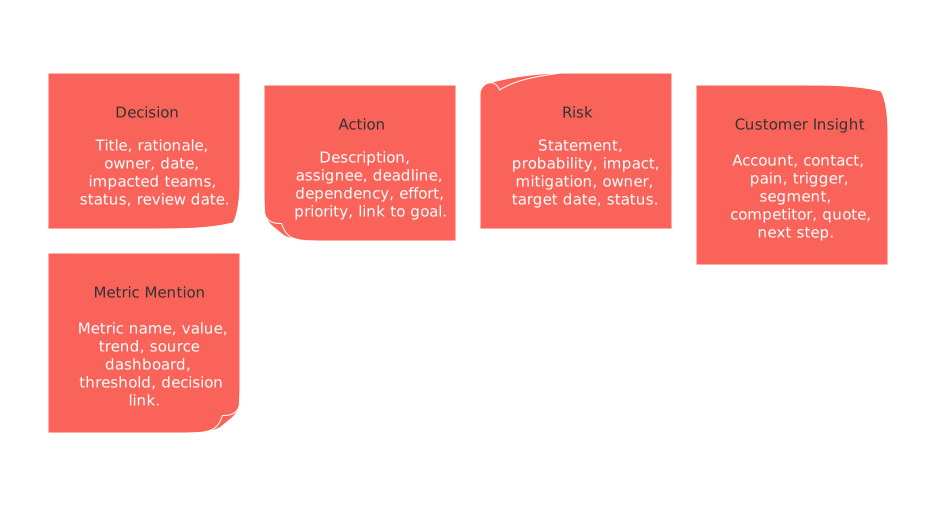
Decision: title, rationale, owner, date, impacted teams, status, review date.
Action: description, assignee, deadline, dependency, effort, priority, link to large-scale goal.
Risk: statement, probability, impact, mitigation, owner, target date, status.
Customer insight: account, contact, pain, trigger, segment, competitor, quote, next step.
Metric mention: metric name, value, trend, source dashboard, threshold, decision link.
Structure reduces ambiguity and shortens handoffs. It also prevents unstructured accumulation of notes without assigned responsibilities (owners) or specific timelines (dates), which are difficult to reference or query later.
For a deeper dive into why structure matters for teams, see the discussion on how structured data fixes team coordination gaps compared with personal apps.
Turning raw conversation into structured entities your tools can consume
Capture the stream. Use a scribe or a recording, ensuring all participants have given consent.
Normalize language. Translate vague phrasing into precise verbs and nouns.
Classify snippets as a decision, action, risk, insight, or metric.
Enrich each item with owners, dates, accounts, and links to related work items.
Publish the structured information to project trackers, CRM systems, and your knowledge base.
Review at the next session to ensure outcomes are closed and documented.
Recommended field taxonomy
Owner and accountability group should be assigned to every item.
Timebox for decisions requiring future review dates.
Relationship links to connect decisions, tasks, and risks across systems.
Confidence score for insights and assumptions.
Maintain a small, manageable taxonomy and expand only after teams demonstrate consistent usage.
From decision in the room to task in the tracker in minutes
The handoff from meeting decisions to actionable work must be as seamless as possible. A decision made in a meeting should initiate or update a live task, large-scale project goal (also known as an epic in some methodologies), or significant project milestone.
Map decision → task with assigned owner, scope, and due date.
Attach affected project goals or milestones in Asana, Jira, or Monday.com.
Link the source decision so future viewers can understand the context.
Automatically notify stakeholders of changes, replacing inefficient recap emails with instant updates.
“We view meetings as vital opportunities to drive decisions and actions. Through collaborative conversations, we create linked tasks and projects.”
This approach minimizes rework and ensures all stakeholders have real-time status updates.
Capturing CRM signals hiding in customer and pipeline meetings
Sales and customer success meetings often reveal valuable CRM insights. Identify key information during the meeting (the source) and update relevant record databases immediately, in real time.
Data points that change win rates
Buying stage transitions and next steps, each associated with a specific date.
Pain points and urgency described by the contact, including direct quotes for authenticity.
Decision criteria such as preferred integrations, security requirements, or budget limits.
Mentions of competitors and triggers for switching products or services.
Strength of internal champions and pathways to reach key economic decision-makers.
Update Salesforce or HubSpot without redundant data entry. Simultaneously, enrich your account briefs with the same insight for holistic visibility.
Metrics that reveal meeting ROI and operational drift
Decision latency: measuring the time from issue identification to decision logging.
Action follow-through rate: the percentage of actions completed by their due dates.
Insight utilization: the number of insights that result in roadmap changes.
Orphaned decision rate: the proportion of decisions lacking linked tasks.
Revisit adherence: how consistently decisions are reviewed as scheduled.
Meeting-to-commit ratio: the number of actionable commitments generated per meeting hour.
Monitor these metrics weekly and address outliers during portfolio reviews to ensure ongoing improvement.
Governance and privacy for meeting-derived data
Treat data generated from meetings as sensitive. Enforce appropriate controls based on data reach and associated risks.
Role-based access that defaults to the minimum necessary privileges.
Granular redaction to safeguard personal identifiable information (PII) and confidential terms.
Retention rules defining how long to keep recordings versus structured data fields.
Consent notices and clearly documented purposes for data processing.
Audit trails that log every edit and permission update for accountability.
Consult with legal advisors about regional regulations before expanding meeting data capture at scale.
Process templates your PMO can roll out this quarter
Weekly decision review: 30 minutes to scan new decisions, confirm owners, and schedule review dates.
Twice-weekly risk triage: 15 minutes to escalate high-impact risks onto the roadmap.
Weekly customer insight harvest: 25 minutes to convert three new insights into actionable backlog items.
Biweekly executive checkpoint: 20 minutes focused on resolving cross-team dependencies and funding issues.
For detailed formats, see these ready-to-use meeting recap templates and structures for different meeting types.
What to look for in a platform that turns meeting data into execution
Unified records: Ensure projects, CRM, and knowledge systems share a common database.
Relationship graph: Allow decisions to link to tasks, accounts, and documents seamlessly.
Schema mapping: Support configurable fields for decisions, risks, and insights.
Automation: Enable triggers that generate tasks and update CRM entries based on meeting outcomes.
Review workflows: Offer scheduled reminders for revisiting decisions and handling exceptions.
Compliance features: Include robust role-based access, redaction tools, and comprehensive audit logging.
Some organizations rely on all-in-one workspaces like Routine or Notion, while others integrate specialized tools such as Asana and HubSpot. Choose based on your need for a shared schema and interoperability between systems.
Common anti-patterns that erase most meeting value
Unstructured accumulation of notes without assigned responsibilities (owners) or specific timelines (dates).
Recording decisions without linking them to concrete tasks or adding review dates.
CRM updates that miss capturing buyer intent or clearly defined next steps.
Privately stored documents that hinder cross-team information sharing.
Recording everything but failing to publish any structured, actionable data.
Replace these habits with small, repeatable actions: publish structured data entities and link them across your project, CRM, and knowledge systems.
Meetings already generate the data your business needs. Capture it, structure it, and link it meaningfully. The result is faster decisions, stronger execution, and fewer unpleasant surprises.
FAQ
Why is structuring meeting data crucial for businesses?
Unstructured data leads to miscommunication and lost productivity. By organizing meeting information into structured entities, companies can seamlessly integrate it into their project management and CRM systems, ensuring clarity and alignment in execution.
How can automation improve the use of meeting-derived data?
Automation ensures meeting outcomes are immediately actionable by triggering tasks and updating CRM entries. This minimizes delays, reduces manual errors, and reinforces accountability across teams.
What are the risks of not linking meeting decisions to tasks?
Failing to connect decisions with actionable tasks can lead to unfinished projects and wasted resources. It disrupts workflow, complicating accountability, and may compound costly missteps later.
How does Routine help in managing meeting data effectively?
Routine integrates project, CRM, and knowledge systems to unify structured meeting data. It provides tools for schema mapping and automation, ensuring that decisions and insights are actionable and trackable.
What common mistakes should companies avoid when handling meeting data?
Avoid accumulating unstructured notes without clear responsibilities and timelines. Failing to publish structured data results in ineffective communication and hinders team coordination, leading to strategic failures.
Why is it important to adhere to governance and privacy guidelines with meeting data?
Meeting-derived data can include sensitive information; hence, respecting privacy regulations is non-negotiable. Lapses can lead to serious legal consequences and damage your company's reputation.
What metrics can help assess the effectiveness of meeting data handling?
Metrics like decision latency and action follow-through rate offer insights into efficiency. Monitoring these metrics helps identify gaps and drive improvements in decision-making processes.
Can structured meeting data improve CRM outcomes?
Yes, capturing and integrating insights from meetings directly into CRM systems boosts customer understanding and sales strategies. It ensures that customer intent and pain points are addressed promptly.
How can teams ensure their meeting outputs are effectively used?
By regularly reviewing and linking decisions and insights to concrete actions and checking their impact. This ongoing assessment prevents 'orphaned' data and enhances strategic alignment.

Julien Quintard
Founder & CEO at Routine12/18/2025
