CPM vs Gantt vs PERT in Construction Scheduling: When Each Method Wins in 2026
Why construction scheduling methods matter in 2026 for complex builds
Margins depend on timely delivery. Supply chain fluctuations persist. Labor availability remains tight. Owners demand reliable timelines. The scheduling method you choose determines how quickly you can identify risks, and how effectively you can respond.
Make the wrong choice and you’ll end up chasing symptoms. Make the right choice and you’ll control handoffs, dependencies, and manage changes proactively. This decision belongs with CXOs and project executives as much as with schedulers and planners.
Schedule is strategy. Budget follows it.
Defining CPM, Gantt charts, and PERT for construction scheduling
Critical Path Method (CPM): A network of linked activities, showing logic ties. It points to the path with zero total float, delay a critical task, and the entire project’s completion date shifts.
Gantt charts: A bar-chart visualization of task timing. Gantt charts make it easy to see who is doing what and when and provide a clear visual for tracking changes in real time.
PERT (Program Evaluation and Review Technique): A probabilistic approach that leverages three-point duration estimates. It helps estimate the likelihood of meeting specific deadlines when task durations are uncertain.
Use CPM to confirm project feasibility and sequence complex dependencies.
Use Gantt to align executives and subcontractors on timing and deliverables.
Use PERT to quantify uncertainty and set realistic contingencies.
When the Critical Path Method wins on deadline-driven construction
CPM excels in projects with complex scopes and real consequences for delays. This method is suitable for projects like hospitals, data centers, transit, and any project where it is essential to strictly adhere to the established schedule.
What CPM gives project executives
Negotiation leverage: Clearly communicate critical path logic to owners and inspectors.
Change control: Simulate the impact of RFIs and change orders before making decisions.
Forensic clarity: Use well-documented logic ties to support time impact analysis.
total float Monitor free float, Critical Path Length Index, and the Tip:. A concentration of activities with minimal float or a low index signals the schedule is vulnerable to disruptions.
When Gantt charts win for executive communication and trade coordination
Gantt charts provide a straightforward visual representation for sponsors, lenders, and field teams. Stakeholders can immediately grasp dates, overlaps, and handoffs without having to interpret complex logic diagrams.
Bid defense: Demonstrate how your project phasing aligns with site access and anticipated weather conditions.
Crew synchronization: Time-box trade activities and clearly display buffers around critical work areas.
Progress reporting: Coordinate baseline, forecast, and actual performance, all in one view.
If your team members struggle to interpret complex charts and plans, consider sharing practical visualization tools for Gantt-based project tracking. These resources simplify Gantt chart information, making it accessible to those without planning experience.
When PERT wins under uncertain design, long-lead items, or first-of-kind scopes
PERT excels when task durations are highly variable, such as during early design phases, complex MEP integration, or when managing specialty equipment with unpredictable lead times.
Three-point thinking: Capture optimistic, most likely, and pessimistic duration scenarios.
Date confidence: Communicate a range of potential finish dates, rather than attempting to pinpoint an exact date.
Contingency logic: Set schedule buffers based on identified risks rather than on subjective judgment.
PERT informs contingency budgets and escalation decisions. It provides a framework for probability-based planning so executives can define acceptable levels of risk.
A practical decision guide for choosing CPM, Gantt, or PERT in construction
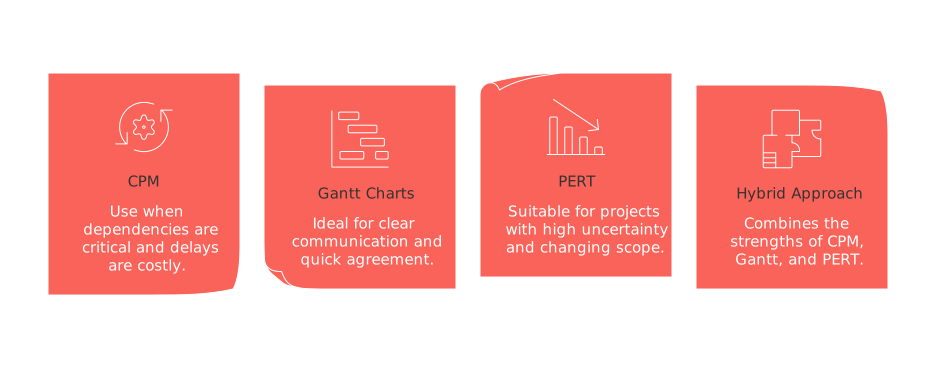
If dependencies dominate and delay penalties are in effect, start with CPM.
If communication rules and rapid buy-in is needed, lead with Gantt charts.
If uncertainty is high and scope is evolving, use PERT.
Hybrid often wins: Build CPM logic, present results in Gantt format, and vet uncertain durations through PERT.
At every major milestone in the project, review your chosen method. As the project scope becomes more clearly defined, you might find a different method becomes more suitable.
How to combine CPM, Gantt, and PERT across the project lifecycle
Apply each method to the phase where it is strongest. A hybrid approach keeps your schedule credible from bidding through closeout.
Preconstruction: Establish a CPM backbone; present a high-level Gantt; use PERT for major risk areas.
Execution: Maintain CPM for logical control; release a rolling Gantt for trade coordination; update PERT ranges to monitor ongoing risks.
Closeout: Use CPM to wind down punch lists and commissioning; summarize with a concise Gantt for stakeholders.
For additional context by phase, see the five project lifecycle phases, they help keep scheduling decisions consistent as your project evolves.
Schedule quality metrics CXOs should track in 2026
Pick a small set of leading indicators. Review them in every steering session.
Total float distribution: If most activities are clustered near zero float, your schedule is fragile.
Criticality index: Track tasks that frequently become critical, these require close attention.
Schedule Performance Index (SPI): Measure earned progress against your planned schedule.
On-time probability: Use PERT-derived metrics to quantify the likelihood of finishing on time.
Tie these indicators directly to decision-making. If risks increase, add schedule buffers or resequence activities instead of simply shifting deadlines.
Tooling that supports method selection without fragmenting project data
Construction teams need a unified platform for schedules, tasks, and stakeholder information. Systems like Routine, Smartsheet, and Microsoft Project integrate CPM logic, Gantt views, and risk notes, keeping everyone, from owners to suppliers, in sync.
Pursue tools that link schedule tasks with change orders and procurement workflows. Good data connections minimize rework when supply durations or vendors change unexpectedly.
If your organization is debating its platform strategy, compare the pros and cons of all-in-one platforms versus specialized tool stacks, and clearly map out how schedule data will flow to finance and CRM systems.
Real-world snapshots that show which scheduling method wins
Hospital tower with scheduled shutdowns: CPM takes the lead because strict logic is required to manage utility outages and infection control measures.
Tenant fit-out with a fixed move-in date: Gantt wins, providing a clear bar chart for executives and weekly trade coordination.
First-of-kind lab equipment: PERT is optimal as variable lead times require risk-based buffers and flexible planning.
Data center with modular assemblies: A hybrid approach wins, CPM manages cranes and energization, Gantt coordinates offsite assembly, and PERT addresses supply volatility.
Implementation checklist for your next bid or phase gate
Define your project’s success criteria: expected completion date, potential costs, and any penalty clauses for delays or missed objectives.
Select the primary scheduling method: CPM, Gantt, PERT, or a hybrid approach.
Create a high-level work breakdown structure (WBS) and standardize task coding.
Treat long-lead procurement items as scheduled activities, not just as assumptions.
Quantify risk and uncertainty using three-point estimates for major or volatile scopes.
Generate an executive summary Gantt from your core project data.
Set metric targets: float distribution, SPI, and criticality index.
Schedule weekly logic reviews and monthly risk recalibrations.
Link schedule items with change orders and supplier documentation.
Document key decisions for future claims and audits.
New to visual tools? Share this primer on Gantt chart visualization tools for simple project management to help stakeholders who prefer visual summaries over logic diagrams.
FAQ
Why are Gantt charts commonly used in project execution?
Gantt charts provide a clear, at-a-glance view of project timelines, which is crucial for stakeholder alignment and trade coordination. Overlooking this can lead to miscommunications and project delays.
In what scenarios should PERT be the scheduling method of choice?
PERT is optimal when uncertainty prevails, such as in projects with unique designs or uncertain task durations. Neglecting PERT in these cases could lead to underpreparedness and unexpected delays.
Can you effectively combine CPM, Gantt, and PERT?
Yes, a hybrid approach allows leveraging each method’s strengths throughout different project phases, maximizing efficiency. Ignoring integration could fragment the scheduling process and cause oversight.
What are key metrics to track for effective scheduling in complex construction projects?
Metrics like total float distribution, Schedule Performance Index (SPI), and on-time probability are essential for gauging schedule robustness. Without these, projects risk unanticipated bottlenecks and overruns.
How can the choice of scheduling method affect project success?
The wrong method leads to symptom-chasing rather than proactive problem-solving. Recognizing and implementing the right method helps control dependencies and manage changes efficiently, preventing project derailment.
What are the risks of not using integrated project management tools?
Disjointed tools can lead to fragmented data, inconsistent communication, and rework. Adopting unified platforms like Routine ensures coherence and responsiveness, vital for timely project delivery.
Is it beneficial to prioritize one scheduling method over others?
Prioritizing one method can be short-sighted; flexibility according to project phase and risk is key. Misalignment of methods to project needs can increase risk of delays and cost escalations.

Julien Quintard
Founder & CEO at Routine02/26/2026
