Why AI That “Writes for You” Doesn’t Actually Save Time
The hidden costs of AI-written copy for business teams
Vendors promise instant drafts, but your team often ends up rewriting them. While the output may appear polished, it usually lacks essential context. Brand identity blurs, factual accuracy wavers, and approval processes drag on. What once seemed like time saved soon turns into repetitive rework.
The root issue: Generative AI tools do not understand your specific systems, customer nuances, or operational constraints. They produce drafts that you then have to adjust, creating an editing loop that consumes significant time and attention.
Why AI-generated drafts increase editing time instead of reducing it
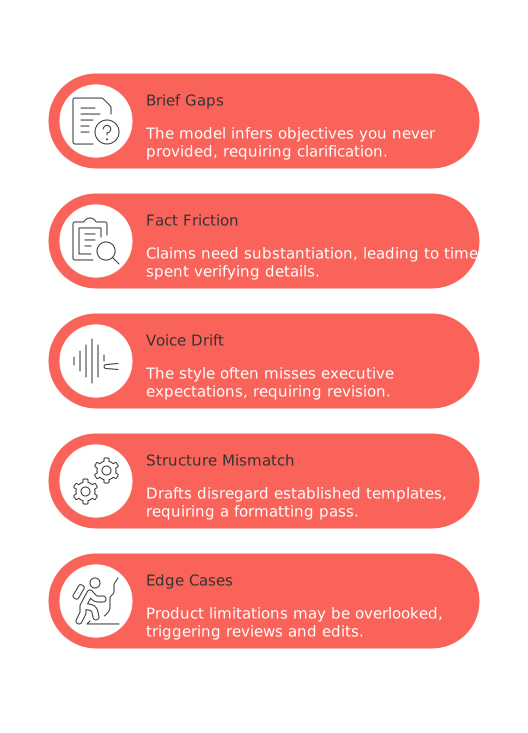
Brief gaps: The model infers objectives you never provided. You end up spending extra time clarifying your brief.
Fact friction: Claims need substantiation. You search through your CRM and internal wikis to verify details.
Voice drift: The style often misses executive expectations. You must revise it to reflect your brand guidelines.
Structure mismatch: AI-generated drafts frequently disregard established templates, requiring a comprehensive formatting pass.
Edge cases: Product limitations may be overlooked, triggering reviews by legal or compliance teams and necessitating further edits.
By the time you’ve made a second revision, you may have exceeded the effort needed if you’d started with a human-created outline. In many cases, a concise, human-drafted outline proves more efficient.
Brand voice, compliance, and risk management add review cycles
Executives expect precise messaging supported by valid evidence, while legal and compliance teams demand strong risk controls. AI-generated drafts often blur these standards, resulting in additional rounds of review.
If a tool invents claims, you own the risk.
Controls that reduce risk and minimize rework
Develop a claims library containing pre-approved language and evidence links.
Maintain a disallowed list with forbidden phrases and prohibited comparisons.
Require dual human approvals, one from product, one from legal, before publishing long-form content.
Log every revision and its rationale; remove prompts that repeatedly cause issues.
Lack of context: AI cannot reach your project plans, CRM, or knowledge base
AI models apply algorithms to fill in gaps when data is missing, yet they seldom have access to the most recent scope, pricing, or roadmap. This lack of updated information translates to a heavier editing burden for you.
Centralize your source of truth. Build content using structured fields rather than relying on memory. If your team is still working from personal documents, see why structured data address team-wide fragmentation. The less copying you do, the fewer fabricated details you need to correct.
Link product information with owners and date stamps.
Display CRM definitions within your content templates.
Place feature limitations alongside listed benefits, not in a separate location.
SEO reality in 2026: search engines reward depth, not filler
Search algorithms now prioritize original insights, verified data, and demonstrable experience. Superficial rewrites rarely perform well. AI-generated “filler” content leads to content pruning and longer indexing times.
Present firsthand results, using specific data, screenshots, or succinct timelines.
Reference credible sources, summarize their findings, and add your unique interpretation.
Comprehensively answer the core question; avoid generalized or incomplete responses.
Limit content sprawl by aligning each article closely with the specific needs of your user.
Depth in content requires careful planning. Speedy writing without sufficient information does not substitute for comprehensive knowledge.
How AI-written customer emails pollute CRM data and slow sales
Sales reps send AI-drafted replies. While the language might seem acceptable, significant aspects frequently remain incorrect or unaddressed. CRM stages get misrepresented and forecasting becomes unreliable, leaving managers searching for clarity.
Ambiguous promises confuse customer success teams.
Unverified pricing details delay procurement processes.
Overly generic value propositions increase the likelihood of hitting spam filters.
Instead, focus on automating appropriate, repetitive tasks to enhance effectiveness. Begin with automation every B2B sales team should consider. Let systems update routine fields, while humans handle critical customer communication.
Measure the true cost: an editing-time equation for executives
Quantify the work effort involved, rather than relying on subjective impressions. Start with a straightforward formula:
Editing time per draft= number of editing passes × minutes per pass.
Total cycle time= briefing + editing time + approvals + publishing.
Compare three approaches over a month: a human-created outline, an AI-generated draft, and a hybrid workflow (outline → AI → edit). Select the process with the lowest average cycle time and least approval churn.
Set a benchmark: two editing rounds at 30 minutes each.
Identify and address drafts requiring more than three passes.
Discontinue prompts that repeatedly miss performance targets.
Where AI writing actually helps without wasting time
Outline assistant: Generate section headings from robust briefs and templates.
Transformer: Convert structured product information into concise bullet points.
Classifier: Tag audience, stage, and intent to facilitate content routing.
Variant creator: Suggest subject line options based on established messaging.
QA checker: Identify missing citations, dates, or unsupported claims.
Redaction assistant: Automatically mask sensitive data before sharing drafts.
Use AI to create the primary structure, trusting humans to infuse judgement, verify evidence, and impart the brand voice.
Process design that makes AI useful inside project management and knowledge management
Efficiency stems from sound processes, not from hoping for a perfect sentence. Implement a repeatable workflow and ensure your data remains accurate and centralized.
Use content templates linked directly to product, pricing, and roadmap information.
Insist that briefs are fully completed before using generation tools.
Limit AI generation to sections that depend only on structured, validated information.
Keep a final human review step for brand voice and risk assessment.
Archive outcomes and source material alongside final assets for future reuse.
If your current infrastructure is fragmented, first compare integrated workspaces versus specialized project tools. Then, map content workflows across the lifecycle, from initial scoping through to release.
Bottom line: AI that “writes for you” rarely delivers time savings on its own. However, AI that aligns with your established structures and workflows can help reduce inefficiencies. Commit to structure, objectively measure editing time, and ensure humans remain responsible for accuracy and accountability.
FAQ
Why does AI-generated content often require more editing?
AI outputs lack contextual understanding and often need refinements to align with brand voice, factual accuracy, and structured templates. This discrepancy can lead to multiple editing passes, diminishing initial speed advantages.
How can businesses mitigate the risk of using AI-generated content?
Controlling risk involves building a claims library, prohibiting certain phrases, and requiring human approvals from product and legal teams. These steps ensure content accuracy and compliance, reducing rework cycles.
Why is AI not effective in producing precise business communications?
AI struggles with nuanced customer interactions and specific business contexts, leading to incorrect categorization and misleading information in CRM data. Human oversight remains crucial to maintaining accuracy and preventing miscommunication.
What are essential steps to effectively integrate AI into content workflows?
Interactive workflows should integrate AI with structured data for drafting while keeping humans responsible for final reviews and brand consistency. Insist on complete briefs, and structure content templates around updated project and product data.
How do search engine priorities affect AI-generated content?
Modern search algorithms reward depth, original insights, and verified data over superficial AI-generated rewrites. Align content strategy with these metrics to ensure relevance and visibility, minimizing \"filler\" content pruning.
How can Routine help in streamlining content creation?
Routine provides tools that centralize sources of truth, linking CRM and knowledge databases directly to content processes. This reduces the need for corrections and enhances data consistency across all business communications.
What are the financial implications of relying solely on AI for content creation?
Though initially appealing, AI-generated content can lead to increased costs due to repetitive editing loops and inefficiencies. Evaluate true costs by comparing editing time, approval cycles, and final output quality against human-involved processes.

Julien Quintard
Founder & CEO at Routine01/20/2026
