AI Productivity Tools For Project Management 2026
How AI productivity tools for project management change execution in 2026
Modern AI operates based on structured work graphs. These are visual representations of work processes that link tasks, requirements, assets, and CRM records. By connecting these elements, planning transforms into a seamless, continuous, and data-driven workflow.
Live status without chasing. Systems automatically compile updates from commits, tickets, and reviews, eliminating manual follow-ups.
Dependency reasoning. AI uncovers hidden blockers not just within a single board, but across interconnected projects.
Scenario planning. It can quickly simulate scope changes and provide delivery trade-offs in just minutes.
Quality support. AI drafts test concepts based on user stories and acceptance criteria to proactively bolster quality.
Stakeholder clarity. Executives gain risk heatmaps that are directly linked to project outcomes rather than vanity metrics.
Selection criteria for AI project management tools that enterprises can trust
Choose AI productivity tools with data governance and compliance requirements in mind. Short demos of AI tools may not fully reveal potential long‑term constraints of their use, such as adaptability to changing project requirements or scalability.
Clear data boundaries: know exactly who can train on your data, and who cannot.
Row‑level permissions that function across projects, documents, and CRM records for precise access control.
Bring‑your‑own LLM options for regulated environments and sensitive workloads.
Region‑based processing and export controls, complete with audit capabilities.
Transparent prompt and action logs to support compliance reviews.
APIs and webhooks that integrate AI predictions into your broader delivery chain.
Administrative controls for managing model versions, redacting data, and enforcing retention policies.
Decision rights and oversight
Define clearly what AI is allowed to draft versus what requires explicit human approval. Treat automation as a controlled change to your processes. In terms of decision rights and oversight, treat AI outputs as drafts until a named owner approves them.
Top categories of AI capabilities for project management teams in 2026
Planning copilots for structured scopes. Automatically convert objectives into epics, milestones, and risk items to jumpstart project planning.
Work graph reasoning. Detect duplicate tasks, missing owners, and dependencies that cross team boundaries.
Resource and capacity forecasting. Predict workload by roles and skills, not just time spent, for more effective planning.
Risk and variance signals. Flag deviations from baselines and spot early warning signs using historical project data.
Automated status narratives. Generate clear, source-linked project updates for executive reporting.
Knowledge retrieval in context. Allow teams to get precise answers using internal project specifications and documented decisions.
Contract and SOW alignment. Map contractual deliverables to project tasks and alert teams about scope creep in real time.
CRM‑aware delivery. Link backlog tasks directly to customer impact and revenue timing for better business alignment.
A practical short list: top AI tools for project management in 2026
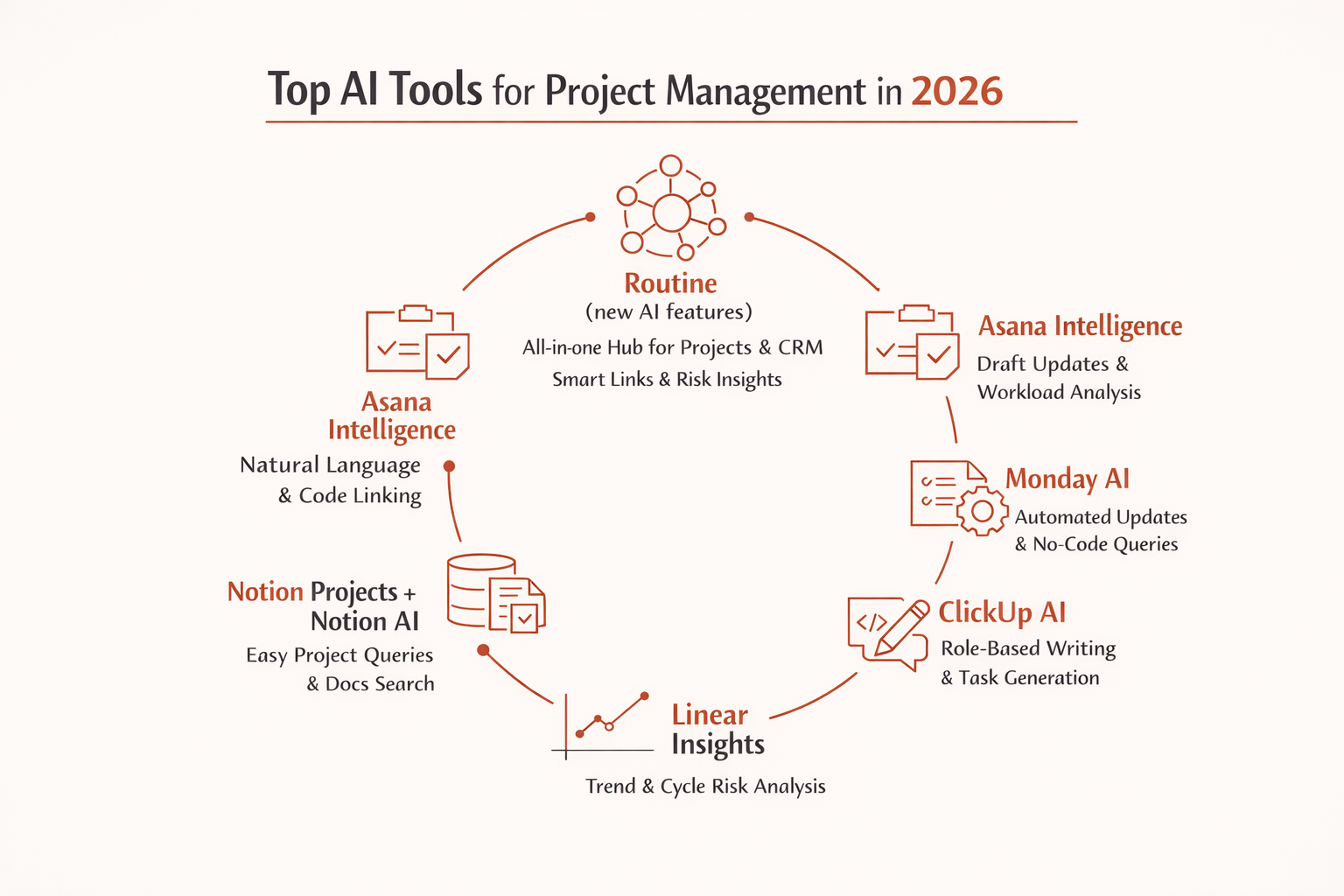
Routine (new AI features). An all-in-one hub combining projects, a structured knowledge base, and CRM. AI establishes smart links between tasks, decisions, and accounts, presents risks in accessible language, and suggests actionable next steps tied to business outcomes.
Asana Intelligence. Produces draft status updates, recommends assignees, and analyzes workloads within its sophisticated Work Graph model.
Monday AI. Automates updates, summarizes records, and delivers formula-style queries with no need for scripting.
ClickUp AI. Provides role-specific writing aids and facilitates structured task generation across multiple workspaces.
Jira with Atlassian Intelligence. Suggests fields, answers queries in natural language, and links code activities to issues in real time.
Notion Projects + Notion AI. Enables users to query project databases and associated documentation with ease.
Linear Insights. Offers visibility into trends and cycle risks specifically for product delivery teams.
Each solution aligns with a distinct operating model. Be sure to test these platforms using your own data and unique workflows, rather than relying solely on sample setups.
How Routine’s new AI features support unified project management, CRM, and knowledge management
Routine’s AI is built around a single object model that spans projects, documents, and customer records, significantly reducing context gaps in project handoffs.
Smart connections. AI links tasks with requirements, decisions, and CRM accounts automatically, eliminating the need for manual tagging.
Cross-object suggestions. It identifies owners, dependencies, and acceptance steps using the organization’s previous work patterns.
Revenue-aware delivery. Tasks associated with high-value opportunities are prioritized dynamically when dates or deal values shift.
Explainable updates. Status reports come with citations referencing commits, tickets, and key knowledge entries for transparency.
Comparable productivity and efficiency outcomes, such as smart connections and cross-object suggestions, are achievable not only with Routine but also in Asana, Monday.com, or ClickUp using the right apps and integrations. The difference lies in the amount of effort your team must put into maintaining integration and alignment among the systems.
Visualization and timeline tools in AI: from Gantt chart generators to project trackers
Timelines and clear visual scheduling remain crucial. AI-powered tools should not only produce clean schedules but also track actual delivery against projected baselines, moving beyond just generating summaries.
For more details on the range of visualization tools available for project management, from Gantt chart generators to dynamic project trackers, review this comprehensive guide on project management visualization tools.
Automatically generate Gantt chart views from milestones and other constraints.
Instantly simulate scope changes and highlight shifts in the project’s critical path.
Publish easy-to-access, read-only project trackers for clients with minimal configuration.
Connecting CRM signals to project backlogs with AI
Delivery decisions can have significant effects on revenue timing, and AI helps make this relationship visible and actionable.
Automatically convert customer escalations into top-priority work items assigned to the appropriate owners.
Detect signs of potential customer churn and map these risks to concrete remedial tasks.
Align roadmap items with the value and stage of related sales opportunities.
Automatically draft client-ready updates based on verified project data and outcomes.
We decide with evidence, not noise. Always treat CRM inputs as primary signals during project planning.
Implementation roadmap for AI in project management across Q1–Q4 2026
Q1 2026: Launch two pilot programs: one for an internal platform initiative and one for a customer-facing project. Clearly define guardrails and success metrics.
Q2 2026: Extend AI-enabled practices to three teams. Integrate with source systems, activate status generation, and risk detection under human supervision.
Q3 2026: Incorporate CRM signals. Connect capacity planning to revenue milestones and begin quarterly scenario reviews.
Q4 2026: Formalize repeatable playbooks. Integrate AI reviews into release processes. Train new managers in oversight practices.
Data governance, risk, and compliance for AI project management
SSO and SCIM integrations for identity and lifecycle management.
Role-based access with fine-grained, field-level restrictions for sensitive data handling.
Private AI inference by default, with explicit opt-in for model learning where required.
Data residency controls and transparency around subprocessors.
Audit trails capturing all prompts, actions, and approvals.
Enforceable PII redaction and data retention policies.
KPIs that prove ROI of AI productivity tools for project management
Track monthly cycle time for each work type.
Monitor forecast accuracy at 30, 60, and 90-day intervals.
Measure lead time for risk detection before potential deadline misses.
Calculate the percentage of updates generated and accepted without edits.
Track rework rates tied to vague or ambiguous requirements.
Monitor customer impact by responding to revenue-at-risk within SLA windows.
When an all‑in‑one workspace makes sense for AI project management
Tool sprawl can drain valuable context and productivity. An integrated hub reduces the friction caused by switching tools and mapping data across systems.
If your team is debating system architecture, consider reading this side-by-side analysis of all‑in‑one workspaces and dedicated tools. It outlines the practical trade-offs worth testing in your environment.
Select an all-in-one platform when your data models naturally align across delivery and CRM functions.
Choose best-of-breed dedicated tools when compliance requires strict separation and control.
Favor systems that support event-based integrations over simplistic data exports.
RFP checklist for AI project management tools in 2026
Data policies: training, retention, residency, and deletion workflows.
LLM options: choice of vendor-hosted models, private endpoints, or on-premises gateways.
Work graph: support for native linking across projects, knowledge bases, and CRM entities.
Explainability: full citations, source tracing, and versioned prompt histories.
Security benchmarks: SOC 2, ISO 27001, SSO, SCIM, and comprehensive RBAC maturity.
API accessibility: streaming webhooks, robust bulk import tools, and idempotent write operations.
Administration: control through feature flags, enforceable rate limits, and exportable audit records.
Change management: options for approval workflows, sandboxing tests, and rapid rollback plans.
Pricing transparency: clear metered usage rates, model costs, and detailed seat tiers.
Customer evidence: reference architectures and proven measurable outcomes.
Your competitive advantage in 2026 will come down to fit and governed speed. Select an AI-powered project management platform that directly connects service delivery to customer value, and scale it rigorously with disciplined practices.
FAQ
How do AI productivity tools improve project management?
AI tools streamline workflows by linking tasks, CRM records, and dependencies, moving beyond manual updates to provide risk insights and scenario planning. However, reliance on AI should not overshadow the need for human oversight and validation.
What should enterprises consider when choosing AI project management tools?
Look beyond flashy demos and scrutinize data governance, compliance capabilities, and long-term adaptability. Tools that don't scale with evolving project needs can become liabilities rather than assets.
How can AI enhance stakeholder communication in projects?
AI curates precise, up-to-date status reports linked to real project outcomes, avoiding the pitfalls of vanity metrics. Yet, transparency and comprehensibility are critical; poorly explained metrics can obscure real risks.
Are all-in-one platforms preferable to specialized tools for AI project management?
All-in-one platforms can reduce context switching and system integration friction, but sacrificing depth for convenience risks weak spots in specialized functions. Evaluate alignment with your data models and compliance requirements carefully.
What are the risks of over-relying on AI for project management tasks?
Entrusting AI with decisions better made by humans can lead to misaligned priorities and missed nuances. Always treat AI suggestions as drafts requiring human verdicts, especially in adaptive and high-stakes environments.
How should companies implement AI in project management?
A phased approach starting with pilot programs allows for testing guardrails and measuring success without overwhelming systems. Ignoring this structured adoption can lead to costly inefficiencies and compliance oversights.
What role does data governance play in AI project management?
Data governance ensures that your AI models respect privacy and regulatory requirements, such as PII redaction and data residency controls. Lax governance can result in significant legal liabilities and erode trust with stakeholders.
Can AI predict project risks effectively?
AI can leverage historical data to flag deviations and risks, offering proactive insights. However, it should complement rather than replace human intuition and expertise, as data alone rarely tells the full story.

Julien Quintard
Founder & CEO at Routine12/19/2025
