AI Meeting Minutes for SOC 2 Compliance: What to Capture and How
Why AI meeting minutes matter for SOC 2 evidence
SOC 2 assessments evaluate operating effectiveness over extended periods, not just isolated events. Auditors expect ongoing, reliable documentation for the full audit window.
AI-generated meeting minutes help transform informal discussions into organized records. These minutes preserve the intentions, decisions, and follow-up actions discussed, complete with precise timestamps.
If it isn’t documented, it didn’t happen. Treat every critical meeting as formal, auditable work instead of casual conversation.
Well-crafted minutes also cut down on redundant work. Teams can quickly reference approvals and reasoning during walkthroughs and audit sampling.
What to capture in AI meeting minutes to satisfy SOC 2 controls
Meeting metadata: Date, start and end time, time zone, and recording status.
Participants: Names, roles, and attendance versus invitation list.
Purpose and scope: The control, risk, or system change under review.
Decisions and approvals: Exact motion, outcome, and any recorded dissent.
Action items: Owner, due date, priority, and expected proof of completion.
Control mapping: Reference to Trust Services Criteria and internal control IDs.
Attachments: Diagrams, pull requests, policies, and vendor reports cited.
Exceptions: Policy deviations, temporary risk acceptances, and compensating controls.
Follow-ups: Scheduled next review date and any early review triggers.
Attestation: Preparer and approver sign-off, with timestamps and version locking.
Which recurring meetings should produce auditable minutes
Not all meetings require formal records, but these types almost always do:
Change Advisory Board sessions for production changes and rollbacks.
Access review meetings for privileged accounts and duties segregation.
Post-incident reviews: Root cause, impact, and remediation discussions.
Risk committee meetings to cover registers, thresholds, and residual risk.
Vendor management reviews: SOC reports, SLAs, and security questionnaire evaluations.
Vulnerability and patch management standups to track remediation status.
BCP/DR tests and walkthroughs with documented results and key lessons.
Security awareness program reviews and training effectiveness assessment.
Data governance sessions: Retention, DPIAs, and data subject rights coverage.
How to structure AI minutes so auditors can trace every control
Adopt a uniform schema to streamline sampling and ensure clarity. Focus on fixed fields and persistent links.
Recommended structure for traceability
Unique meeting identifiers that remain consistent across exports and archives.
Stable links to tickets, pull requests, vendor records, and risk logs.
Control references for criteria, such as Security (CC series) or Privacy (P series).
Decision statements in active voice, stated explicitly.
Audit trails of edits, with reason codes for each change.
Train AI models to apply topic labels consistently. Use a fixed taxonomy for risks, assets, and systems.
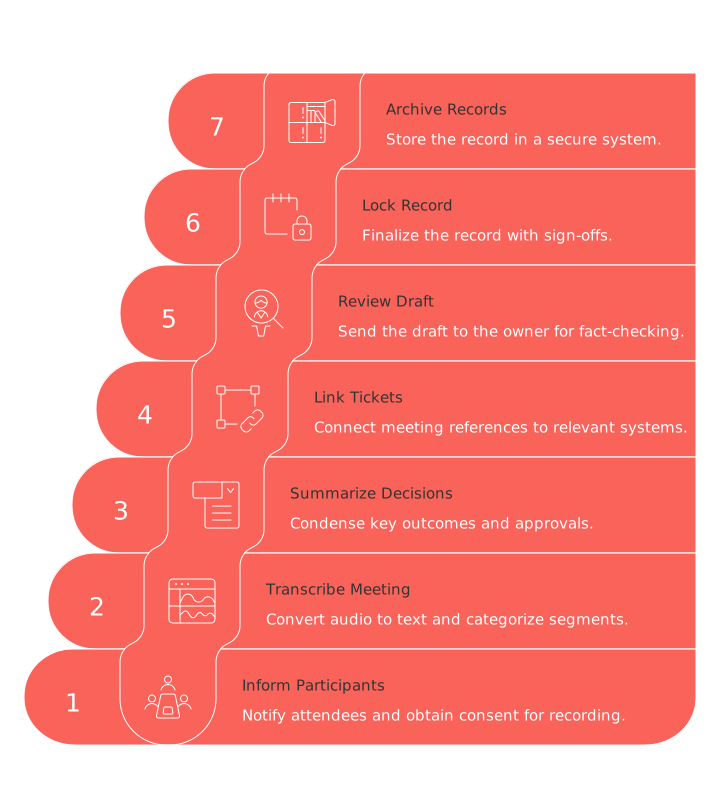
Workflow from live conversation to auditor-ready record
Inform meeting participants and secure required consent. Do not capture sensitive data unnecessarily.
Transcribe the meeting, classifying each segment by control, asset, and risk category.
Summarize decisions, approvals, and exceptions clearly and concisely.
Automatically link relevant tickets and repositories referenced in the meeting via IDs.
Send the draft to the meeting owner for fact-checking and review within 24 hours.
Lock the approved version, recording the preparer, approver, and time of sign-off.
Archive records in a system that supports retention, legal holds, and export capabilities.
Keep draft and final versions separate. Auditors prefer a singular source of record with a tracked version history.
Protecting sensitive content when AI handles conversations
AI meeting records may involve sensitive information and customer data. Treat the AI system as in-scope for compliance.
Enforce role-based access control with least privilege and SSO authentication.
Encrypt data at rest and in transit. Log all administrative access.
Enable redaction for secrets, keys, and personal data before saving.
Set retention periods in line with policy and documented audit requirements.
Prefer regional data residency to align with customer commitments.
Run regular access and sharing audits on your meeting repository.
Document your AI vendor as a subservice provider. Collect their SOC reports and establish their security posture.
Connecting minutes with projects, knowledge, and CRM for end-to-end traceability
Executives and auditors benefit from a single, integrated source of truth. Minutes should be connected to project management and CRM data, not kept in isolation.
Link meeting approvals directly with change tickets, remediation tasks, and customer commitments to close the loop for auditors.
Consider systems that unify projects, knowledge bases, CRM, and meetings in one workspace. Platforms such as Routine, ClickUp, and Notion are options to evaluate. Assess features like control mapping, permission controls, and export flexibility before rollout.
For recommended cadence and structures, see these effective meeting templates for recurring compliance meetings. For a discussion on data consistency, visit the advantages of structured data for team compliance.
Metrics that show you stay audit-ready all year
Coverage rate: Percentage of key meetings with approved minutes.
Approval cycle time: Hours from draft creation to supervisory sign-off.
Action completion: On-time closure rate for meeting-generated action items.
Exception aging: Number of days open for policy or control exceptions.
Linking ratio: Proportion of minutes with at least one associated artifact or reference.
Access accuracy: Number of mismatches found in quarterly repository access reviews.
Common pitfalls with AI meeting minutes and how to avoid them
While AI provides substantial help, human governance is still essential. Watch out for these common issues:
Over-summarization that omits critical control details. Require human oversight for important meetings.
Inconsistent topic or risk labels. Enforce a standardized taxonomy and use shared minute templates.
Unregulated sharing of raw transcripts. Restrict standard access and prevent unauthorized external downloads.
Lack of version locking before audits. Ensure opinionated finals and record all edits and change reasons.
Missing participant consent disclosures. Standardize meeting notices and archive acknowledgment proof.
SOC 2 minute capture checklist you can adopt this quarter
Use this checklist to elevate your evidence quality without major disruptions:
Define which recurring meetings must generate minutes.
Adopt a unified schema including control identifiers and decision fields.
Route each draft for review and sign-off within 24 hours.
Enable redaction and determine retention policies in advance.
Link minutes to relevant tickets, repositories, risks, and vendor documents.
Schedule quarterly compliance sampling to verify completeness and accuracy.
Document your AI vendor review and maintain a current subprocessor list.
Train meeting facilitators on required disclosure and consent language.
This article is not a substitute for legal advice. Confirm requirements with your auditor or legal counsel.
For definitive guidance and criteria, see the AICPA Trust Services Criteria and official SOC 2 resources.
FAQ
Why are AI meeting minutes essential for SOC 2 compliance?
AI meeting minutes ensure continuous, detailed documentation across the audit window, turning informal discussions into formal records with precise timestamps. They help auditors trace decisions and exceptions, reducing redundancy and enhancing accountability. Routine offers tools that automate and standardize this process.
What specific details should AI meeting minutes capture to meet SOC 2 controls?
Capture meeting metadata, participants, purposes, decisions, and actions with exact dates. It's crucial to link these details to internal control IDs and Trust Services Criteria. Routine provides structured templates to ensure no critical aspect is overlooked.
How does AI help in reducing redundant work during audits?
AI-generated minutes offer a singular reference for approvals and justifications, streamlining audit walkthroughs and sampling. This reduces rework and facilitates quick retrieval of crucial decisions and actions, cutting down unnecessary backtracking.
What are the risks associated with using AI for meeting documentation?
AI may over-summarize and miss critical details without human oversight, potentially jeopardizing control veracity. Role-based access and robust encryption are essential to protect sensitive information, a key feature of Routine's compliance-focused solutions.
Why should meeting minutes be integrated with project management and CRM systems?
Integrating meeting minutes with project management and CRM systems creates a seamless traceability chain from discussion to action. This consolidation prevents information silos, making audit trails more accessible and cohesive, a setup that Routine supports.
Which meetings should consistently produce auditable minutes for SOC 2 compliance?
Meetings involving critical system changes, incident reviews, and risk management should always produce minutes. Formal documentation ensures all discussions and decisions are properly recorded and linked to relevant controls, enhancing compliance efficacy.
What metrics indicate good audit readiness in minute documentation?
Metrics like meeting coverage rates, action completion timeliness, and cycle time for approvals reflect audit readiness. High values in these metrics demonstrate thorough documentation and effective follow-through, reducing audit vulnerabilities.

Julien Quintard
Founder & CEO at Routine02/19/2026
