The Zeigarnik Effect: Why Unfinished Tasks Hijack Your Focus
Why your brain clings to unfinished tasks
Unfinished work nags because your brain dislikes loose ends. Psychologists call this the Zeigarnik effect, which describes the mental tension created by incomplete tasks.
That tension keeps the task active in working memory. You feel pulled back, even while doing something else. Research suggests that in many cases, the mind seeks closure more than comfort.
Open loops steal attention until you close or reframe them.
Use this knowledge strategically. You can structure tasks for clear completion, or set them aside in a way that minimizes continuous mental engagement. The sections below show both paths.
How the Zeigarnik effect derails everyday focus for individuals
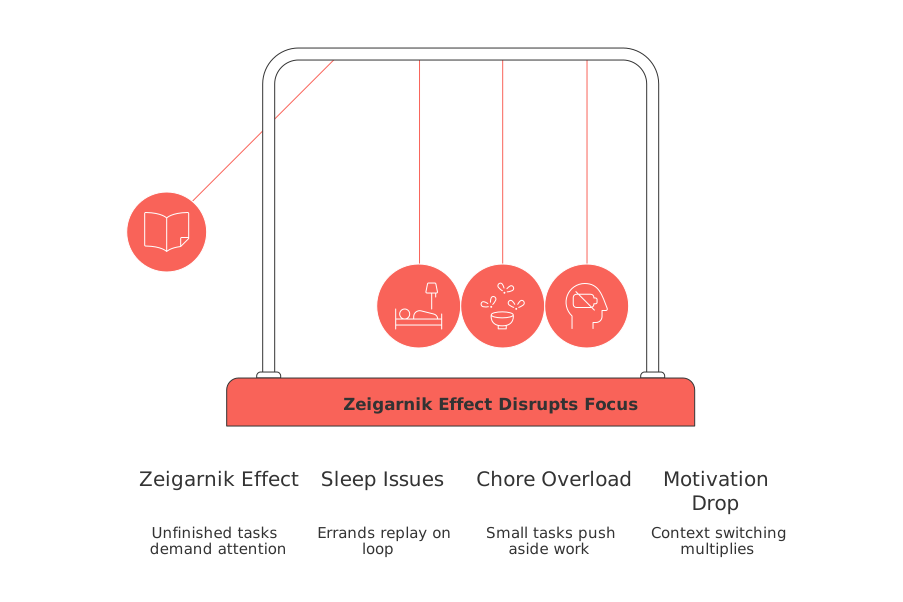
You scroll a feed and remember the half-written email. You cook dinner and recall a return label. Each fragment snaps your attention. Stress compounds fast.
Sleep resists you because errands replay on loop.
Small chores crowd out meaningful work.
Context switching multiplies, then motivation drops.
Give the brain what it wants: a believable finish line. Or, set a trusted container that quiets the loop. You can start with a tiny, concrete step.
Try using the following method as a guide when your mind feels scattered.
Prompt: Act as my focus coach. I will paste 7 unfinished tasks. For each, propose a 15‑minute next action and a clear definition of done. Return a short checklist I can follow today.
Practical ways to quiet task tension without ignoring work
Close the smallest loop that counts. You do not need to finish the project. You only need to finish a unit that satisfies your brain.
Name the next visible action. Keep verbs concrete.
Define “done” in one sentence. Avoid vague endings.
Limit active tasks. Cap work‑in‑progress at three.
Batch similar actions. Protect attention from mode changes.
Schedule review cadences. Decide, don’t dwell.
When you still feel mental noise, renegotiate the task. Shrink scope until it fits the day you have, not the day you wish for.
Prompt: You are a ruthless scope‑cutter. I will paste one daunting task. Rewrite it into three tiny deliverables that I can finish in under 20 minutes each, with acceptance criteria.
Applying the Zeigarnik effect in project management and CRM workflows
Project work
Split epics into finishable slices with acceptance criteria.
Use WIP limits on your board. Reduce juggling.
Surface dependencies early. Prevent silent blockers.
Visual timelines help clarify what “finished” means next. Consider visualizing dependencies with a lightweight tracker or a compact Gantt chart. That picture alone can dissolve anxiety by exposing true order of work.
CRM follow‑through
Every deal must have one next step and an owner.
Use event triggers like proposal sent to create tasks.
Archive stale leads fast. Closing a loop beats pretending.
For team scale, structured data matters more than pretty to‑dos. Learn why many personal productivity tools fail teams and how structured data improves follow‑through.
Designing tasks that finish cleanly and leave no mental residue
Messy phrasing invites rumination. Rewrite tasks so completion is obvious.
Use verb‑first language: Draft, Call, Ship.
Add a receiver: who gets the deliverable.
State quality in numbers, not feelings.
Prefer artifacts: files, tickets, or page updates.
Example rewrite: Instead of “Research event marketing,” try “Collect 3 competitor landing pages and list 5 tactics in one page for review.”
Prompt: Rewrite my task list for clean finishes. For each item, return: new task wording, a one‑sentence definition of done, and the artifact to produce. Here are my tasks: [paste].
When to keep tasks open on purpose
You can also harness the Zeigarnik effect to jumpstart momentum. Leave a tiny step pending by design, then re‑enter tomorrow with energy.
Stop after outlining the first paragraph, not zero.
End design sessions with a marked “next stroke.”
Park debugging at a reproducible failing test.
Keep this tactic scarce. One or two open loops can motivate. Ten will swamp your head.
Tools that respect attention: all‑in‑one vs a zoo of tabs
Fragmented tools create accidental open loops. Important data can be distributed inconveniently across platforms, and the context of the tasks can be lost. An all‑in‑one workspace can reduce that cognitive tax by centralizing project boards, knowledge, and CRM next steps.
Before changing stacks, compare trade‑offs. This guide weighs the options: all‑in‑one workspaces versus dedicated project tools.
Examples include Routine, which connects projects, knowledge, and CRM in one system, and alternatives like Notion or ClickUp. Choose the approach that preserves focus and makes “done” unambiguous, not the one with the most features.
Micro‑playbooks for everyday focus
The two‑minute closure
Scan your task list. If a step takes under two minutes, finish it now. Free the memory slot it occupies.
The three‑slot rule
Pick only three active tasks for the day. Everything else waits in a backlog by design.
The artifact finish
End each session by producing one artifact. It could be a file, a comment, or a shipped change. The artifact proves closure.
Prompt: I will paste today’s work. Create a plan with only three active tasks, each with a two‑minute closure action and one artifact to produce. Keep the language crisp.
Related resources and next steps
If you want more structure around sequencing, explore resources on visual project timelines and lifecycle planning. A helpful companion reads on visualizing work and another explains what really happens across project phases. The latter pairs well when scoping finishable slices.
For a quick psychology primer, see the concept’s background in accessible terms from a reputable source like the APA Dictionary of Psychology. Browse concise definitions of attention concepts and apply them to your workflows.
Prompt: Summarize the Zeigarnik effect for a non‑technical teammate in 120 words, then list three ways we can redesign our tasks tomorrow to reduce mental residue.
FAQ
What is the Zeigarnik effect, and why should I care?
The Zeigarnik effect highlights your brain's tendency to fixate on unfinished tasks. Ignoring it can lead to stress and distraction, harming productivity. Recognize this effect to manage task completion more effectively.
How can the Zeigarnik effect impact my daily routine?
The effect causes distractions by keeping unfinished tasks at the forefront of your mind. This leads to frequent context switching and diminishes focus, complicating task management.
What strategies help counter the Zeigarnik effect?
Close simple loops first; these smaller victories reduce mental strain. Utilize tools like Routine to create clear, actionable steps and maintain focus on active tasks.
How can I minimize the mental residue of unfinished tasks?
Design clear and finishable tasks using verb-first language and defined outcomes. Leverage platforms, such as Routine, to centralize task and project management, reducing the mental load.
Why are all-in-one workspaces beneficial for managing the Zeigarnik effect?
Centralizing tasks reduces the cognitive burden of switching between fragmented tools. Routine, as an all-in-one solution, helps maintain clarity and focus, ensuring tasks are completed rather than lingering half-done.
Can leaving tasks partially done actually benefit my work?
Yes, strategically leaving minimal work unfinished can provide a motivational boost for future sessions. Use this technique sparingly; too many open loops will lead to overwhelmed mental states.
What common task management practices might exacerbate mental clutter?
Excessive multitasking and poorly defined tasks contribute to mental clutter. Clear task segmentation and focus are crucial; utilize tools like Routine to streamline your daily workflow.
How can teams optimize task management to reduce distractions?
Implement clear acceptance criteria for each task and avoid excessive juggling. Use Routine to set work-in-progress limits and ensure structured data management, improving team focus and follow-through.

Julien Quintard
Founder & CEO at Routine06/05/2026
