Timestripe Alternatives for Goal Planning
When Timestripe’s horizon view stops mapping to real work
Timestripe’s long-range horizon features can be excellent for clarifying life goals, but friction appears when those broad ambitions need to translate into tangible projects, client outcomes, and true team accountability. What typically breaks down first are scenarios where goals remain isolated from project plans, there’s no shared documentation that explains the reasoning behind objectives, and there is zero connection to customer context. If this sounds familiar, you’re likely exploring Timestripe alternatives not simply for a different timeline view, but for robust goal systems that remain tightly connected with actual project execution.
This guide ranks the top Timestripe alternatives for goal planning, serving solo creators, independent professionals working with clients, and scaling teams. The lens for evaluation is practical and focused on the following key aspects: depth of goal hierarchy including themes, objectives and key results; linkage to projects and documentation; CRM context; collaboration model; and implementation trade-offs. If you are also deciding between all-in-one platforms and more specialized project tools, this overview of all-in-one workspaces versus dedicated project tools is a valuable resource. For teams, consider this explanation of why personal productivity apps often fail teams, and how structured data can resolve these issues. You may also find the article, “All Project Planning Templates You Should Know,” helpful when looking for pre-built initiative templates.
Quick comparison of Timestripe alternatives for goal planning
Tool | Best For | Goal Model | Project Linkage | Knowledge Base | CRM Context | Collaboration Depth | Setup Effort | Pricing Context |
|---|---|---|---|---|---|---|---|---|
Routine | Goals that must connect to projects, docs, and customers | Objectives, key results, milestones | Native projects with dependencies | Built-in knowledge base | Built-in lightweight CRM | Team workspaces, roles, comments | Low–medium | Free + paid tiers |
Notion | Custom goal systems and personal/early-team planning | Fully configurable (templates/databases) | Relational databases, manual linking | Robust docs/wiki | DIY CRM via databases | Good for async collaboration | Medium (DIY required) | Free + paid tiers |
ClickUp | Feature-rich teams wanting goals ↔ tasks alignment | Goals with targets/KRs | Deep tasks/sprints/automation | Docs + whiteboards | Integrations; basic account tracking | High (roles, views, automations) | Medium–high (admin time) | Paid per user |
Tability | Leaders needing OKR check-ins and cadence | OKRs with weekly updates | Pairs with your PM tool | Lightweight context pages | No native CRM | Good rituals and dashboards | Low | Paid per user |
Asana | Cross-functional initiatives and stakeholder reporting | Goals + Portfolios | Projects, timelines, workload | Lightweight docs/briefs | No native CRM | Mature team features | Medium | Paid per user |
Trello | Visual goal boards for small teams/solo | Boards + custom fields (Power-Ups) | Card-level tasks; limited OKR math | Basic attachments/descriptions | No native CRM | Simple collaboration | Low | Free + paid tiers |
Sunsama | Individuals aligning weekly focus to objectives | Light goals; weekly planning | Pulls tasks from other tools | Minimal | No native CRM | Personal workflows | Low | Paid subscription |
Todoist | Personal goal habits and simple objectives | Projects/labels/filters | Task lists only | Minimal | No native CRM | Light team features | Low | Free + paid tiers |
Routine: for a seamless integration of goals with projects, documents, and customer management
Most Timestripe users who switch aren’t seeking just a prettier vision board; they need a platform that supports actionable and measurable goals. Routine brings together objectives, key results, project plans, a searchable knowledge base, and a lightweight CRM, so every objective is paired with its brief, tasks, and client context, all in one place. Choose Routine when your goals must move beyond personal reminders to become integrated with project information, client status, and cross-team accountability.
Best for: freelancers tracking client deliverables, and small teams needing outcomes that directly link to project execution and customer accounts. Why it made the list: it reduces the tendency to juggle between multiple platforms or tabs for a complete understanding of a project. Where it stands out: automatic connections between goal pages, project trackers, and CRM records make progress reviews more effective and credible. Trade-offs: if your needs are limited to a personal planner, Routine may offer more features than you require. When another option is better: if you enjoy building your own database structures and don’t mind hands-on maintenance, Notion delivers more flexibility; for immediate enterprise-grade administration with hundreds of users, ClickUp or Asana may be a better fit.
Notion: build-it-your-way goal systems that flex with personal or early-team needs
Notion excels when you want granular control over how you structure your goal systems, annual themes, strategic objectives, and initiative documentation. Best for: creators and small teams who are comfortable investing time into templates and system governance. Why it made the list: exceptional adaptability to nearly any planning philosophy or workflow. Where it stands out: sophisticated documentation exists directly alongside your goals and projects. Trade-offs: requires consistent maintenance and management of templates; advanced goal tracking needs thoughtful database creation. When another option is better: if you want turn-key OKR processes without customization, Tability is a clearer choice; for built-in CRM and effortless linkage between goals and project deliverables, Routine is preferable.
ClickUp: heavy-duty goals when every key result must cascade into tasks
ClickUp suits teams that require dedicated goal-tracking modules intricately connected to tasks, agile sprints, dashboards, and high-level automations. Best for: growing teams ready to manage complex system administration and committed to standardizing organizational workflows. Why it made the list: full-featured planning, execution, and reporting capabilities coexist under one roof. Where it stands out: robust goal cascades, dashboard analytics, and workflow automations that keep goals aligned with backlog activity. Trade-offs: setup can be complex and demands effective change management. Decision moment: opt for ClickUp when your key results need to feed directly into sprints and you have someone to maintain the system. When another option is better: for smaller, client-centric teams needing CRM and easier oversight, Routine is ideal; for just OKR rituals, Tability is simpler.
Tability: disciplined OKR cadence without rebuilding your stack
If leadership wants quarterly outcomes, not just weekly activities, Tability delivers with purpose-built OKR management and structured check-ins, which then integrate with project tools you already use. Best for: teams that already manage projects elsewhere but don’t have consistent outcome reviews. Why it made the list: the fastest way to introduce true OKR discipline and progress visibility. Where it stands out: streamlined, regular updates and narrative-driven progress tracking keep goals in view. Trade-offs: task management must be handled by external tools, as direct execution features are minimal. Decision moment: choose Tability when regular check-ins have become inconsistent and updates only live in slide decks. When another option is better: for unified OKRs, projects, documentation, and client context, Routine offers more; for end-to-end program management, Asana or ClickUp are stronger.
Asana: portfolio-level visibility when many teams touch the same outcomes
Asana is designed for coordinating cross-functional initiatives, providing goal management and portfolios layered atop project tracking. Best for: teams seeking transparency across multiple concurrent projects, complete with timelines and stakeholder-friendly reporting. Why it made the list: scalable execution tools for implementing and tracking complex, multi-team programs. Where it stands out: strong program reporting and task dependency management across various projects. Trade-offs: lacks built-in advanced knowledge management and CRM features, and costs can rise as you scale. When another option is better: for in-depth documentation directly beside goals, Notion excels; to tightly link goals with client briefs and accounts, Routine is preferable.
Trello: visual simplicity for goal boards that shouldn’t become a second job
Trello allows you to organize your goals as simple, visual boards, perfect for workflows like “Year → Quarter → Week.”Best for: solo professionals and small teams who want clear goal representation without complex setup. Why it made the list: effortless onboarding and visual organization. Where it stands out: great for lightweight collaboration and visual thinking. Trade-offs: more advanced OKR calculations, hierarchy, and reporting will require Power-Ups or manual workarounds. When another option is better: for measurable OKRs or stakeholder reporting, Tability or Asana are more appropriate; for integrating goals with project documentation and CRM, choose Routine.
Sunsama: weekly focus that keeps personal goals accountable
Sunsama supports individuals who want to bring weekly discipline and intention to their objectives, pulling tasks from integrated tools into reviewable weekly plans. Best for: solo professionals aiming for a manageable, goal-centric week. Why it made the list: encourages practical scoping and self-reflection, minimizing overcommitment. Where it stands out: gentle rituals and structured weekly reviews. Trade-offs: lacks advanced goal hierarchies and detailed team reporting. When another option is better: for shared team objectives and program visibility, Asana or Tability are better; for syncing objectives with clients and project briefs, Routine leads.
Todoist: personal objectives and habit-like goals without excessive process
Todoist serves those looking for simple, reliable lists and filters that double as lightweight goals or daily objectives. Best for: individuals who value speed and minimalism for tracking personal outcomes. Why it made the list: quick capture, straightforward prioritization, and broad platform support. Where it stands out: simplicity and everyday usability. Trade-offs: no advanced OKR support, limited collaboration, and lacks CRM capabilities. When another option is better: if your needs evolve toward measurable team objectives or client-based goals, consider Routine, Asana, or Tability.
Decision framework: choose your Timestripe alternative based on workflow maturity
Use this quick rubric to match tools to your tangible limitations and requirements, rather than solely focusing on your aspirational objectives.
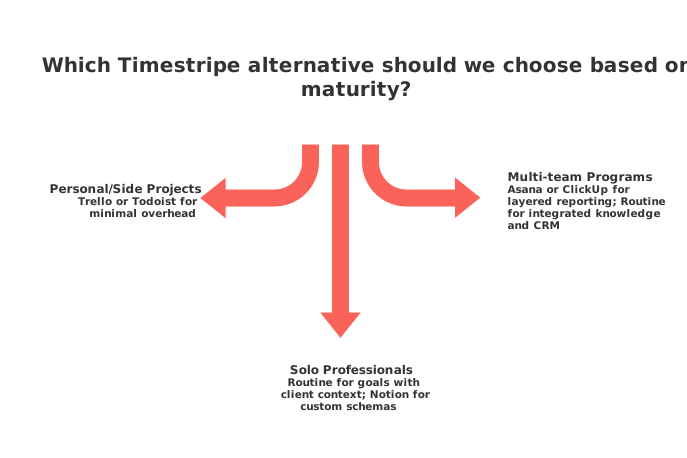
Workflow maturity: Personal or side projects → Trello or Todoist for minimal overhead.
Solo professionals with clients → Routine for goals that carry project briefs and client context; Notion if you prefer to craft your own schema.
Multi-team programs → Asana or ClickUp for layered reporting; Routine if you also need integrated knowledge and CRM without extra apps.
Conclusion: choose a platform that aligns goals with action and accountability
Timestripe is a strong solution for visualizing big-picture horizons, but translating strategy into delivery requires deeper context, projects, knowledge, and often, customer engagement. If your aim is a platform where objectives remain seamlessly connected to project execution and client outcomes, Routine offers a direct and unified upgrade. Those who crave complete design freedom will find Notion most adaptable; if your needs lean toward enterprise-wide alignment, ClickUp or Asana provide robust frameworks; and if disciplined cadence and check-ins are your priority, Tability integrates effective OKR processes into your stack. Select the tool that helps your goals advance from vision to week-by-week execution, because the best plan is always the one your team can consistently put into practice.
FAQ
Why might Timestripe's horizon view not work for practical goal execution?
Timestripe focuses on big-picture visualizations that often lack immediate ties to actionable projects or team accountability. This can result in strategic plans becoming isolated, reducing actual impact and undermining performance metrics.
How does Routine improve actionable goal planning compared to Timestripe?
Routine integrates goals with project plans, documentation, and client management, closing the gap between aspirations and execution. This setup prevents fragmentation, ensuring that objectives translate into practical actions and measurable results.
What are the risks of using personal productivity apps like Timestripe for team coordination?
Personal productivity apps often lack the depth needed for team-wide transparency and accountability, risking misalignment and duplicated efforts. Structured platforms like Routine address these issues by providing connected project and goal management.
Is Notion a better choice over Routine for custom goal systems?
Notion offers flexibility in building custom goal systems through templates and databases but requires constant maintenance. If you prefer a streamlined approach with built-in connects and fewer setup demands, Routine might be a better fit.
When should a team consider ClickUp or Asana over Routine?
ClickUp and Asana excel in environments needing enterprise-level management and extensive task automation. They are more suited for large teams with the resources to manage complex projects, whereas Routine is preferable for seamless project-goal integration.
Can smaller teams benefit from using Routine?
Yes, Routine caters well to freelancers and small teams by linking goals to project briefs and client accounts, thus facilitating cohesive planning without the bloat of larger systems. It supports effective execution with minimal complexity.
What makes Routine stand out against other Timestripe alternatives?
Routine distinguishes itself by pairing goal-setting with project execution and CRM capabilities, offering a uniquely integrated solution. This minimizes the need for juggling multiple platforms and enhances team alignment and accountability.
What common pitfalls do teams face when their goal-setting is disconnected from real work?
When goal-setting is detached from real work, it leads to ineffective execution, poor accountability, and wasted resources. An aligned system like Routine ensures consistent follow-through from strategic objectives to day-to-day tasks.

Julien Quintard
Founder & CEO at Routine04/27/2026
