Task Completion Isn't Progress: The Difference Between Output and Momentum
Why finishing tasks can hide a stalled project
Your checklist shrinks. Your outcome does not budge. That gap exposes a trap: output without momentum. Finishing work feels rewarding, yet the destination stays distant.
Momentum asks a sharper question: did the project’s chance of success rise this week? If not, the completed tasks were noise, not progress.
Tasks are receipts; momentum is the route. You need the route.
What momentum really means in projects and personal work
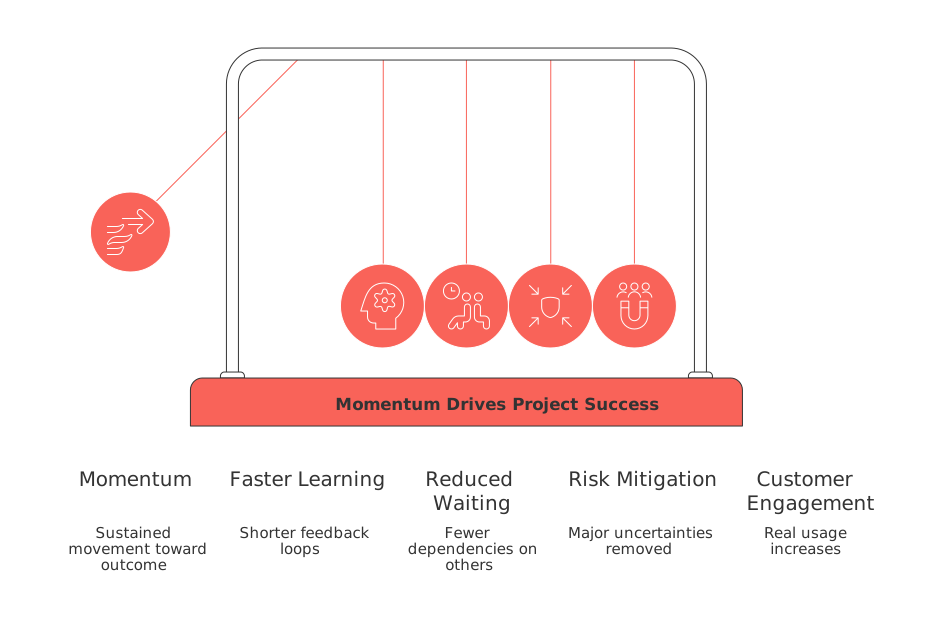
Momentum is sustained movement toward a specific outcome. Momentum, being sustained movement toward a specific outcome, increases in strength each time a task is completed that reduces risk, shortens feedback time, or clears dependencies. You feel it as flow, and you can show it in data.
Shorter feedback loops: you learn faster than last week.
Fewer dependencies: others wait on you less, not more.
Risks retired: major uncertainties move off the board.
Customer behavior change: real usage, not just interest.
Output versus momentum: a simple diagnostic you can run today
Pick one active goal. Run this five‑minute check.
State the next visible outcome a stranger could verify.
List yesterday’s finished tasks.
Ask: which task reduced time to that outcome by a full day?
If none did, you had output. You lacked momentum.
Repeat this check daily for one week. Track the share of tasks that truly moved the outcome. Aim for a rising share, not a larger pile.
Measure momentum with human-friendly signals instead of vanity counts
Volume metrics celebrate movement in place. Momentum metrics show motion in the right direction. Keep them simple and visible.
Time to insight: hours from work started to learning recorded.
Risk burn‑down: number of top risks retired this week.
Dependency lead time: wait time you impose on others.
Rework rate: ratio of fixes to new value shipped.
Outcome proximity: days to next verifiable milestone.
Small, frequent wins matter. See the well‑known research on the progress principle for a clear explanation.
Design your week around momentum, not task volume
Plan for motion, then pick tasks
Define one weekly outcome a stranger could confirm.
List three blockers that stop that outcome.
Choose two moves that remove those blockers fastest.
Protect one deep‑work window daily to advance those two moves.
End each day by noting what reduced risk or wait time.
Keep the plan short. If you need a page to explain it, the outcome is vague.
For teams and executives: rewrite standups and dashboards to track motion
Team rituals often reward activity. Shift the questions first, then the charts.
What risk did we retire yesterday?
Which dependency did we clear for another group?
What experiment delivered a learning within 24 hours?
Which task today most reduces time to the next outcome?
Swap burndown obsession for blocker burn‑up, milestone trend lines, and time‑to‑insight. You will notice fewer surprises and calmer releases.
Visual tools that make momentum visible in project management
You do not need a heavy suite to see motion. Simple trackers, milestone trend charts, and cumulative‑flow visuals reveal whether work accelerates or clogs.
Explore practical options for visualizing work with trackers and simple Gantt alternatives. Choose views that highlight wait times, handoffs, and risk retirement, not just completed cards.
Case vignette: a solo freelancer swaps output for motion
Maya, a designer, shipped daily but stalled on revenue. She reframed her week around one outcome: three paid trials by Friday.
She cut template tweaks and wrote two outreach scripts.
She replaced a portfolio overhaul with two fast case studies.
She booked calls by removing a scheduling bottleneck for prospects.
By Thursday, two trials started. The portfolio still needed polish. The business finally moved.
Choose software that supports momentum-first work across projects and CRM
Pick tools that connect tasks, knowledge, CRM, and meetings in one place. You want smart links between goals, risks, dependencies, and customer touchpoints.
Link every task to a clear outcome and owner.
Model dependencies and surface who is waiting on whom.
Show risk retirement and time‑to‑insight on dashboards.
Tie CRM stages to project milestones for shared truth.
Support short review cycles and lightweight retrospectives.
Workspaces like Routine, Notion, ClickUp, or Monday can support this approach. Choose the one that makes relationships obvious and friction low.
Keep progress honest with short review cycles
Short cycles help maintain focus and clarity on project goals. Quarterly sprints, for instance, can be effective for solo operators and small teams because they allow for frequent reassessments and readjustments.
See why many individuals favor a 12‑week cadence over annual plans. Fewer cycles mean faster course corrections, clearer priorities, and stronger momentum.
When to eliminate unproductive or distracting tasks
It does not shorten time to the next outcome.
No risk is retired when it ships.
It increases handoffs or review layers.
It is only needed if a separate gamble succeeds.
Prune without guilt. Free capacity for moves that shift the timeline.
Sales and CRM example: momentum over activity counts
More calls do not equal pipeline progress. Momentum shows as stage movement, cycle time drops, and cleaner handoffs to success teams.
Set weekly outcomes like “ten qualified demos” instead of “fifty dials.”
Automate alerts for stalled deals and missing next steps.
Review time‑to‑first‑response and time‑to‑proposal every Friday.
Capture learnings from lost deals within 24 hours.
While engaging in activities can fill your days, only momentum, actions that genuinely move you closer to your goal, can fill your forecasts and give an accurate projection of your progress. Therefore, choose tasks that contribute to your momentum.
FAQ
How can you differentiate between output and momentum in project management?
Output is simply the completion of tasks, often leading to a false sense of progress, while momentum reflects meaningful progress towards a goal. Concentrate on tasks that eliminate barriers, reduce risk, and lower dependency. Tools like Routine can help visualize and manage these distinctions effectively.
What are key indicators of momentum in a project?
Momentum can be measured by reduced feedback loops, elimination of major risks, and shortened dependency wait times. It's about advancing toward verifiable milestones, not just ticking boxes.
Why is focusing solely on task completion potentially misleading?
Simply completing tasks without considering their impact on overall objectives can lead to stagnation. The key is choosing tasks that significantly advance the objective, not merely add to a completed list.
How can visual tools help drive momentum in projects?
Visual tools, such as milestone charts or cumulative-flow diagrams, expose process bottlenecks and reveal true progress, as opposed to just activity levels. These insights are critical to avoiding activity-focused traps and focusing on real advancement.
How can team meetings be restructured to focus on momentum rather than just activities?
Update team rituals by focusing on recent risk retirements, cleared dependencies, and rapid learnings. Shift from traditional task reports to discussions about true progress-movers.
How does reducing wait times contribute to project momentum?
Minimizing wait times directly speeds up progress, ensuring that no team member is idle due to unaddressed dependencies. This promotes more fluid teamwork and keeps the project moving forward efficiently.
What is a practical approach for measuring momentum in sales and CRM?
In sales, shift focus from sheer activity counts to outcomes that indicate deeper commitment, such as qualified demos or shorter cycle times. Utilize CRM tools like those offered by Routine to align tasks and milestones for shared clarity.
How should one handle tasks that don’t contribute to momentum?
Eliminate tasks that do not meaningfully shorten timelines or reduce risk. Focus resources on actions that tangibly advance project goals, ensuring progress does not stall under unnecessary work.

Julien Quintard
Founder & CEO at Routine06/25/2026
