RICE vs ICE vs MoSCoW: Roadmap Scoring Models Compared for Early-Stage SaaS
Why prioritization models matter to early-stage SaaS roadmaps
Your backlog grows faster than your runway. You need a fair referee. Scoring models provide a consistent framework for trade-offs and foster a shared language for prioritization. Product, sales, and customer success can debate the merits of outcomes rather than relying on individual opinions. Select a model, define your scoring scales, and commit to them.
Roadmaps fail when urgency outruns evidence. Scores slow the panic and focus the plan.
How the RICE scoring model works for early-stage SaaS roadmaps
RICE multiplies four inputs and adjusts for effort. This model is suited for features with measurable reach and allows teams to compare ideas on a uniform scale.
Reach: The number of people or accounts affected over a specific timeframe.
Impact: The anticipated positive effect or quality of the outcome, typically rated on a simple scale.
Confidence: Your level of certainty in the estimates, rated from 0 to 1.
Effort: The total person-weeks required to deliver a satisfactory result.
Apply this formula: RICE = (Reach × Impact × Confidence) ÷ Effort. Maintain consistent scales across planning periods, and document your assumptions alongside each scoring field.
RICE in practice: a quick example
Example feature: “Usage-based billing.” Reach 300 accounts this quarter. Impact 2.5 (on a 0.25–3 scale). Confidence 0.7. Effort 6 person-weeks. Score: (300 × 2.5 × 0.7) ÷ 6 = 87.5. You can now compare this directly with alternatives contending for the same development resources.
Strengths: Clearly quantifies both upside and uncertainty. Limits: Reach may favor mature segments if not adjusted, ensure goals are clearly defined.
When ICE scoring beats RICE for lean experiments
ICE bases its score on three factors: Impact, Confidence, and Ease. It’s especially well-suited for rapid tests, user experience changes, or growth initiatives.
Measure Impact as the anticipated positive effect or outcome quality.
Rate Confidence from 0 to 1, drawing on available evidence.
Score Ease based on the amount of effort required, rather than the complexity of the coding involved.
The ICE model is advantageous for quick decision-making as it omits consideration of reach, therefore reducing the amount of data you need to gather. Apply it in situations like discovery sprints or fast-paced project cycles.
Where MoSCoW fits in backlog discussions with sales and support
MoSCoW organizes work into Must, Should, Could, and Won’t categories. This method helps frame the scope for a fixed window, such as a quarterly objective.
Must: Essential , without it, your goal fails.
Should: High value but can be deferred if needed.
Could: Opportunities to pursue if capacity remains.
Won’t: Explicitly deprioritized for now, but not forever.
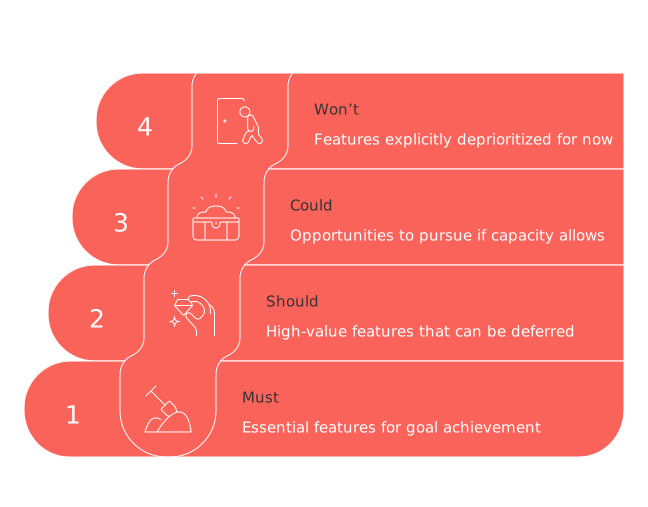
MoSCoW is especially effective in cross-functional planning. Sales and support can tie customer pain points to the roadmap, while engineering ensures the release remains achievable. For particularly tough “Musts,” complement with a brief RICE analysis.
Choosing between RICE, ICE, and MoSCoW for your current context
Choose the model that fits your current decision, not merely your established routines.
Use RICE for estimating feature bets where you have real data on reach.
Apply ICE for speed when prototyping, experimenting, or refining UX.
Leverage MoSCoW to structure release scope and facilitate prioritization trade-offs.
Mix strategically: score with RICE to prioritize, then allocate with MoSCoW to finalize release scope.
Data sources that keep roadmap scores honest across product and GTM
Base your scores on reliable, shared data. Use analytics to derive meaningful insights, factors like user activation rates, cohort retention, and funnel drop-offs can inform both reach and impact. Confidence should be based on the depth of your research, not wishful thinking.
Analytics: Use data such as user activation rates, retention by cohort, and funnel drop-offs to assess reach and impact.
CRM: Evaluate pipeline value blocked by missing product capabilities.
Support: Track the volume and severity of issues by category.
Finance: Analyze cost to serve and margin impact for each segment.
A lightweight workflow to operationalize scoring in one workspace
Centralize all ideas, scores, and specifications in a shared database. Tools like Routine, Notion, or Asana offer flexible schemas to manage this process. Assign ownership, document decisions, and track outcomes to create a single source of truth accessible to all stakeholders.
Suggested fields for a scoring database
Title, problem statement, and linked supporting evidence.
Model in use (RICE, ICE, or MoSCoW).
Scores, underlying assumptions, and notes on confidence.
Effort range, dependencies, and team weeks committed.
Status, release targets, and post-shipment results.
Common pitfalls that skew prioritization in startups
Avoid these missteps, they distort prioritization and slow progress.
Vanity reach: Counting signups instead of measuring active users.
Effort fiction: Overlooking time needed for integrations and quality assurance.
Scale drift: Changing scoring scales midway through a cycle.
Confidence inflation: Relying on anecdotes rather than solid evidence.
Scope creep: Expanding Musts by adding Shoulds and Coulds unnecessarily.
Run a one-week prioritization sprint with your team
Day-by-day cadence
Day 1: Gather ideas and define clear problem statements.
Day 2: Attach supporting data and select the appropriate model for each idea.
Day 3: Score ideas independently, then discuss any discrepancies.
Day 4: Rank items, trim scope, and define success metrics.
Day 5: Finalize the plan and brief stakeholders.
Accelerate your team’s scoring process by using clear prompts. Try pasting one of the examples below into your workflow assistant, along with your backlog:
You are a pragmatic product operator. Given a backlog with Reach, Impact (0.25–3), Confidence (0–1), and Effort (person-weeks), calculate RICE for each item, rank from highest to lowest, flag items with Confidence < 0.6, and suggest one experiment to raise Confidence for the top three. Return a concise table and a one-paragraph summary.
You are a release planner. Given a ranked list and a team capacity of 12 person-weeks, assign MoSCoW categories, keep Musts within capacity, and list explicit Won’t items with reasons. Output a short plan and risks.
Further reading and templates for SaaS prioritization
Strengthen your approach with proven guides and templates. Explore the following resources for practical support:
Project planning templates for roadmaps and charters to standardize scoring inputs and define success criteria.
Review visualization tools for simple project management to clarify and communicate your roadmap priorities.
For a strategy on selecting the appropriate tools, refer to the article “All‑in‑One Workspaces vs Dedicated Project Tools: Which Serves Your Business Best?”. This resource provides guidance on how to choose the best tools for your specific business needs.
FAQ
What is the RICE scoring model and why is it important for SaaS roadmaps?
The RICE model, which stands for Reach, Impact, Confidence, and Effort, offers a structured approach for prioritizing features. By quantifying these factors, teams can objectively allocate resources and reduce reliance on subjective opinions or pressure-driven decisions.
When should the ICE model be preferred over RICE for prioritization?
The ICE model is ideal for rapid experiments and user experience improvements, as it simplifies scoring by focusing on Impact, Confidence, and Ease. It bypasses the extensive data collection required for evaluating reach, enabling faster decision-making.
How does the MoSCoW method help with prioritizing tasks?
MoSCoW categorizes initiatives into Must, Should, Could, and Won’t, clarifying priorities and ensuring that essential tasks align with business objectives. It provides a transparent framework for discussions between teams, helping prevent scope creep and misaligned priorities.
Why is confidence a crucial component in scoring models like RICE and ICE?
Confidence gauges the reliability of the data supporting your estimates, acting as a reality check against optimistic assumptions. Ignoring it risks overcommitting to initiatives that may not deliver anticipated outcomes, wasting resources and time.
What are common pitfalls in prioritization that startups should avoid?
Startups often fall into the traps of vanity metrics, such as focusing on sign-ups rather than active users, or underestimating effort requirements. Relying on anecdotes instead of evidence inflates confidence and skews prioritization, often leading to misguided resource allocation.
How can Routine help teams operationalize scoring methods effectively?
Routine offers flexible schemas to centralize ideas, scores, and specifications, fostering a single source of truth accessible to all stakeholders. This ensures consistent application of scoring models like RICE and ICE, minimizing miscommunications and alignment issues within teams.

Julien Quintard
Founder & CEO at Routine02/20/2026
