Top 9 Retrospective Formats for Fully Remote Scrum Teams
Why remote retrospectives need their own playbook
Fully remote teams can’t rely on spontaneous hallway conversations. Retrospectives must intentionally draw out real issues, minimize friction, and foster clear accountability among team members.
Inspect together. Adapt quickly. Ensure every action has a clear owner by the end.
Outcomes that matter to executives:
Fewer cross-team blockers identified and resolved before the next sprint.
Clear action owners and deadlines for every agreed follow-up.
Action items directly linked to trends in delivery and quality metrics.
Format 1: Start, stop, continue retrospective for remote scrum teams
Choose this when the team needs straightforward commitments on behaviors. Ideal for newly formed teams.
Silently brainstorm in three columns: Start, Stop, Continue. Five minutes.
Group similar items and clarify each one. Seven minutes.
Vote for the top three priorities. Three minutes.
Assign owners, define next steps, and set due dates. Ten minutes.
Remote tip: Collect suggestions anonymously at first to avoid groupthink. Reveal names only for action items to establish ownership.
Format 2: 4Ls retrospective for distributed teams
The 4Ls method helps capture what’s working and where gaps exist: Liked, Learned, Lacked, Longed for.
Liked: Practices that should remain.
Learned: Valuable insights to share with others.
Lacked: Missing information, resources, or skills.
Longed for: Aspirations or experiments to try next.
Wrap up by translating each “Lacked” or “Longed for” into a measurable experiment for the next sprint.
Format 3: Mad, sad, glad retrospective to surface emotions safely online
Perfect after high-stress sprints or major incidents. Emotions often provide key signals.
Collect events that triggered emotional responses. Five minutes.
Organize each event as Mad, Sad, or Glad. Seven minutes.
Ask, “What patterns emerge?” Three minutes.
Identify actions to reduce pain points or repeat successes. Ten minutes.
Facilitators should encourage honest emotional sharing, but always keep discussions concrete and focused on behaviors.
Format 4: Sailboat retrospective to align on risks and momentum
This metaphor is effective on virtual whiteboards. It’s instantly understandable for everyone.
Wind: What’s propelling us forward?
Anchors: What’s creating drag, processes or tools?
Rocks: Risks or obstacles ahead.
Island: Short-term team goals.
Translate every anchor into a practical step to remove it. Assign ownership immediately.
Format 5: Hot air balloon retrospective to identify what lifts and what weighs down the team
Use this approach when the team is bogged down by excessive process or handoffs that slow delivery.
Altitude: What practices help us deliver faster?
Ballast: Which processes, meetings, or approvals are slowing us down?
Weather: Uncontrollable external factors to plan for.
Agree to remove at least one ballast item in the next sprint. Test the change with a clear measure of success.
Format 6: Lean Coffee retrospective for agenda‑less prioritization
Works best for experienced teams who wish to surface and prioritize many topics democratically.
Team members submit topics on virtual cards. Three minutes.
Everyone votes; cards are sorted by score. Two minutes.
Discuss the highest-ranked item for five minutes.
If the discussion is still valuable, extend by two minutes; otherwise, move on.
Record only concrete decisions and assigned actions. Avoid unowned or theoretical debates.
Format 7: DAKI retrospective to update working agreements
DAKI stands for Drop, Add, Keep, Improve. Use it to fine-tune how the team works together.
Drop: Habits or rituals that no longer add value.
Add: New practices to experiment with next sprint.
Keep: Methods or routines that support team flow.
Improve: Existing processes that need a small, safe tweak.
Limit changes to one item per category to maintain clarity and focus.
Format 8: Timeline narrative retrospective to reconstruct sprint reality
Build a collaborative timeline when team memories differ. This minimizes blame and highlights weak handoffs.
Plot key events on a horizontal digital timeline.
Add relevant artifacts like commits, tickets, or releases.
Mark points of stress and waiting.
Ask, “Where and why did our workflow stall?”
Convert observed delays or blockages into one updated policy, one new process automation, or one clear process definition for each sprint.
Format 9: Metrics-driven retrospective using flow and quality indicators
Anchor your discussions in objective data rather than opinions.
Lead time and cycle time trends.
Team throughput and work-in-progress limits.
Change failure rate and count of rollbacks.
Percentage of sprint goals achieved and tasks carried over.
Select one metric to target for improvement in the next sprint. Set a clear goal and design the smallest possible experiment to move the needle.
Async-first retrospectives that create commitment in remote scrum
Asynchronous input streamlines meetings and eases time-zone challenges.
Collect discussion topics 24 hours in advance.
Require each submission to have a supporting sentence or piece of evidence.
Allow team members to vote on topics before the live call.
Reserve real-time meetings for making decisions only.
Document and share outcomes in a single accessible workspace. Keep this information visible to related teams.
Facilitation tips for global, fully remote scrum retrospectives
Establish a quick working agreement at the outset of each session.
Switch facilitators each retrospective to diversify perspectives and encourage balanced input from all team members.
Use timers and visible cues to manage speaking turns during the retrospective.
Invite guest participants only when their responsibilities are directly relevant to the topics discussed.
Conclude with a one-line confidence vote, where each team member states their overall confidence in the team's action plan and ability to achieve objectives.
For more structured approaches, review our practical guide to effective meeting formats and recap templates.
Turning retrospective insights into accountable follow‑ups across project and CRM systems
Action items lose impact when scattered across tools. Centralize ownership, links, and deadlines in one shared space.
Most teams track tasks in tools like Routine, Jira, or Notion. Choose one authoritative source for all action items.
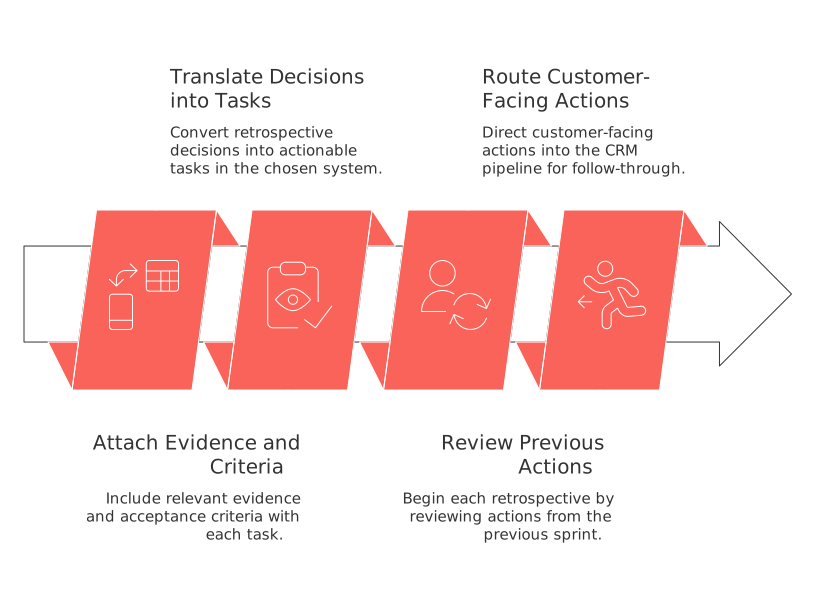
Translate each decision into a ticket or task in your chosen system.
Attach relevant evidence and acceptance criteria to each item.
Route any customer-facing actions directly into your CRM pipeline for better follow-through.
Start every retrospective by reviewing actions from the previous sprint.
Relate the improvements identified in retrospectives to specific stages of your product or service delivery. For a deeper understanding, see our in-depth guide on mapping actions to project lifecycle phases.
Choose the right retrospective cadence and format based on team signals
Select the most lightweight retrospective format that still uncovers risks and improvement opportunities. Change your approach when engagement or actionable insights decrease.
Choose a metrics-driven approach when opinion-based debates lead to deadlock.
Select Mad, Sad, Glad after particularly challenging or emotional sprints.
Adopt Lean Coffee when the backlog of discussion topics feels unmanageable.
Need a reminder of Scrum events and purposes? Review the official Scrum Guide before your next sprint to realign with core principles.
FAQ
How do remote retrospectives differ from in-person ones?
Remote retrospectives lack spontaneous interactions and require intentional planning to surface real issues and assign accountability. Without proper structure, teams risk superficial discussions and vague outcomes.
Why is it critical to assign clear action owners in retrospectives?
Without clear ownership, action items tend to dissipate into the ether, allowing issues to persist unaddressed. Accountability ensures that improvements are acted upon and progress is measurable.
What role does anonymity play in the Start, Stop, Continue format?
Anonymity prevents groupthink and encourages honest input, yet action must connect to individuals for responsibility. This balance is crucial for uncovering genuine challenges and ensuring follow-through.
How can emotional retrospectives benefit virtual teams?
Emotional retrospectives like Mad, Sad, Glad highlight stressors that data misses. Ignoring team emotions leaves unresolved tensions that could harm collaboration and efficiency.
Why is the Sailboat retrospective metaphor effective for remote teams?
The Sailboat metaphor visually aligns strengths and obstacles, making it easier for remote teams to conceptualize and address challenges. Abstract terms won't engage or yield tangible improvements.
How can asynchronous retrospectives improve remote team efficiency?
Asynchronous retrospectives reduce time-zone hurdles and streamline decision-making by allowing teams to prepare beforehand. However, they require rigorous discipline in documentation to prevent misalignment.
What risks arise from scattered action items across tools?
When action items are dispersed, teams face confusion and missed priorities. Centralizing tasks in a tool like Routine ensures focus and results rather than fragmented obligations.
How should retrospective insights be integrated into project systems?
Convert decisions into tasks within your project management tool with full accountability. Disconnected insights lack impact; they need to be traceable and actionable to drive meaningful change.

Julien Quintard
Founder & CEO at Routine02/23/2026
