OKRs for Customer Success in B2B SaaS: Metrics, Examples, and Pitfalls
Why customer-success OKRs matter for B2B SaaS revenue and retention
Renewals are the backbone of any SaaS business’s long-term health. Objectives and Key Results (OKRs) provide a clear, outcome-focused framework for customer success teams, one that can be shared and aligned with sales, product, and finance. Instead of prioritizing activities, OKRs shift the focus to results that drive revenue and reveal trade-offs executives must address early.
OKRs vs KPIs: While Key Performance Indicators (KPIs) track current performance, OKRs define the specific changes you aim to accomplish. Use both, but let OKRs drive the strategic conversation.
Clarifying meaningful metrics: Effective customer-success OKRs are based on robust metrics, such as Net Revenue Retention (NRR), time-to-value, and revenue expansion. These provide actionable insights, as opposed to vanity targets like “conduct more Quarterly Business Reviews (QBRs),” which may not directly impact customer outcomes or revenue. Focus your targets on metrics that reflect actual business impact rather than activity counts.
Act as a Vice President (VP) of Customer Success. Propose three company-level outcomes that increase Net Revenue Retention (NRR) within two quarters. For each outcome, draft 3 measurable Key Results (KRs), list owners by role, and define weekly input metrics to monitor. Keep KRs specific and binary.
How to define outcomes that matter for customer success OKRs
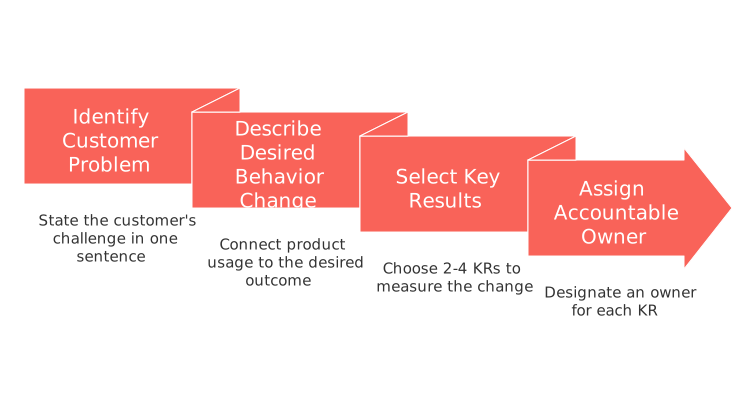
Start with the customer’s point of friction, not your org chart. Translate real customer challenges into targeted outcomes, and then break these down into quantifiable Key Results (KRs).
Write the customer problem in one factual sentence.
Describe the desired behavior change, connecting it to product usage.
Select 2–4 KRs that provide proof the change has happened.
Assign a single accountable owner for each KR and clarify supporting roles.
Resist mixing tasks with results in your OKRs. While tasks like Reduce time‑to‑value from 14 to 10 days are critical for execution, OKRs should emphasize the outcomes, such as Launch new playbook, that clearly demonstrate business impact.
You are a Customer Outcomes strategist. Map three common onboarding frictions to outcomes and KRs. Inputs: current TTV 14 days, activation 63%, data import failure 12%. Output: a table with Outcome, KR, Metric source, Owner, Risk.
Core metrics for customer-success OKRs that executives can trust
Focus on a concise, reliable set of metrics. Define each metric clearly, specify its data source, and standardize when measurements are taken.
Net Revenue Retention (NRR): Measures revenue retained and expanded from existing customers over a set period. Review with cohort-level and segment notes for context.
Gross Revenue Retention (GRR): Tracks revenue retained without considering expansion, revealing pure churn risks.
Time‑to‑Value (TTV): Tracks days from contract signing to a customer’s first meaningful outcome. Clearly define your milestone for measurement.
Product adoption depth: The number of key features used per account, weighted by business impact.
Product adoption breadth: The percentage of licensed users actively engaging with the product, monitored weekly and monthly.
Health score coverage: The percentage of accounts with a current, credible health score, a low coverage rate may mask risk.
Expansion revenue: Revenue from upsells and cross-sells in existing accounts. Validate with finance each month.
Ticket deflection rate: The proportion of self-serve solutions that prevented support tickets, only count those that also met customer satisfaction criteria.
Examples of quarterly customer-success OKRs for B2B SaaS
Objective: shorten onboarding for mid-market accounts
KR1: Reduce median TTV from 14 to 10 days.
KR2: Raise activation within 7 days from 63% to 80%.
KR3: Decrease data import failures from 12% to 4%.
Objective: grow expansion in product-qualified accounts
KR1: Increase expansion revenue by 18% quarter over quarter.
KR2: Raise multi-feature adoption from 42% to 60%.
KR3: Conduct 20 targeted value reviews with a CFO or CIO in attendance.
Objective: protect renewals in usage-declining cohorts
KR1: Improve GRR in at-risk cohort from 86% to 92%.
KR2: Recover 30 accounts from red to green health status.
KR3: Reduce executive-escalated churns to 2 or fewer.
Objective: make forecasting reliable for finance
KR1: Achieve 95% renewal forecast accuracy by two months before renewal.
KR2: Ensure 100% health score coverage for accounts due for renewal this quarter.
KR3: Document a risk reason for every at-risk account.
Create four quarterly CS OKRs for a $30M ARR SaaS. Segments: SMB and Mid‑Market. Current NRR 112%, GRR 90%. Include baselines, targets, KR owners, and leading input metrics to watch weekly.
How to connect customer-success OKRs with sales, product, and finance
Design shared KRs that align at critical handoff points. For example, sync onboarding OKRs to sales’ mutual plan milestones. Connect adoption KRs to product activation events, and link revenue KRs to finance’s timeline and reporting standards.
Centralize customer information across systems for accuracy. If your teams use tools such as Intercom, Front, or email, first merge customer data from multiple sources without extra coding. Feed this unified data into your health and forecast models.
One team owns the customer; many teams own the outcome. Treat OKRs as a shared contract across functional owners.
Instrumentation: collecting the data you need for customer-success OKRs
Clarify and establish one accurate data source for each metric before launch to ensure consistency and avoid any disputes or confusion about data accuracy later in the quarter.
CRM (Salesforce or HubSpot): Tracks renewals, expansions, stage transitions, and account ownership.
Product analytics (Amplitude or Mixpanel): Measures activations, feature usage depth, and product adoption trends.
Support (Zendesk or Intercom): Provides ticket volume, handle time, and ticket deflection indicators.
Data warehouse: Used for joining datasets, analyzing cohorts, and providing audit trails that finance can validate.
Document, and freeze, metric definitions, edge cases, and cutoffs for the quarter. Assign a named steward to own change control.
Governance cadence: running OKR check-ins and QBRs that create decisions
Keep OKR check-ins efficient and action-oriented. Present trend lines, not raw tables, and highlight both current risks and recommended next steps for each risk.
Weekly, 30 minutes: Review metric changes, surface risks, assign and update actions, confirm owners. Monthly: Hold cross-functional reviews. Quarterly: Conduct a strategic review and set new priorities.
Use crisp facilitation for these sessions. If you need structure, learn how to run effective OKR check-ins using clear formats and recaps. Decisions stick when meetings do the basics well.
Draft a 30‑minute weekly CS OKR check-in agenda. Include purpose, inputs to review asynchronously, a 5-slide narrative flow, decision log template, RACI matrix for action items, and a sample risk escalation message to executives.
Common pitfalls when setting customer-success OKRs and how to avoid them
Vanity framing: Avoid setting goals based solely on task completion, focus on writing the customer impact first.
Mixed timeframes: Don’t blend metrics tracked monthly with quarterly targets; instead, nest short-term input metrics under longer-term outcomes.
Low sample sizes: Be wary of making big claims based on a few accounts. Always flag when data confidence is low.
Sandbagging: Targets set too low can lead to complacency. Counter this by referencing external benchmarks and finance audits.
Metric drift: Changing definitions mid-quarter undermines data integrity. Prevent this by freezing metric definitions and assigning a responsible steward.
Tool sprawl: Avoid splitting OKRs across too many trackers, use one workspace that combines CRM, knowledge, and projects. Compare unified workspaces to point tools before making a choice.
Tooling notes: selecting a system to track customer-success OKRs without fragmenting work
Choose a tool that brings together projects, documentation, CRM data, and meeting workflows. All-in-one platforms like Routine, Notion, ClickUp, or Monday.com can centralize your work and operate alongside your CRM and analytics tools, instead of duplicating data entry.
Prioritize clear ownership, streamlined reporting, and reliable dashboards. Leadership should have one trustworthy source for status, not five incomplete ones.
Quarter-by-quarter roadmap to mature your customer-success OKRs
Q1: Define key metrics, assign owners, and gather baselines. Launch weekly OKR check-ins.
Q2: Automate input data from CRM, product analytics, and support channels. Publish segmented reporting dashboards.
Q3: Link compensation and incentives directly to OKRs. Introduce cohort-level forecasting.
Q4: Run cross-team strategic bets tied to adoption and expansion; audit and update metric definitions.
Build a 4‑quarter maturity plan for CS OKRs. Include key goals per quarter, system integrations, enablement milestones, a risk register, and specify which metrics mark the transition from pilot to standard operating procedure.
FAQ
What makes OKRs more effective than KPIs for customer success teams?
OKRs focus on achieving specific outcomes that drive growth and retention, while KPIs often measure current performance. By centering on results over activities, OKRs bring strategic clarity that KPIs alone cannot provide.
How can I ensure that the OKRs set by my customer success team are genuinely impactful?
Start by addressing actual customer pain points and translate them into clear, measurable outcomes. Avoid vanity metrics and ensure that every Key Result has a direct business impact in mind.
What should I track weekly to ensure our team stays on target with OKRs?
Use weekly input metrics aligned with desired outcomes to monitor progress closely. These should include early indicators of success like customer engagement rates or initial feedback, rather than waiting for end-of-quarter results.
Is it necessary to have a single tool to manage all OKRs?
Centralizing your OKR management with a tool like Routine helps maintain consistency and accuracy, preventing the fragmentation of data across separate systems. This consolidation allows for more effective team collaboration and reporting.
How can we avoid common pitfalls such as sandbagging or low sample sizes in OKR setting?
Sandbagging is countered by using external benchmarks and audits, while low sample sizes should come with confidence warnings. Always seek to calibrate targets to realistic yet challenging levels without inflating claims.
When is it appropriate to update our OKRs?
OKRs should be set before the start of a quarter and metrics definitions frozen to ensure integrity. Adjustments mid-quarter lead to drift and confusion, so focus on reviewing and adjusting only during formal planning sessions.
Why is it important to document metric definitions and edge cases in customer-success OKRs?
Documenting metric definitions and edge cases avoids discrepancies and debates about data interpretation throughout the quarter. Clear documentation allows smoother adaptations and ensures shared understanding across all stakeholders.
How do we determine the right number of OKRs to focus on each quarter?
Aim for two to three key objectives each with 2–4 Key Results to maintain focus and prioritization. Overextending with too many OKRs dilutes effort and reduces effectiveness.
What role does Routine play in managing customer-success OKRs effectively?
Routine provides an integrated platform to align projects, documentation, data, and workflows, minimizing tool sprawl. It ensures that everyone works from a single source of truth, enhancing coordination and performance accountability.

Julien Quintard
Founder & CEO at Routine03/13/2026
