KPIs vs OKRs: How to Pick the Right Goal System for B2B SaaS Growth
OKRs for aligning B2B SaaS growth bets with measurable outcomes
OKRs are especially effective when your company must focus on a few high-impact strategic changes, such as moving upmarket, accelerating time-to-value, or increasing expansion revenue. OKRs transform strategy into concrete outcomes instead of prescribing specific tasks, making them ideal for cross-functional collaboration among Product, Marketing, Sales, and Customer Success. For example: “Objective: Reduce time-to-first-value for new mid-market accounts. Key Results: decrease median onboarding days from 21 to 10; increase guided onboarding completion from 45% to 75%; enable 30% of new customers to go live within 7 days.”
Promotes clarity by focusing on defined outcomes, ensuring teams rally around measurable results rather than just delivering features.
Fosters cross-functional alignment, allowing multiple departments to contribute toward the same Key Results (like activation rates or expansion MRR).
Encourages disciplined prioritization, typically limiting teams to 1–3 objectives per quarter and reducing unnecessary context switching.
Creates a learning loop through quarterly scoring and retrospectives, revealing what worked and what to adjust in the next cycle.
Scales seamlessly from company-wide to team-level goals without heavy-handed bureaucracy, maintaining autonomy with clear accountability.
Opt for OKRs when you face high uncertainty and need to focus effort on a select few growth strategies, rather than attempting to monitor an unwieldy number of elements.
KPIs for running the steady-state engine room of a B2B SaaS business
KPIs are the essential metrics for maintaining operational health. They serve as ongoing indicators that must remain within established thresholds, such as net revenue retention (NRR), gross logo churn, sales cycle length, pipeline coverage, trial-to-paid conversion rate, first-response time in support, and deployment lead times. KPIs become indispensable after achieving product-market fit, supporting a stable foundation while you pursue more ambitious growth initiatives elsewhere.
Enable continuous monitoring to quickly surface emerging issues (e.g., pipeline coverage falling below 3× next-quarter quota).
Assign clear ownership, with each KPI having a designated accountable individual and defined acceptable ranges, which strengthens responsibility.
Allow for trend and cohort analysis, making it possible to determine if observed changes are situational or systemic.
Trigger operational decisions, as falling outside thresholds prompts targeted actions (e.g., a win-rate drop results in enablement refresh).
Pair KPIs with simple visuals and trackers to help all team members, regardless of their background, to quickly spot trends. For practical ideas, see this overview of visualization tools for simple project tracking, from Gantt charts to lightweight project trackers, excellent options for use in weekly business reviews.
The North Star metric model for creating company-wide focus in SaaS
A North Star metric (NSM) is a single, value-reflective measure aimed at aligning all employee efforts to improve it. It serves as the leading indicator of business success, supported by a small set of input metrics that teams can directly influence. For many B2B SaaS organizations, NSMs could be “weekly active teams using two or more core features,” “activated accounts with 3+ active users,” or “qualified product usage leading to expansion within 90 days.” The NSM sits at the top, unified and fed by controlled input metrics that accelerate value creation.
Unites the organization’s narrative for both the board and employees, minimizing competing priorities and superficial goals.
Links daily activities to overall value by breaking the NSM into actionable components (such as activation, engagement depth, and expansion triggers).
Prevents suboptimal local optimization by exposing trade-offs (like acquisition tactics that reduce activation quality).
Simplifies forecasting by connecting revenue growth assumptions directly to the NSM and its supporting lead indicators.
Consider introducing a North Star metric when organizational focus is fragmented or when you need a unifying measure to anchor company-wide planning across different functions and regions.
Balanced scorecard for handling trade-offs across finance, customer, process, and learning in SaaS
As your SaaS business matures, a single metric or a handful of OKRs may no longer capture every strategic nuance. The balanced scorecard approach frames objectives across four key lenses: Financial, Customer, Internal Process, and Learning & Growth. This ensures your team doesn’t prioritize ARR at the expense of system reliability or ongoing talent development. For instance, a later-stage SaaS balanced scorecard might include: Financial (ARR growth, gross margin); Customer (NRR, time-to-value); Process (deployment lead time, incident frequency); and Learning & Growth (quota attainment ramp time, enablement completion rate).
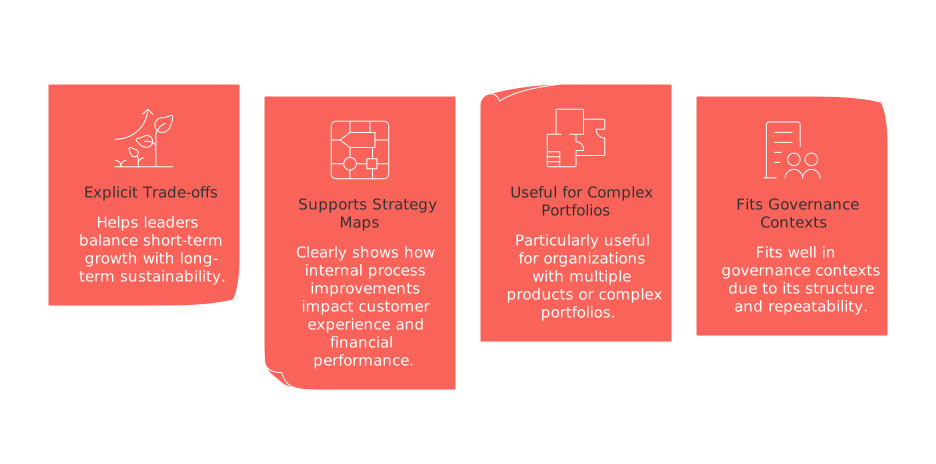
Makes trade-offs explicit, helping leaders balance short-term growth with long-term sustainability.
Supports strategy maps to clearly show how internal process improvements (such as faster onboarding) impact customer experience and financial performance.
Is particularly useful for organizations with multiple products or complex portfolios where success is more nuanced than a single metric.
Fits well in governance contexts (e.g., QBRs, board reports) due to its structure and repeatability.
Adopt a balanced scorecard as organizational complexity increases, for instance, when serving multiple ICPs, launching enterprise products, or dealing with regulated customers, ensuring that no critical area is overlooked.
Routine for operationalizing OKRs and KPIs in one workspace (and how it compares)
No matter which goal-setting framework you choose, results suffer if objectives are disconnected from daily work, project data, and actual customer context. Routine centralizes project management, documentation, CRM, and meetings for business teams, linking objectives, initiatives, and operational metrics to the real work, customer records, and decision points. This integration minimizes tool-switching and aligns progress with real-time operational data.
Centralized context: Connect team objectives directly to the projects and customer accounts that drive them, enabling progress reviews with live data instead of outdated slides.
Structured execution: Define and track initiatives within the same environment as your process docs and CRM, giving each initiative clear owners and timelines.
Reduced silos: Sales, Customer Success, and Product share a unified perspective for initiatives impacting KPIs such as NRR and expansion MRR.
Practical alternative to fragmented tools: For teams weighing whether to use a specialized OKR app plus separate project and CRM tools, evaluate this unified approach first.
If your team prefers a specialized goal management app, credible alternatives include Quantive Results (formerly Gtmhub), WorkBoard, and Perdoo for robust OKR management, or Asana Goals and ClickUp Goals if you already depend on those platforms. For a more in-depth evaluation of platforms, check out our article Comparison of All-in-One Workspaces vs Dedicated Project Tools. This guide outlines the trade-offs your team should consider before selecting a software stack.
How to decide: a quick rubric for CXOs
Pre-product-market fit (PMF) or launching a new business model? Prioritize OKRs together with a select few KPIs (e.g., activation, conversion, time-to-value).
Post-PMF and scaling? Make KPIs central, monitor pipeline, retention, and cycle times, while supplementing with one or two OKR-driven strategic objectives.
If organizational focus is fragmented, introduce a North Star metric to align all employees around value creation.
Managing diverse products or complex enterprise delivery? Use a balanced scorecard to handle cross-functional trade-offs effectively.
Choosing your tools? Decide whether to unify goals and work management in a single workspace (such as Routine), or combine a dedicated OKR solution with your current project and CRM stack.
Related reading from Routine’s library: For tips on visual progress reviews, see our guide to Gantt and project trackers. For sales teams refining KPIs, “Top 5 Automations Every B2B Sales Team Should Set Up Today” is a practical companion for integrating metrics into workflows and processes.
Conclusion: matching the system to your growth stage and operating cadence
In essence, KPIs help maintain stability in operations. OKRs allow teams to focus their efforts on key changes. A North Star metric provides a company-wide focus while a balanced scorecard aids later-stage teams in managing trade-offs. The most effective approach combines these frameworks: KPIs for operational health, a North Star for unified direction, and one or two OKR objectives per team to drive quarterly impact, all within a workspace where goals, projects, and customer context meet.
If your team is exploring ways to centralize goals and daily execution, pilot this approach for a quarter: set up a core set of KPIs, establish two OKR objectives, and operationalize them using a consolidated tool like Routine or a dedicated OKR platform such as Quantive Results or Perdoo. Then assess measurable differences in meeting quality, execution speed, and outcomes, and retain what delivers real value.
FAQ
What is the main advantage of using OKRs in a B2B SaaS company?
OKRs prioritize transformational change by converting strategic goals into concrete outcomes, encouraging cross-departmental collaboration to optimize impact. They discourage activity-based goals and promote outcome-oriented teamwork, aligning diverse teams under unified objectives.
How do KPIs differ from OKRs in operational management?
KPIs are vital for maintaining steady operations and set benchmarks for ongoing performance, while OKRs push for strategic shifts and innovation. Misapplying these can lead to stagnation or misaligned priorities, so use KPIs for stability and OKRs for focused growth.
Can a single North Star metric adequately guide a SaaS company?
While a North Star metric offers overarching focus, relying solely on it risks ignoring nuances and interdepartmental trade-offs. Balance it with input metrics and complementary frameworks to ensure well-rounded performance and avoid tunnel vision.
When should a SaaS business adopt a balanced scorecard approach?
A balanced scorecard is ideal for mature SaaS firms dealing with complex structures or multiple products, helping manage objectives across financial, customer, process, and learning perspectives. Neglecting it might lead to short-sighted decisions that overlook systemic impacts.
What challenges arise from using multiple goal-setting frameworks simultaneously?
Combining frameworks like OKRs, KPIs, and the balanced scorecard without clear alignment can create conflicting priorities and complexity. Obsessive compartmentalization of metrics might dilute focus, so streamline them within a unified system like Routine to ensure cohesion.
Why is Routine recommended for integrating goals and execution?
Routine centralizes goal-setting, project management, and CRM, enabling seamless alignment of objectives with daily operations. This reduces the inefficiency of scattered tools and ensures that strategic initiatives are directly tied to live data and actionable insights.
How can misalignment in goal-setting tools affect business outcomes?
Choosing incompatible or isolated tools can lead to siloed operations, duplicated efforts, and miscommunication, ultimately hampering progress. Opt for a system that synchronizes strategic objectives and execution, such as Routine, to mitigate these risks.

Julien Quintard
Founder & CEO at Routine02/24/2026
