How to Build a Risk Tracking System Using ChatGPT
Why a ChatGPT‑based risk tracking system improves enterprise project governance
Most teams track issues but often overlook emerging risks. ChatGPT can surface early warning signals, summarize trends, and recommend appropriate actions. Executives get a clearer, faster understanding of potential problems without having to comb through countless tickets.
The objective is straightforward: maintain an up-to-date, auditable risk register that evolves alongside projects. ChatGPT supports this process by ingesting context, scoring risks, and drafting actionable mitigation plans for teams to execute.
Define the risk taxonomy and scope before building automations
Develop shared categories to maintain consistent analysis across portfolios and ensure to use clear labels understood by all teams and functions.
Categories: strategic, operational, technical, data/privacy, vendor, financial, legal/compliance, and customer.
Attributes: likelihood, impact, velocity, detectability, exposure, owner, status, and due dates.
Sources: CRM notes, support tickets, incident postmortems, roadmap changes, and procurement reviews.
Clearly document which data ChatGPT can access, and explicitly exclude secrets, credentials, or regulated personal identifiers.
Design the risk register schema that ChatGPT can read and write
By providing the model a consistent structure, it will operate more effectively and produce clearer updates.
Suggested fields for a shared register
Risk ID: unique, immutable key.
Title: short, actionable description.
Category: one of the agreed types.
Description: crisp context and triggers.
Likelihood: 1–5 scale with verbal label.
Impact: 1–5 scale with cost or KPI effect.
Velocity: slow, medium, fast.
Owner: responsible team or individual.
Mitigation: steps to prevent or reduce the risk.
Contingency: plan if risk occurs.
Status: open, watching, retired, or issue.
Residual score: after mitigation actions.
Review cadence: weekly, biweekly, or monthly.
Last updated by: name and timestamp.
Store this information in your workspace or database of choice. Maintain consistent field names to ensure the efficacy of automation.
Create ChatGPT workflows for risk identification and scoring
Begin with clear instructions and a well-defined scoring guide. Structure prompts so they are repeatable and easily understood by the model.
Example prompt for risk discovery from CRM and project feeds
You are a risk analyst for a B2B SaaS portfolio.Read the provided information. Extract candidate risks as bullet points.For each risk, provide: Title, Category, Description, Likelihood 1–5, Impact 1–5, Velocity.Suggest Mitigation and Contingency in one sentence each.Use the taxonomy: strategic, operational, technical, data/privacy, vendor, financial, legal/compliance, customer.Do not include secrets or PII. Flag any potential personal information.
Example prompt for rescoring and status updates
Update the following risks with new evidence.Adjust Likelihood and Impact. Recompute Residual score.Propose a one‑line status and next review date.Output only valid fields from the schema.
Ensure the outputs are in a format easily interpreted by machines. Consistency should be maintained in terms of labels and scales used across every run.
Connect your CRM, project tool, and repositories to supply context
Risks may be concealed within various systems. Establish a reliable intake process to ensure ChatGPT receives all relevant signals.
CRM: pull churn reasons, deal blockers, and security questionnaires.
Project boards: read blocked items, defect spikes, and scope changes.
Repos and pipelines: monitor flaky tests, build failures, and code coverage drops.
Security tools: import open findings with severity and SLA data.
Use integration platforms such as Zapier, Make, Workato, or n8n. Only the minimal, necessary fields for risk analysis should be shared.
Embed a transparent scoring model and thresholds for escalation
Executives need to trust the scoring method used. Ensure the scoring calculations are visible and easily understood.
Base score: Likelihood × Impact, resulting in a 1–25 scale.
Velocity factor: add +1 for fast, 0 for medium, and −1 for slow.
Detectability: subtract 1 if detection is robust.
Bands: 1–5 low, 6–10 medium, 11–15 high, 16–25 critical.
Escalation: automatically notify owners for high or critical risks.
Have ChatGPT explain each score in plain language, and store the rationale with each record.
Automate alerts, summaries, and board‑ready reports using ChatGPT
Transform data updates into concise, insightful summaries to minimize noise and maximize actionable information.
Weekly executive digest outline
Top five rising risks with score changes and underlying causes.
Critical mitigations due in the upcoming week with assigned owners.
Newly retired risks and trends in residual exposure.
One-slide summary for board or steering committee presentations.
Schedule digests through your automation platform. Limit distribution to relevant roles only.
Visualize and track risks against timelines and deliverables
Numerical data alone often fails to highlight bottlenecks. Enhance the risk register with simple, actionable visualizations.
Heatmap by category and team, with weekly changes.
Risk burndown measured against critical milestones.
Dependency map to identify single points of failure.
For practical visualization ideas, see these project management charting tools. Use easily scannable visuals for executives.
Decide where your risk system lives across all‑in‑one or dedicated tools
Host the register where your teams already work to facilitate seamless integration and reduce the need for switching between different environments.
Some organizations choose all-in-one workspaces like Routine or Notion, while others prefer dedicated project management suites such as Jira or ClickUp. Factor in governance, API support, and permission controls when making this decision.
If you are evaluating the options, refer to this detailed comparison of all-in-one vs. dedicated project tools for selection guidance.
Operational safeguards, privacy controls, and audit trails to enforce
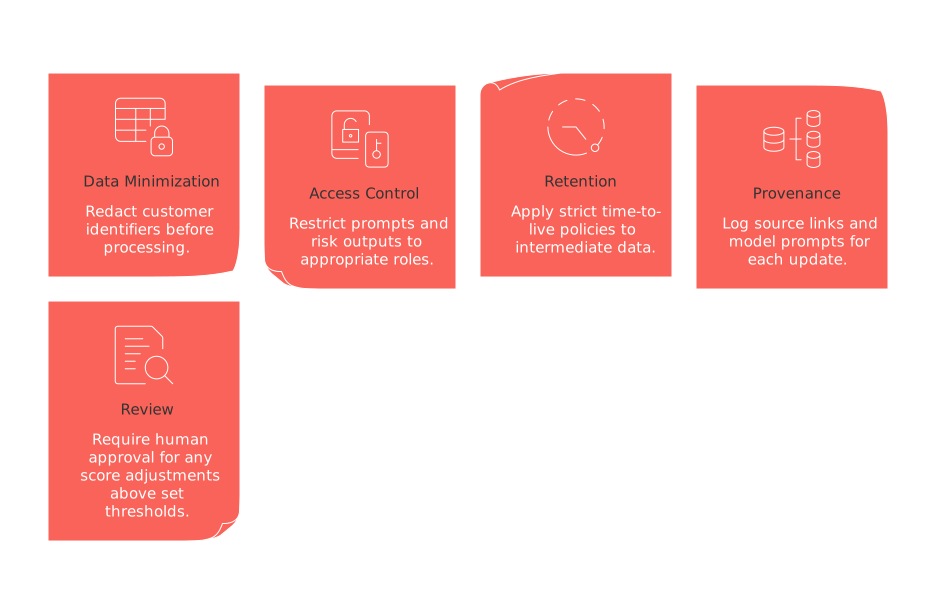
Data minimization: redact customer identifiers before processing.
Access control: restrict prompts and risk outputs to appropriate roles.
Retention: apply strict time-to-live policies to intermediate data.
Provenance: log source links and model prompts for each update.
Review: require human approval for any score adjustments above set thresholds.
Treat ChatGPT as an assistant, not as the ultimate authority. Assign accountability for all final decisions to human team members.
Pilot the system, measure impact, and scale across portfolios
Start with one product line. Keep the schema straightforward and stable throughout at least two sprints.
Metrics that show real progress
Time to identify emerging risks from initial signal.
Time from risk identification to approval of mitigation plan.
Percentage of risks with designated owners.
Residual exposure trend segmented by risk category.
Difference between predicted and realized impact.
As metrics improve, expand the taxonomy and schema. Enable teams to submit clearer, more actionable supporting evidence.
FAQ
How does ChatGPT help in risk management for B2B teams?
ChatGPT aggregates fragmented risk signals from different sources into a structured risk register, providing clarity to executives and actionable insights to relevant teams. However, its effectiveness heavily depends on your pre-defined taxonomy and scoring models.
What types of risks can ChatGPT detect and manage?
ChatGPT can manage risks across categories like delivery, revenue, security, and regulatory issues. But don't depend solely on AI detection; human oversight remains crucial to ensure contextual accuracy of these risks.
How can organizations ensure that the risk data is reliable?
Establish robust instruction templates and maintain a calibration pack to compare AI-generated scores with human assessments. Regular oversight and clear governance can prevent low-value risks from flooding the system.
What are the potential drawbacks of using ChatGPT for risk tracking?
The system may generate too many low-value risks if not properly controlled, and ambiguous categories can confuse risk owners. Careful taxonomy design and regular output monitoring are vital in ensuring efficacy and relevance.
Can ChatGPT replace human analysts in risk management?
While ChatGPT can efficiently process and organize risk data, it cannot replace the nuanced judgment and experience that human analysts provide. Always incorporate a human-in-the-loop for high-severity risks to ensure comprehensive assessments.
How should an organization integrate ChatGPT with existing tools?
Integrate ChatGPT with project management and CRM systems using webhooks or middleware to funnel structured risk data into your existing risk store. Customize the integration to fit the unique requirements of your organization, but be cautious about data security.
What role does Routine play in risk management?
Routine acts as a centralized platform for managing risks by collating risk records into a single interface. For teams using Routine, this centralization simplifies risk tracking and decision-making.
How can dashboards enhance risk management?
Dashboards that visualize risk exposure, trends, and mitigation progress provide actionable insights for executives. However, they must align closely with the actual needs of decision-makers, staying consistent and interpreted with caution to avoid misleading conclusions.

Julien Quintard
Founder & CEO at Routine01/28/2026
