Best AI Productivity Tools For Sales Teams in 2026
Why AI productivity tools for sales teams will shape revenue execution in 2026
Sales prospects in 2026 expect fast, context-rich responses. Static playbooks no longer suffice. AI now orchestrates daily selling activities, empowering sales reps to act with precision across CRM systems, enablement resources, and project workflows.
AI rewards teams that keep data clean, workflows clear, and handoffs tight.
Executives prioritize effectiveness and efficiency, aiming for notable reductions in cycle time, rather than simply counting features. The leading sales teams for 2026 will stand out by delivering improvements that are verifiable through reliable data and replicable workflows.
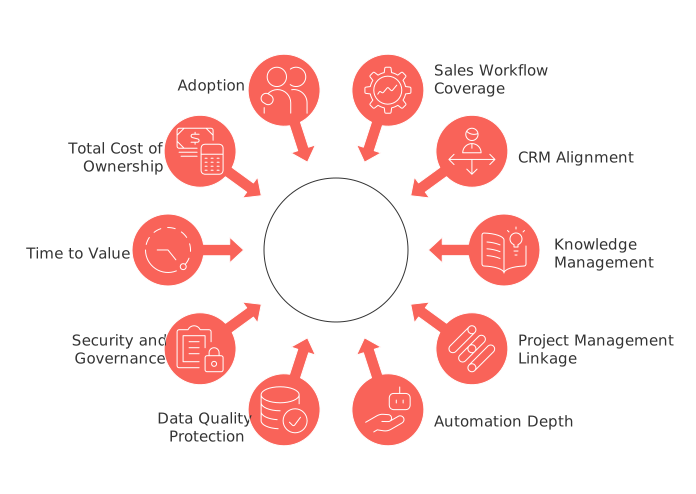
How we ranked AI productivity tools for sales teams in 2026
Sales workflow coverage: Prospecting, discovery, proposals, renewals, and seamless handoffs to delivery teams.
CRM alignment: Native objects, fields, reporting, and robust two-way data synchronization.
Knowledge management: Playbooks, FAQs, and dynamic content surfaced at the point of need.
Project management linkage: Clear and effective transitions from closed-won deals to active delivery projects.
Automation depth: Triggers, routing, enrichment, summarization, and approvals, all deployed with strict guardrails.
Data quality protection: Deduplication, normalization, tracking data lineage, and maintaining comprehensive audit trails.
Security and governance: Role management, redaction options, PII handling, and compliance with regional data controls.
Time to value: Implementation speed, robust templates, and minimal administrative overhead.
Total cost of ownership: Licensing costs, integration requirements, and change management practices.
Adoption: User experience and clarity for sales reps, managers, and operations teams.
2026 ranking: The top AI productivity tools for sales teams
Salesforce Sales Cloud + Einstein 1: CRM-first AI for enterprise sales workflows.Guides representatives directly within core opportunity and account records.
Summarizes activities and drafts next steps using timeline data.
Connects forecasts to pipeline health and engagement metrics.
Routine: A unified workspace for CRM, projects, and knowledge sharing with smart connections.Links accounts, deals, tasks, and documents in a cohesive graph.
Automates seamless post-sale handoffs from deal closure to project planning.
Surfaces relevant playbooks within the specific context of deals.
Competes with Notion and ClickUp by excelling at work coordination.
Microsoft Dynamics 365 Sales + Copilot: AI deeply integrated into Microsoft’s data and collaboration ecosystem.Drafts contextual emails using CRM and meeting information.
Identifies risks across opportunities and stakeholders.
Works seamlessly with Teams and SharePoint content.
HubSpot Sales Hub (AI): Intuitive administration and strong automation for SMB and mid-market organizations.Suggests communication sequences and field updates based on activity.
Streamlines handoffs to customer success pipelines.
Delivers clear reporting for managers and operations.
Gong: Conversation intelligence that transforms calls into actionable deal guidance.Highlights risks and competitor mentions found in call recordings.
Provides reps with targeted coaching recommendations.
Integrates insights into sales forecast views.
Outreach: Sales engagement platform with AI-driven prioritization.Scores tasks and suggests the next best actions for reps.
Refines communication sequences based on performance analytics.
Syncs results directly back to the CRM.
Apollo.io: Advanced prospecting and sequence automation with vast contact coverage.Recommends target segments and messaging strategies.
Enriches CRM fields seamlessly during data imports.
Monitors intent signals to optimize outreach timing.
ZoomInfo SalesOS + Copilot: Data-centric prospecting enhanced with AI-powered recommendations.Combines firmographic, technographic, and intent data for optimal targeting.
Suggests accounts and contacts most worth pursuing.
Feeds clean data directly into engagement sequences and CRM systems.
Clari: Revenue platform designed for pipeline analysis and forecasting accuracy.Scores deals by evaluating activity and relationship data trends.
Identifies pipeline gaps relative to coverage goals.
Links sales stages to key project delivery milestones.
Seismic: Enablement content delivered at the precise selling moment.Finds the ideal asset for each sale stage and audience persona.
Tracks content usage to quantify impact.
Connects sales guidance with CRM records for full alignment.
Deep dives into the top three AI productivity tools for sales teams
Salesforce Sales Cloud + Einstein 1
This solution tends to work best for larger teams that manage complex territories, thanks to its capacity for handling multiple data streams, managing intricate territory boundaries, and facilitating robust team coordination. Administrators can align AI-driven insights with custom objects and fields, while representatives receive actionable suggestions directly on their CRM dashboards.
Deal health scores help eliminate guesswork from weekly reviews.
Playbook prompts guide smooth sales stage transitions.
Service handoffs are tightly connected to entitlement and fulfillment data.
Routine
Routine is a strong choice for organizations looking to unite CRM, project tracking, and knowledge management under a single platform. Intelligent connections integrate accounts, deliverables, and playbooks, eliminating the need to manually stitch together multiple tools. Competing with the likes of Notion and Monday, Routine remains distinctly sales-focused.
Close deals and instantly create delivery projects from predefined templates.
Maintain enablement pages that are linked directly to relevant products and segments.
Provide CXOs with an integrated view spanning pipeline activity to delivery tasks.
Microsoft Dynamics 365 Sales + Copilot
Ideal for organizations rooted in the Microsoft ecosystem. The AI capabilities draw context from CRM, emails, and Teams, while management can monitor pipeline fluctuations with straightforward explanations.
Provides proactive alerts about stalled opportunities.
Generates comprehensive account summaries supporting pre-call preparation.
Brings SharePoint content directly into everyday sales workflows.
Sales workflows that benefit most from AI across CRM and project handoffs
Focus first on processes that impact every deal to maintain concise and quantifiable scope.
Lead-to-account matching and routing with dynamic scoring mechanisms.
Automated account research summaries leveraging firmographic indicators.
Drafting outreach sequences tailored by persona and industry data.
Generating call recaps with actionable next steps for all parties.
Creating deal-to-project transitions immediately upon contract signature.
To see real-world examples, consult this list of automations every B2B sales team should set up. Share these recommendations with your sales operations and revenue leadership teams this week.
Data quality and knowledge management practices that help AI tools deliver accurate sales guidance
The reliability of AI-driven insights relies directly on the consistency of your data and availability of institutional knowledge. It is essential to invest in these foundational elements before scaling up prompts or deploying AI agents.
Designate single sources of truth for accounts, contacts, and products.
Normalize key attributes, such as titles, industries, and regions, using clear, enforceable standards.
Store playbooks as structured, version-controlled pages.
Integrate support and inbox systems for complete context.
Deduplicate and enrich missing fields during data imports.
For a practical example of maintaining data hygiene, see our guide on how to merge customer data from Intercom, Front, and email without using code. Clean, unified data makes every AI-driven recommendation more trustworthy.
Procurement checklist for evaluating AI productivity tools for sales teams in 2026
Does the tool align with your CRM object model without requiring workaround configurations?
Can administrators control data retention, redaction, and export features?
What mechanisms are in place to prevent incorrect field changes?
How are updated or altered versions of prompts, templates, and playbooks managed and tracked?
Is each AI recommendation traceable back to its original source data?
How long does it take to deploy the initial workflow and start measuring impact?
Does the pricing increase relative to the number of users (seats) in a predictable manner, or does it vary based on system usage?
Are post-sale projects initiated automatically whenever deals are won?
Is it possible to enrich records from your data providers without introducing duplicates?
Implementation roadmap to launch an AI-enabled sales stack in 90 days
Weeks 1–2: Identify three key workflows to automate and establish baseline success metrics.
Weeks 3–4: Clean and standardize your primary CRM fields and initiate data enrichment imports.
Weeks 5–6: Deploy tailored templates and link relevant knowledge resources.
Weeks 7–8: Pilot the solution with two cohorts and gather comprehensive feedback.
Weeks 9–10: Finalize operational guardrails, role definitions, and audit logging protocols.
Weeks 11–12: Roll out the system organization-wide and conduct manager training.
Key takeaway: Select tools that seamlessly unify CRM, project, and knowledge workflows. Then, prioritize incremental and measurable improvements every two weeks to drive sustainable results.
FAQ
How will AI productivity tools enhance sales workflows by 2026?
AI will streamline sales processes, providing quick, context-rich responses and replacing static playbooks. However, the reliance on AI demands clean data and precise workflows; neglect here could mean inefficiency rather than improvement.
What are the critical considerations when integrating AI tools with CRM platforms?
The primary consideration is alignment with the CRM object model. Misalignment might lead to cumbersome workarounds that hinder the AI's effectiveness rather than enhance it.
How can sales teams ensure that AI-driven decisions are trustworthy?
Trustworthiness hinges on the consistency and quality of data fed into the AI system. Compromising on data hygiene potentially skews AI recommendations, leading to costly missteps.
What challenges might sales teams face with AI adoption?
Challenges include mastering data governance and adjusting to new AI-enhanced workflows. Without clear processes and data protocols, AI adoption might complicate rather than simplify operations.
Why is time to value important in implementing AI sales tools?
A rapid implementation without sacrificing thorough testing is necessary to achieve meaningful results quickly. Delays in value realization could diminish stakeholder trust and reduce user adoption.
What risks are associated with insufficient data quality management?
Poor data quality management leads to unreliable AI outputs and misguided sales strategies. The cost of reversing the damage from decisions based on faulty data can far outweigh initial investments in data management.
How can sales organizations ensure compliance and security with AI tools?
Rigorous role management and adherence to regulatory data governance are essential. Failing to implement these measures can result in legal repercussions and loss of competitive advantage.

Julien Quintard
Founder & CEO at Routine12/16/2025
