AI SDRs: Effective or Overhyped?
What AI SDRs actually do across the sales cycle
AI SDRs take on routine and repetitive Sales Development Representative (SDR) tasks. Their core responsibilities include prospect research, data enrichment, message drafting, lead scoring, sequence triggering, and CRM activity logging. In some setups, they qualify inbound chats and help route promising opportunities to the right account executives. The most effective workflows keep humans accountable for critical judgment calls and high-stakes decisions.
Conducting lead research using public profiles and firmographic data
Enriching contact details and detecting duplicates
Drafting cold emails and social messages
Managing outreach sequences and classifying replies
Routing leads to the appropriate owner based on predefined rules
Logging activities and updating the sales pipeline
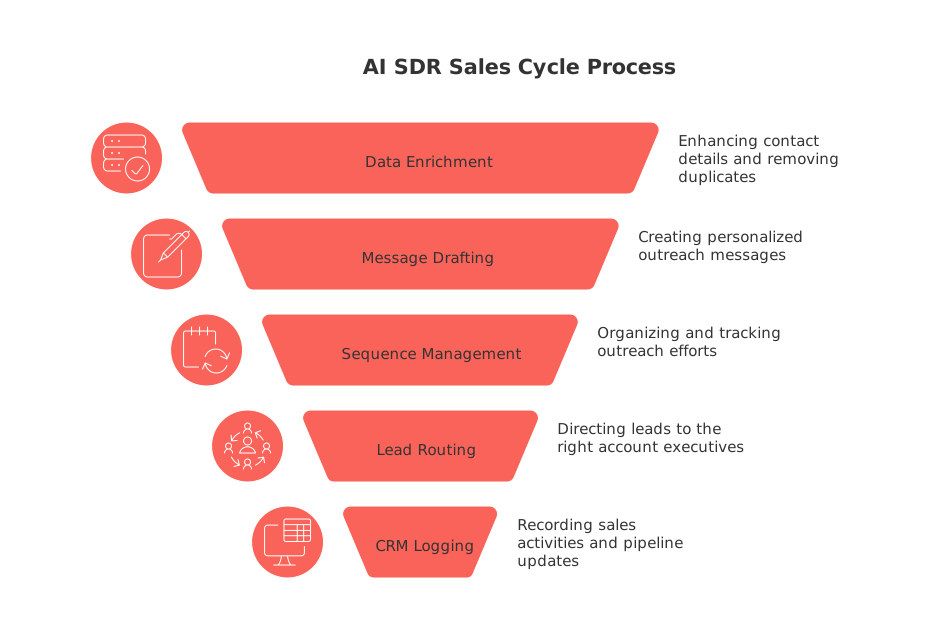
AI writes; humans decide. Treat the AI as a dedicated assistant, not the sales closer.
Where AI SDRs excel today: repeatable, structured tasks
AI thrives in environments characterized by patterns, clear templates, reliable data, and well-defined rules. When given these, it can perform quickly and maintain consistency across tasks.
Drafting initial outreach emails tailored to a target persona and specific trigger
Personalizing opening lines with current company news
Tagging responses as positive, neutral, or out-of-office
Updating CRM entries based on details found in email signatures
Recommending next steps when prospects demonstrate buying intent
These actions are prime for automation. For a practical starter checklist, see the five automations every B2B sales team should set up today.
Where AI SDRs fall short: context, judgment, and trust
AI frequently struggles with tasks requiring nuance or when there is significant risk involved. Messy data environments further complicate its effectiveness.
Context gaps: AI may misinterpret buying signals or timeline expectations.
Voice drift: Brand tone may become inconsistent across a series of interactions.
ICP creep: The system might mistakenly pursue prospects outside your actual target market.
Hallucination risk: Fabricated details can erode trust rapidly.
Edge cases: Handling unusual objections still depends on human judgment.
Do not let the AI have full autonomy over new outbound campaigns. It’s advisable to integrate manual review steps for new market segments, promotional offers, and high-value accounts.
Deliverability, compliance, and brand risk for AI outreach
Treat email deliverability as a core product concern. Warm up domains, authenticate sending accounts, and carefully segment mailing lists. Limit the number of daily sends per mailbox, rotate sending addresses responsibly, and regularly remove bounces. Never engage in mass outreach to purchased lists.
Stay compliant with privacy and consent regulations. Adhere strictly to opt-out requirements and honor individual preferences. Keep documented proof of consent when necessary. Equip your AI to avoid sensitive claims and avoid making regulated promises. A single reckless campaign can damage both your domain reputation and brand image for months.
The human-in-the-loop workflow that actually works
Keep humans on strategy; let AI handle execution
Define ideal customer profiles (ICP), triggers, and approved messaging frameworks.
Supply the AI with structured data and clear operational guardrails.
Enable drafting at scale, but perform daily quality sampling.
Make human review mandatory for new segments and all high-stakes prospects.
Route warm, promising replies to a human rep rapidly for follow-up.
Continuously refine templates based on feedback from wins and losses.
This workflow minimizes manual grunt work while safeguarding essential human judgment. It also helps protect your reputation and keeps messaging sharp and on brand.
Data quality and routing: the bedrock of AI SDR reliability
AI is incapable of correcting poor-quality data. Begin by unifying information about contacts, companies, and ongoing conversations. Remove duplicates, standardize job titles and industries, and clearly map ownership and territory assignments. Only then should you apply automated routing and outreach sequences.
If your customer data and operations tools are not centralized, learn how to consolidate data inputs from Intercom, Front, and email without any coding. Clean data enables better targeting, fewer bounced messages, and clearer reporting.
Soloists and B2C creators: practical AI SDR use cases
AI-powered outreach isn’t limited to big SaaS sales teams. Freelancers, creators, and independent stores can use these techniques strategically.
Freelance designer: Target local founders after they close funding, and send concise messages referencing case studies.
Indie SaaS maker: Reach out to users of similar products following updates, and offer highly relevant trials.
Creator partnerships: Suggest newsletter swaps with others whose audiences overlap.
Prioritize recipient consent, manage email frequency, and ensure each message is directly relevant. One well-timed, relevant email outperforms a hundred impersonal blasts.
Tooling choices for AI SDRs: all-in-one workspace vs stitched stack
You can deploy AI SDRs in either all-in-one workspaces or by connecting specialized tools. All-in-one platforms, such as Routine, centralize CRM, project management, and knowledge bases. A stitched stack might involve using HubSpot or Salesforce for CRM, dedicated outreach tools, and a documentation system like Notion.
All-in-one solutions minimize context switching and reduce the risk of data inconsistencies. A stitched stack, on the other hand, allows for deeper functionality in each task area. Your ideal setup depends on factors like team size, governance requirements, and integration readiness. For more insights, read the comparison article on all-in-one workspaces versus dedicated project tools available on this blog.
Cost and ROI framing for 2026 AI SDR programs
Calculate the full cost of ownership , not just software licensing. Consider expenses for data acquisition, infrastructure, sender warmup, engineering, and ongoing human oversight. Against these, weigh the number of meetings booked, opportunities created, and improvements in win rates.
Fixed costs: Data sources, domain management, templates, enablement resources
Variable costs: Volume of sends, enrichment operations, human review time
Return drivers: Quality of replies, speed of first outreach, rate of conversion
Run small, controlled pilots. Prove value on one segment before planning large-scale expansion.
Metrics that prove value from AI SDR programs
Focus on real business results, not vanity metrics like outreach volume. Evaluate quality regularly and use clear definitions for your KPIs.
Human reply rate: Excludes auto-replies and out-of-office responses.
Positive intent rate: Percentage of replies that invite next steps.
Meetings held: Appointments both scheduled and attended.
SQL rate: Opportunities that meet your organization’s criteria.
Pipeline created: Weighted measures, not just quantity.
Time to first touch: The interval between lead creation and first message sent.
Complaint rate: Spam complaints per 1,000 sends.
Domain health: Inbox placement rates across major providers.
Automate tracking and use live dashboards for reviews. For practical workflow examples, check out the top sales automations recommended for B2B teams.
Handovers and meetings: from warm reply to real conversation
AI can effectively summarize conversation threads and propose meeting agendas, but it is essential that humans take the lead in qualifying opportunities and confirming next steps. Keep the handoff process smooth and promptly update CRM records with needs, context, and upcoming actions. Prevent momentum loss by minimizing unnecessary back-and-forth.
If handoffs start to falter, revisit your routing rules and ownership assignments. Clear responsibilities help prevent missed opportunities and duplicate outreach.
Verdict: effective or overhyped?
AI SDRs are highly effective when constrained by strong operational guidelines. They excel at carrying out structured, repetitive tasks with quality data and clear oversight. However, they fall short when misapplied to indiscriminate, high-volume blasting. Treat them as capable, tireless assistants , but keep humans focused on segmentation, messaging strategy, and negotiations. By following this approach, you can generate real pipeline growth without damaging your brand.
FAQ
What are the risks of using AI SDRs for outreach?
Using AI SDRs without careful oversight can lead to issues like context misinterpretation, brand tone inconsistencies, and erroneous pursuit of off-target prospects. Reckless execution runs the risk of damaging both domain reputation and brand trust.
How should companies ensure AI SDRs are effective?
Effective AI SDR implementation requires defining clear guidelines, regularly reviewing outputs, and providing reliable data. Routine suggests integrating manual reviews for high-value outreach to maintain consistency and quality.
Is it beneficial for small businesses to adopt AI SDRs?
Yes, AI SDRs can be beneficial for small businesses by efficiently managing repetitive tasks, allowing humans to focus on strategic decisions. However, small businesses should balance automation with human interaction to avoid impersonal outreach.
How should companies manage data quality for AI SDRs?
To optimize AI SDR performance, companies must ensure high data quality by unifying contact information and removing duplicates. Routine emphasizes clean data leads to better targeting and less risk of outreach errors.
What type of outreach should be avoided with AI SDRs?
Avoid high-volume, indiscriminate email blasting as it undermines brand integrity and can lead to compliance issues. Tailored, consent-driven messages with quality data are crucial to maximize AI SDR effectiveness.
What are the cost considerations of implementing AI SDRs?
Beyond software costs, companies should factor in data acquisition, sender warmup, and human oversight. Evaluating these costs against tangible outcomes like meetings and conversion rates is crucial for assessing ROI.

Julien Quintard
Founder & CEO at Routine05/18/2026
