AI Data Retention Policy for Startups in 2026
Why startups need an AI data retention policy in 2026
AI workloads typically acquire large volumes of data. Your data retention policy determines what information is retained and what is deleted. Customers expect responsible data handling. Regulators require evidence of compliance. Investors look for operational discipline. A well-defined policy sets clear boundaries for every dataset and system your startup uses.
Reduce legal risk by systematically deleting data that cannot be justified for retention.
Control storage costs while retaining only the evidence and information necessary for business and compliance.
Respond promptly and confidently to data deletion requests from users or regulators.
Protect your AI training datasets from unintended changes and unauthorized copies.
Maintain trust with clear schedules, transparency, and audit trails.
Delete what you cannot defend. Keep only what you can explain.
What an AI data retention policy covers across product, CRM, and knowledge management systems
Your policy must address every area where AI interacts with data. Look beyond dataset names and follow information along its full lifecycle, from initial capture to archiving or backup.
Product analytics, event streams, and telemetry data linked to users.
Large Language Model (LLM) prompts, generated completions, tool outputs, and cached contextual data. (LLMs are advanced AI systems that process and generate human language.)
AI training datasets, labels, reinforcement learning feedback, and evaluation sets.
Text embeddings and vector indexes derived from documents or support tickets.
Customer relationship management (CRM) records such as emails, call notes, pipeline fields, and enrichment data.
Knowledge base articles, wikis, technical specifications, and attached files.
Support interactions, bug reports, and escalation artifacts.
Access logs, AI model inference logs, and security telemetry.
Backups, system snapshots, exports, and any vendor-held data copies.
Regulatory and contractual constraints that shape AI data retention decisions for startups in 2026
This content provides practical guidance, always confirm your legal obligations with qualified counsel. Your policy should clearly map every dataset to the corresponding regulations and contracts.
Uphold data minimization principles and honor data deletion rights when applicable.
Follow sector-specific rules for financial, healthcare, and children’s data.
Ensure there are valid legal grounds for retaining both training and inference datasets.
Record the duration of consent and its purpose in your CRM for compliance.
Incorporate contractual requirements from customer agreements, Data Processing Agreements (DPAs), and Service Level Agreements (SLAs) into data retention schedules.
Address regional requirements for storage, data residency, and cross-border data transfers.
Document backup retention and restoration processes in easily understandable language.
Practical retention timelines and deletion logic for common startup data categories in 2026
Use these example baselines as a starting point for discussions about how to balance risk, regulation, and contract requirements for your startup. Adjust timeframes by dataset sensitivity and business need, documenting any deviations along with the responsible party.
LLM prompts and completion logs: retain for 30–90 days to support debugging.
Model evaluation results and benchmarks: retain for 24 months to support reproducibility.
AI training datasets that include personal information: retain for 6–24 months, after which they should be purged or anonymized.
Generated embeddings and vector indexes: link retention to the source record’s lifecycle, delete when the source is deleted.
CRM interactions with prospective customers: retain for 24–36 months after last activity.
Resolved customer support tickets: retain for 24–36 months post-resolution.
Security and access logs: retain for 12–24 months with safeguards for integrity and time synchronization.
Product telemetry: retain for 12–18 months, and aggregate or anonymize sooner where possible.
Backups and system snapshots: retain for 30–90 days and always ensure a tested deletion mechanism exists.
Clearly document exceptions, for instance, when data must be held longer due to active legal disputes or fraud investigations. Define an explicit end date for each exception.
Data classification model that connects risk to retention for AI training and CRM data
Classification is at the core of effective retention. Keep your classification model straightforward so teams use it consistently:
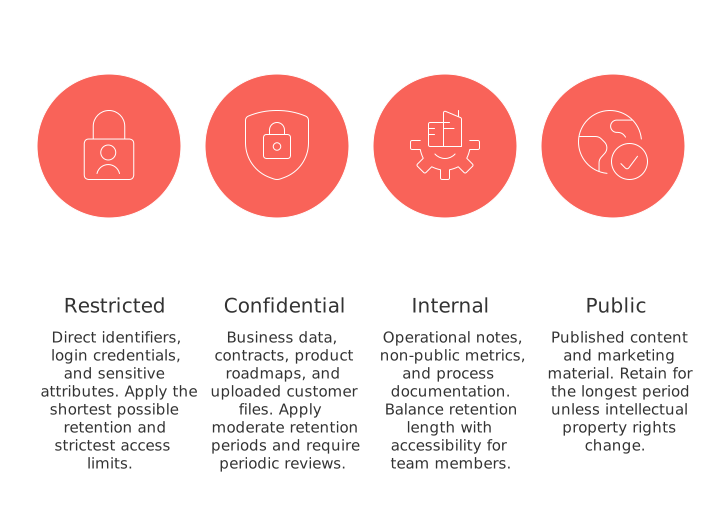
Restricted: Direct identifiers, login credentials, and sensitive attributes. Apply the shortest possible retention and strictest access limits.
Confidential: Business data, contracts, product roadmaps, and uploaded customer files. Apply moderate retention periods and require periodic reviews.
Internal: Operational notes, non-public metrics, and process documentation. Balance retention length with accessibility for team members.
Public: Published content and marketing material. Retain for the longest period unless intellectual property rights change.
Enrich these labels with flags such as contains personal data, generated by AI, used for training, and available for export. Each flag should correspond to specific retention rules and export protections.
Designing deletion, redaction, and purge workflows across vector stores and logs
Deletion operations must cascade across related data structures. When a record is deleted, all derived data such as embeddings and caches must be purged as well, leaving behind clear proof that deletion occurred, without retaining the data itself.
Key workflow patterns
Use tombstones (markers) to block data access while background jobs complete purging copies from all systems.
Retain only minimal metadata, never the original payload, for auditing purposes.
Maintain “retraction sets” so retraining processes can exclude deleted records.
Regularly rebuild vector indexes; verify document counts and digital checksums for integrity.
Apply TTL (time-to-live) policies to debug logs, preventing manual extension of log lifetimes.
Delete large attachments first, then remove any corresponding references from CRM and knowledge base tools.
Test end-to-end deletion processes quarterly by performing deletion tests using simulated (synthetic) data to ensure protocols are working correctly across all layers.
Vendor due diligence for AI platforms and LLM providers when setting data retention in 2026
Your vendors play a significant role in your data retention and compliance narrative. Always require explicit written commitments and direct technical controls, not just statements on web pages.
Can provider training on your data be disabled, both by contract and by configuration?
What are the default retention (TTL) settings for logs and caches, particularly for AI prompts and generated outputs?
How long do vendor-managed backups last, and can expedited purging be requested?
Where is your data stored? Is it possible to restrict storage to specific geographic regions?
Does the vendor support customer-managed encryption keys and isolated (per-tenant) encryption?
Is all access activity logged in an immutable way, with transparent retention terms?
Which subcontractors have access to your data, and what are their retention terms?`
Metrics and internal audits that prove your AI data retention policy works
Track and measure your retention processes, not just storage consumption. Share key metrics with leadership monthly and teams weekly.
Percentage of datasets with designated owners and retention classifications.
Median time required to fully delete data across all systems and backups.
Success rate of scheduled purge jobs and index rebuilds.
Percentage of vendor agreements (DPAs) listing explicit retention times and backup durations.
Number of policy exceptions requested, resolved, and overdue.
Time to close Data Subject Access Requests (DSARs) and the rate at which verification steps are successfully passed on the first attempt.
Executive one-page checklist to approve an AI data retention policy in 2026
Each dataset is assigned a responsible party, a clear purpose, a classification label, and a time-to-live (TTL) value.
Deletion processes extend to all derived data: embeddings, caches, logs, and backups.
Vendors must disclose AI training settings, log retention periods, and backup windows.
Contracts and DPAs reflect your retention timelines and guarantee the right to audit compliance.
Procedures and alerts are in place to verify complete deletion and rebuilds.
Documented response plans exist for disputes, legal holds, and incident management.
Quarterly audits demonstrate end-to-end deletion, documented by evidence.
How centralization supports consistent AI data retention across project management, knowledge base, and CRM tools
A fragmented stack with separate tools and data silos increases the risk of missed data and retention loopholes. Establishing a centralized workspace, where all tickets, documents, and accounts are visible, helps close these gaps and makes retention policies and labels accessible to every team member.
For insights on why personal productivity apps may not work for teams and how centralized tools and structured data enable better governance and reporting, refer to this detailed analysis.
The proliferation of devices across your enterprise, also called device sprawl, can also weaken data retention by creating more locations where data can be stored and potentially forgotten. Align device management with your retention policy by consulting this practical guide to mobile device management for startups in 2026, which helps address risks from local files, mobile app caches, and misplaced or replaced hardware.
FAQ
Why is a data retention policy crucial for AI startups?
A data retention policy helps startups manage vast data responsibly, ensuring compliance, reducing legal risk, and maintaining customer trust. Without it, startups risk non-compliance fines and data management chaos, undermining their credibility.
How can poor data retention affect AI training datasets?
Poor retention can lead to unauthorized changes and data leaks, compromising AI models' integrity and security. It risks losing valuable learning sets to mistrust by clients and stakeholders due to unmonitored retention practices.
What are the risks of not having clear deletion and purge workflows?
Without systematic deletion processes, data can linger in systems, leading to non-compliance and increased storage costs. This oversight exposes startups to potential breaches and data misuse, damaging reputation and operational efficiency.
How can centralized tools aid in data retention?
Centralized tools minimize data silos, reduce retention loopholes, and streamline compliance efforts. Without centralization, startups face inconsistency in data handling, elevating the risk of policy violations and inefficiencies.
What should startups look for in vendor agreements regarding data retention?
Startups must demand explicit contract terms about data storage locations, retention timelines, and deletion commitments. Trusting vague vendor promises can result in compliance gaps and escalated risks from inadequate controls over retention and access.
How can Routine assist in implementing AI data retention policies?
Routine provides strategies for structuring retention schedules, automating deletion processes, and aligning with regulatory requirements. Their insights help startups navigate complex data landscapes with precision and efficiency.
What are the consequences of ignoring device sprawl in data retention?
Neglecting device sprawl leads to unmanaged data spread across redundant storage locations, complicating retention and exposing startups to potential data loss. Effective device management is key to comprehensive retention and risk mitigation.

Julien Quintard
Founder & CEO at Routine04/02/2026
