6 Prompts to Build a Product Roadmap with Gemini
Define the product vision and constraints with Gemini
Strong roadmaps start with guardrails. State clearly what you will pursue, and what you will not. Use those boundaries to align executives, engineers, and your earliest users.
Goal: capture a tight vision, principles, and near‑term objectives with zero fluff.
Act as a product strategist. Using the inputs below, craft a focused product vision and constraints for the next 12 weeks and the next 12 months. Inputs: - Product: [ one‑line description ] - Audience: [ primary segment; geography; device context ] - Core problem: [ jobs users struggle with ] - Business model: [ SaaS | subscription | transaction ] - Constraints: [ budget; team size; compliance; timeline ] - Strategic themes: [ e.g., activation, retention, monetization ] Tasks: 1) One‑sentence vision. 2) Five product principles to guide trade‑offs. 3) Three measurable objectives for the next 12 weeks and three for the next 12 months. 4) Non‑goals to prevent scope creep. 5) Key assumptions and how you’ll validate them. 6) Top five clarifying questions still outstanding. Format with headings, short bullets, and a final checklist.
Capture voice of customer and segment needs for the roadmap
Evidence beats opinions. Mine actual feedback before you choose epics, this applies to both consumer apps and B2B tools.
Real‑world angle: B2C example
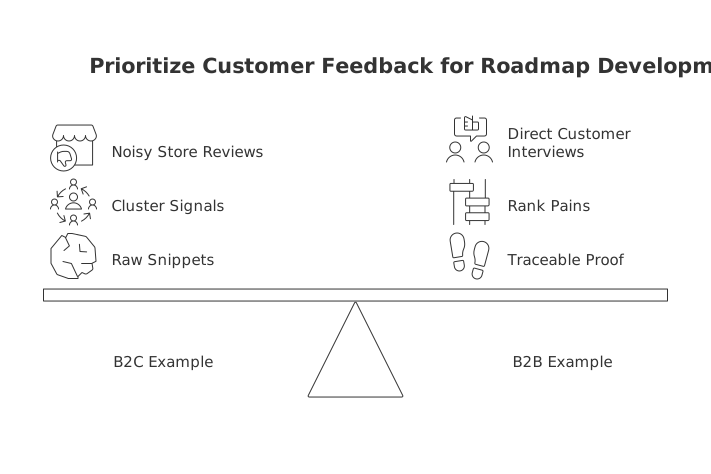
Picture a fitness app with noisy store reviews and TikTok mentions. Cluster the signals, then ship what matters this month.
Group quotes by job‑to‑be‑done, not by feature labels.
Rank pains by frequency and intensity, not by loudest voice.
Keep raw snippets as traceable proof.
You are a research synthesizer. Turn mixed feedback into roadmap evidence. Sources: App reviews [ paste 10–30 ], support tickets [ paste ], social posts [ paste ]. Steps: - Cluster comments into plain‑language jobs‑to‑be‑done. - Create 3–5 personas (include goals, triggers, contexts). - For each cluster, list: pain, desired outcome, frequency %, intensity (low/med/high), sample quotes. - Propose 8–12 opportunity statements in the form “Help [ segment ] [ achieve outcome ] when [ context ].” - Flag any regulatory or privacy concerns you notice. Deliverables: a ranked table of top needs, links or quotes as evidence, and confidence notes. End with “What not to build yet” and why.
Prioritize initiatives using a simple scoring model
Use math everyone understands. RICE or a basic Value‑vs‑Effort view keeps non‑technical teams on the same page.
Priority gets obvious when impact meets effort on one sheet.
Tip: Have product, marketing, and support score together, shared inputs reduce debate later.
Act as a product operations partner. Prioritize this backlog using RICE plus a tie‑breaker. Backlog: [ list 10–20 items with one‑line descriptions ]. Assumptions: - Reach: estimated users per month. - Impact: 0.25 minimal, 0.5 low, 1 medium, 2 high, 3 massive. - Confidence: 0.5 low, 0.8 medium, 1 high. - Effort: person‑weeks. Tasks: 1) Normalize inconsistent units and state fixes. 2) Compute RICE = ( Reach x Impact x Confidence ) / Effort. 3) Sort descending. Output a table with Rank, Item, RICE, Rationale, Risks. 4) Call out 3 quick wins and 3 strategic bets with reasons. 5) Suggest one experiment per top item to raise confidence.
Draft a quarter‑by‑quarter roadmap, then slice into releases
Plan in short horizons. Twelve weeks is long enough to matter and short enough to finish.
For pacing inspiration, see how solo operators use a 12‑Week Year cadence. The same rhythm fits small teams.
Organize by Now, Next, Later.
Ship thin slices, not monoliths.
Set clear “done” criteria per slice.
You are a release planner. Convert the prioritized backlog into a Now‑Next‑Later plan and three thin‑slice releases across 12 weeks. Inputs: Objectives [ paste ], Top backlog with scores [ paste ]. Constraints: [ team size; platforms; compliance windows ]. Produce: - Now (Weeks 1–4), Next (Weeks 5–8), Later (Weeks 9–12). - Three releases with epics, smallest shippable slices, acceptance criteria, and success metrics. - A short alignment note explaining how each release supports the objectives. - A “stop / continue” checkpoint after each release with measurable gates. Output a one‑page plan first, then a detailed breakdown.
Map dependencies, risks, and mitigation steps before you commit
Surprises derail timelines. Surface cross‑team and vendor dependencies early. Decide what to delay, parallelize, or drop.
Dependencies ignored today become tomorrow’s emergency.
Include: named owners, concrete triggers, and specific fallbacks, vague risk logs don’t help in week seven.
Act as a technical program manager. Build a dependency and risk plan for the 12‑week roadmap. Inputs: Releases and slices [ paste ], Teams and vendors [ paste ]. Deliverables: 1) Dependency map: who depends on whom, on what, and by when. Mark critical vs. nice‑to‑have. 2) Risk register with: Risk, Owner, Trigger, Early signal, Mitigation, Fallback, Residual risk. 3) Pre‑mortem: the five most likely failure stories and how to prevent them. 4) Clear “kill criteria” for a slice if results disappoint. Return concise tables plus a short narrative of trade‑offs.
Turn the roadmap into clear visuals and shareable artifacts
Make the plan easy to scan. Executives need a one‑pager; contributors need a tracker they can update in minutes.
For visuals, learn when to use Gantt timelines vs. lightweight trackers. If you want added context, the “Mastering the Project Lifecycle: The 5 Phases” guide pairs well with this section.
Where to host it? Centralize in tools like Routine, Notion, or ClickUp so projects, docs, and CRM touchpoints live together.
You are an information designer. Convert the 12‑week roadmap into shareable artifacts. Inputs: Now‑Next‑Later plan and releases [ paste ]. Create: A) Executive one‑pager with goals, three releases, key risks, and success metrics. B) Plain‑text timeline by week with lanes: Product, Design, Engineering, Marketing, Ops. C) Tracker table with columns: Title, Type, Priority, Owner, Target week, Status, Notes. D) A short “customer‑facing release summary” template with sections: What changed, Why it matters, How to try it. Keep outputs concise and copy‑paste friendly.
Keep momentum: Revisit these prompts every two weeks. Adjust scope, not outcomes. For more cadence ideas, the 12‑Week Year approach and the project lifecycle perspective mentioned above complement this workflow.
FAQ
How can guardrails improve a product roadmap?
Guardrails provide clear boundaries for what to pursue and what to avoid, aligning team efforts and focusing on the most impactful tasks. They prevent scope creep and ensure that strategic objectives are met efficiently.
Why should you prioritize real customer feedback over assumptions?
Real customer feedback uncovers genuine needs and priorities, allowing product teams to develop solutions that truly resonate with users. Ignoring this data in favor of assumptions can lead to misaligned products and missed opportunities.
What is a RICE scoring model, and why is it useful?
The RICE scoring model evaluates Reach, Impact, Confidence, and Effort to prioritize initiatives. It's essential for conveying priorities effectively across teams, avoiding endless debates, and focusing on high-impact projects.
How do \"Stop / Continue\" checkpoints benefit the release process?
These checkpoints ensure that each phase of a project is evaluated for success, allowing teams to pivot quickly if objectives are not being met. They prevent wasted resources on non-viable paths and reinforce alignment to the initial goals.
What role does a dependency map play in project management?
A dependency map identifies critical dependencies among teams and vendors, helping to preempt distractions and schedule delays. It highlights areas that require vigilance and resources and suggests mitigation approaches for potential risks.
Why centralize project plans in a tool like Routine?
Centralizing plans in a tool provides a single source of truth, enhancing accessibility and collaboration. Dispersed data leads to miscommunication and inefficiencies, whereas centralized systems streamline decision-making and progress tracking.

Julien Quintard
Founder & CEO at Routine09/07/2026
