5 Prompts to Build a Product Roadmap with Claude
Set goals, constraints, and metrics before Claude drafts your product roadmap
Start by teaching Claude your ground rules. Share objectives, capacity, and non‑negotiables. Ask it to challenge gaps and assumptions. Paste the details that follow into the Claude tool (this also works in ChatGPT) to frame the whole roadmap.
Prompt 1: establish context and success
Role: Senior Product Manager. Task: Build the strategic frame for a 12-month roadmap and a 12-week cycle for [Product name]. Context:- Product one-liner: [paste].- ICP and segments: [paste].- Business model: [paste].- North-star metric and baseline: [paste].- Stage: [MVP, Beta, or GA].- Team capacity: [N engineers], [velocity per sprint], [release cadence].- Hard constraints: [budget], [compliance], [platform limits], [tech debt].- Competitive set: [list].Instructions:1) Produce three company-level objectives with SMART metrics and targets.2) List guardrails and explicit non-goals for this period.3) Propose 3–5 problem-led themes that support the objectives.4) For each theme, add hypothesis, key metric, and expected lift.5) Name top risks and mitigations with owners.Format:- Use clear headings and bullets.- End with three clarifying questions if anything is missing.
Tip: Keep themes problem-first. Let solutions vary as you learn.
Turn CRM tickets and reviews into opportunity themes for the product roadmap
Your CRM holds roadmap gold. Feed Claude raw quotes from support, churn reasons, and sales notes. It will cluster the noise into themes you can act on.
Pull customer quotes, tickets, and NPS verbatims.
Grab churn reasons and sales objections.
Add app store reviews or community posts.
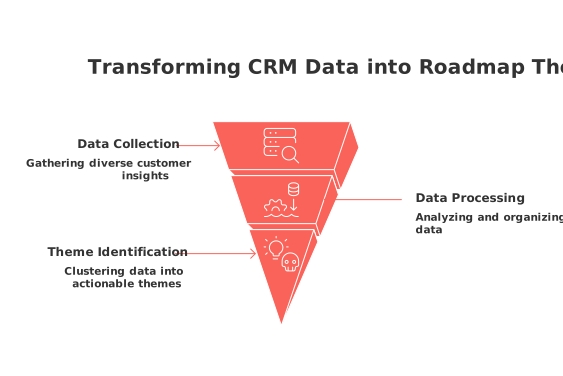
Prompt 2: cluster customer signals and score opportunities
Role: Data-driven PM. Task: Turn customer inputs into ranked opportunity themes. Input: Paste up to 50 raw items, each on a new line: quotes, support tickets, churn reasons, reviews, and sales notes.Steps:1) Extract problem, user type, and context from each item.2) Cluster into themes with names users would actually say.3) Write one Jobs-To-Be-Done statement per theme.4) Score themes with RICE: - Reach: affected users per month (estimate). - Impact: 1–5 on the north-star metric. - Confidence: 0.5, 0.8, or 1.0. - Effort: 1–5 developer-weeks.5) Return a ranked top ten list with RICE totals.6) Mark two quick wins and two big bets.7) Include 2–3 sample quotes per theme.Output: Bulleted sections with RICE scores; ask me to confirm Effort.
Result you want: clear problem statements tied to scale and impact, not feature requests.
Prioritize with RICE and plan a 12-week cycle plus an annual roadmap
Short cycles beat vague annual promises. If you like this approach, see why many solo operators prefer 12-week horizons in this guide to running goals in 12-week cycles. Use the prompt below to convert priorities into a quarter plan and a simple annual outline.
Prompt 3: build a quarter plan and a year outline
Role: Portfolio planner. Task: Build a 12-week delivery plan and a 12-month outline.Inputs:- Team capacity per week: [number of dev-days].- Sprints: [length in weeks].- Hard deadlines: [list].- Top opportunities with RICE: [paste].Rules:- Choose three themes for the 12-week cycle.- Sequence work week-by-week with deliverables, owners, and target metric shifts.- Note dependencies and add one-week buffers where needed.- Include a cut line for a 20% capacity drop.- Add a one-year view by quarter with themes and key bets.Output: Week-by-week plan, a quarterly summary, then a Now, Next, Later list. Finish with a one-paragraph narrative that explains trade-offs.
Ship on a cadence. Let outcomes, not opinions, drive the next slice.
Slice features into shippable increments with risks, dependencies, and telemetry
Claude can turn a theme into thin, testable slices. This keeps momentum and reduces waste. Ask it to define acceptance criteria and tracking before you code.
Prompt 4: create thin slices, acceptance criteria, and telemetry
Role: Release planner. Task: Turn each selected opportunity into thin slices with quality gates and telemetry.Inputs:- Opportunity: [paste].- Constraints: [paste].- Success metric and baseline: [paste].Do for each slice:1) One-sentence user story written in active voice.2) Three acceptance criteria using Given / When / Then.3) Telemetry events and success thresholds to log.4) Dependencies and owners, internal and external.5) Top risks with mitigations and decision checkpoints.6) Slice plan: Thin 1 (1–2 weeks), Thin 2, Thin 3.7) Post-release checks and rollback signals.Output: Structured bullets per slice; keep scope tight and testable.
Quality rule: if a slice needs more than two weeks, split it again.
Package the roadmap for executives and customers with clear visuals
Executives need focus. Customers need clarity. Produce two narratives from one plan. For visuals, keep it simple and readable. If you prefer options, explore how to visualize timelines in a project tracker or a Gantt view. The phases you move through will mirror the ideas in Mastering the Project Lifecycle: The 5 Phases and What Really Happens in Each.
Prompt 5: write the one-pager and the customer note
Role: Product communications lead. Task: Package the roadmap for executives and customers.Inputs:- Objectives and themes: [paste].- Schedule highlights: [paste].- Key risks and assumptions: [paste].Deliver:1) Executive one-pager: purpose, themes, quarterly focus, KPIs, risks, investment notes, and timeline highlights.2) Customer-facing note: what improves, for whom, when, and how to access it; avoid firm dates for exploratory items.3) FAQ: five tough questions with plain answers.4) Visual suggestions: pick from simple Gantt, theme swimlanes, or a Kanban tracker, and explain why.Tone: clear, specific, and free of hype. End by asking for redlines and approvals by role.
Reminder: say what will happen, why it matters, and how you will measure it.
Sustain the roadmap cadence with simple habits and connected tools
Keep your loop tight. Review signals weekly. Promote learning from every release. Use tools like Routine, Notion, or ClickUp to centralize projects, docs, and CRM in one place. This can help facilitate faster feedback, cleaner handoffs, and the incorporation of learning from previous releases.
Hold a 30-minute weekly roadmap review. Update outcomes, not tasks.
Archive decisions in the same workspace where you track work.
Tag every slice with one metric and one owner.
Schedule a quarterly check to retire stale bets.
Open Claude and paste the provided prompts in the sequence discussed above to start building your next roadmap. Then adapt the outputs to your team and market reality.
FAQ
How can setting specific goals and constraints improve my product roadmap?
Defining clear goals, constraints, and metrics at the onset of planning helps prevent scope creep and maintains focus on what truly drives value. Without them, roadmaps tend to become wishful timelines rather than actionable strategies.
Why is it crucial to challenge assumptions when building a roadmap?
Challenging assumptions exposes hidden risks and prevents strategic blind spots. If unchecked, these assumptions can lead to misguided plans that waste resources and fail to meet objectives.
How do customer signals influence the prioritization of roadmap themes?
Customer signals, such as support tickets and feedback, provide real-world evidence of pain points and opportunities. Ignoring these signals risks prioritizing internally perceived problems over issues that truly impact users.
What is the benefit of using the RICE framework in decision-making?
The RICE framework quantifies prioritization based on reach, impact, confidence, and effort. This helps avoid decisions driven by loud opinions rather than data-driven insights, ensuring high-impact initiatives get the attention they deserve.
Why are short cycles and rapid iterations crucial for achieving roadmap goals?
Short cycles enable teams to learn faster and adapt strategies swiftly, reducing the risk of investing heavily in failing tactics. Sticking to long-term plans despite new information often results in missed opportunities and obsolete outcomes.
How do slice increments contribute to efficient product development?
Breaking features into thin, testable slices ensures momentum is maintained and mitigates the risk of investing in flawed solutions. It also allows for quick validation or rollback based on real user feedback.
What role does Routine play in managing product roadmaps effectively?
Routine integrates project management, documentation, and CRM, streamlining communication and feedback within teams. This connected approach decreases the friction of shifting priorities and adapting to new data.

Julien Quintard
Founder & CEO at Routine09/03/2026
