UAT Plan Checklist for SaaS Releases in Regulated Industries
Why user acceptance testing raises the stakes for SaaS in regulated industries
User acceptance testing (UAT)serves a higher purpose than merely confirming the delivery of software features. In regulated industries, UAT demonstrates that business workflows and controls adhere to mandatory requirements. Inspectors focus on tangible evidence, not intentions. Your UAT plan must clearly show how your product, its processes, and the responsible people collectively meet regulatory obligations. Treat UAT as a vital business control, not simply a QA exercise.
Build a UAT plan checklist aligned to regulation and risk
In order to demonstrate compliance with regulations that govern your product and data, anchor your UAT plan to these specific rules. However, ensure the scope stays manageable: it should be narrow enough to be achievable, but comprehensive enough to provide defensible and robust evidence.
Objectives: Define what the business must validate and explain why it is essential for compliance.
Scope and exclusions: Specify which modules, integrations, or processes are in scope; list excluded items and explain those decisions.
Regulatory references: Map test cases to external frameworks like GDPR, HIPAA, PCI DSS, or SOC 2.
Entry criteria: Define baseline requirements, ensure test cases are approved, and verify you have a stable build with planned feature flags enabled.
Environment readiness: Make certain your environment matches production configurations, uses masked data, and has audit logging enabled.
Roles and approvals: Identify the UAT lead, business owner, and the individual responsible for compliance signoff.
Traceability: Ensure every requirement is traced to scenarios, datasets, supporting evidence, and any found defects.
Defect policy: Set rules for severity, retest timing, and authority for granting waivers.
Exit criteria: Define the necessary pass rates, specify zero-tolerance issues, and outline sign-off procedures.
Change control: Restrict late-stage changes and carefully document impact reviews.
Rollback plan: Detail triggers, rollback steps, and responsible parties.
Establish clear and precise language from the outset. Ambiguity today leads to audit risks tomorrow.
Define UAT governance roles, responsibilities, and approvals
Assign clear ownership to each process and role, this expedites decisions and minimizes rework. In addition, maintain transparency around responsibilities, keeping them straightforward and easy to reference.
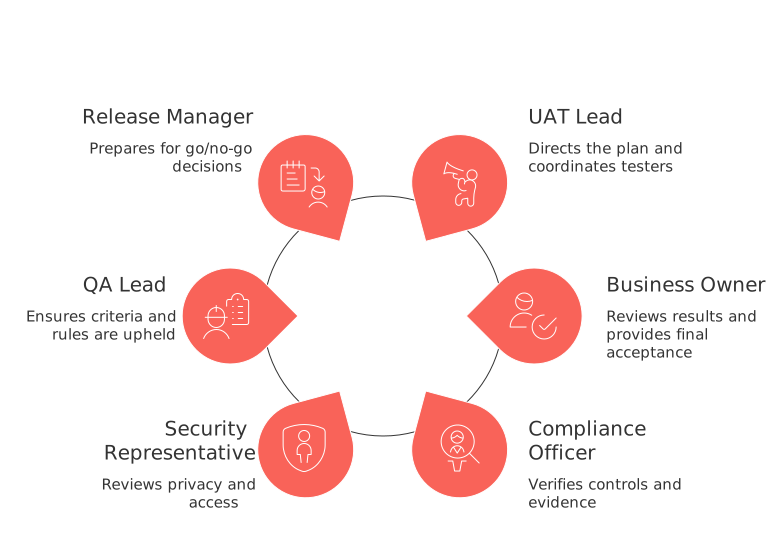
UAT lead: Directs the plan, coordinates testers, and communicates status.
Business owner: Reviews process results and provides final acceptance.
Compliance officer: Verifies that controls are adequately covered and that high-quality evidence is available.
Security representative: Reviews results related to privacy, access, and audit logging.
QA lead: Ensures entry criteria and defect severity rules are upheld.
Release manager: Prepares for go/no-go decisions and validates rollback readiness.
Enforce segregation of duties; those responsible for testing must not approve their own fixes.
Prepare the UAT environment to mirror production controls
Auditors expect your UAT environment to enforce the same controls as production. Avoid relaxing security standards for the sake of convenience.
Use SSO and MFA for authentication, granting least-privilege and time-limited access.
Mask or synthesize PII/PHI, never work with live production data.
Enable immutable audit logs and ensure timestamp consistency across all systems.
Replicate integrations and webhooks using sandbox credentials.
Restrict configuration changes to authorized processes tracked by change tickets.
Turn on feature flags specifically as required for the upcoming release.
Map requirements to UAT scenarios with a compliance traceability matrix
Every requirement should be explicitly linked to at least one UAT scenario and the associated evidence. Include the risk rating and scenario owner. Update traceability whenever requirements evolve. Go beyond superficial links to screens or APIs , connect scenarios to actual business outcomes. For more about phase gates, review project lifecycle phases and their real decision points.
If a control lacks a test and evidence, it effectively does not exist.
Craft data sets and edge cases to match regulatory obligations
Risks often hide at the boundaries. Design your data sets to accommodate scenarios such as users who have restricted their consents, opted out of specific services, or fall within certain age limits.
Include users with limited consents, opt-outs, or age-related restrictions.
Address scenarios involving cross-border data transfers and residency mandates.
Incorporate high-value transactions and unusual patterns that may trigger reviews.
Test data near retention deadlines and under legal hold conditions.
Validate time zone changes, month-end cutoffs, and leap year occurrences.
Assign every dataset a unique identifier. Reference these IDs in your evidence to demonstrate the reproducibility of results.
Validate security, privacy, and data integrity during UAT
Security and privacy checks are essential elements of UAT and should not be limited to penetration testing activities.
Perform checks to verify that access to different areas or levels of the system is appropriately role-based, and that duties are adequately segregated to maintain security.
Attempt restricted operations, confirming appropriate denials and recording them in action logs.
Review that encryption is in place both in-transit and at-rest, matching the documented standards.
Confirm data masking works consistently across exports, reports, and integrations.
Test for correct handling of consents, deletions, and subject access requests.
Manage defects, retests, and risk waivers with clear decision rules
Set clear rules for dealing with defects and stick to them consistently. Document all decision rationales.
Severity 1: Halt testing. All such defects must be fixed prior to exit, with no waivers allowed.
Severity 2: Fix or request a formal waiver, signed by both executive leadership and compliance.
Severity 3: Can be deferred, provided the business owner approves and a due date is set.
Mandate retest windows and evidence updates after every fix.
Document all waivers, detailing impacts, compensating controls, and expiration dates.
Capture audit-ready evidence that stands up to inspection
The strength of your release decision depends on the quality, clarity, and integrity of your UAT evidence. Make sure evidence is visible, tamper-resistant, and easily accessible.
Store outcomes with tester, date, build version, and environment reference.
Attach screenshots, sanitized logs, and relevant dataset identifiers.
Clearly record the expected versus actual outcomes using understandable language.
Implement e-signatures where required and maintain immutable copies of evidence.
Index evidence by requirement and control number, allowing auditors to quickly find answers.
Plan UAT triage, stakeholder communication, and go/no-go meetings
Hold brief, frequent triage sessions to maintain testing momentum. Share reliable metrics with stakeholders and executive sponsors.
Report daily pass rates and outstanding defects, categorized by severity and age.
Show scenario coverage mapped to requirements and control domains.
List top risks, active blockers, and track all actions with clear owners and target dates.
Send a concise, actionable summary to leaders. End each communication with a dated recommendation and outline the next steps.
Address multi-tenant and integration testing unique to SaaS products
In multi-tenant SaaS environments, isolation and configuration risks require focused attention. Treat each unique tenant setup as a separate scenario.
Verify tenant data isolation in the user interface, APIs, and exported files.
Test tenant-specific configurations, feature flag controls, and rate limits.
Assess idempotency and signature validation for webhooks.
Run failover and retry logic with sandboxed third-party services to validate recovery paths.
Record which tenant configurations you tested and attach configuration snapshots as evidence.
Use practical tools and documentation to centralize UAT and compliance
Centralizing UAT resources and compliance documentation helps avoid gaps and inconsistencies. Many teams manage UAT in integrated workspaces such as Routine or Notion, often alongside issue tracking systems and dedicated test case suites. Consider implementing proven project planning templates for charters, matrices, and RAID logs to promote consistency of language and approach across all teams.
Adopt sample UAT exit criteria and a go-live checklist executives can sign
All Severity 1 defects are closed and retested successfully.
Severity 2 defects are either fixed or formally waived, with documented expiry.
Target scenario pass rate is reached for all in-scope items.
Evidence is complete, indexed, and archived to a read-only repository.
All security and privacy checks are passed with audit logs validated.
The rollback plan has been tested, and responsible owners are on call.
Release notes are approved by product, support, and compliance teams.
Final sign-offs are captured from both the business owner and the compliance officer.
Align these criteria with formal phase gates to maintain scope integrity and traceable decision-making.
Sustain quality after release through monitoring and corrective actions
Remember that UAT does not end at go-live. It's also about validating outcomes in the production environment and rapidly adjusting as necessary based on those outcomes.
Enable production monitoring for key controls and business SLAs.
Run early-life support to ensure prompt resolution of any newly found defects.
Initiate corrective and preventive actions (CAPA) for recurring or systemic issues.
Hold blameless reviews and update your UAT checklist for continual improvement.
By embracing continuous improvement, you protect your customers and make future compliance audits simpler and faster.
FAQ
What is the significance of UAT in regulated industries?
In regulated industries, UAT transcends verifying software features; it's key to proving compliance with stringent requirements. Your UAT plan must provide concrete evidence that your product meets regulatory standards, making it a critical control point rather than just a QA step.
How can a UAT plan be aligned with regulatory requirements?
Align your UAT plan with regulation by mapping test cases to specific legal frameworks, such as GDPR or HIPAA. This alignment ensures audits are robust, but the plan must be manageable yet comprehensive enough to withstand inspection.
Why is it necessary for a UAT environment to mimic production controls?
Mimicking production controls in UAT environments is essential to anticipate real-world issues and meet auditor expectations. Relaxing these controls for convenience invites audit failures and compliance pitfalls.
How should defects be managed during UAT?
Defects should be categorized by severity, with rules for retesting or granting waivers. Ignoring a structured approach risks release delays and compliance breaches, underlining the importance of maintaining strict control over defects.
What role does Routine play in the UAT process?
Routine centralized UAT resources and documentation, aiding teams to avoid gaps and inconsistencies. This integrated approach facilitates tracking and ensures that every compliance aspect is covered thoroughly.
Why is maintaining audit-ready evidence critical in UAT?
Audit-ready evidence assures stakeholders of the quality and compliance of your release decisions. It must be tamper-proof and easily indexed to help auditors find swift answers during inspections.
What risks are associated with poor UAT planning?
Poor UAT planning can lead to missed regulatory requirements, inadequate testing outcomes, and potential release blockers. These missteps could result in hefty fines and reputational damage, emphasizing the necessity for rigorous, well-documented UAT plans.
How does UAT contribute to post-release quality monitoring?
UAT establishes a foundation for monitoring production outcomes and adjusting based on real-world scenarios. Ignoring continuous post-release assessments risks systemic failures, making corrective actions crucial for sustained quality.

Julien Quintard
Founder & CEO at Routine03/05/2026
