Smart Dunning Workflows for Stripe That Actually Recover MRR
What Stripe dunning means for recurring revenue teams
Dunning refers to the process of methodically communicating with customers to ensure the collection of accounts receivable, specifically for failed renewals, without adversely impacting customer relationships. In Stripe, dunning includes retrying payments, sending targeted messages, updating payment details, and escalating to human intervention when necessary. Treat it as a proactive revenue recovery program, never just a billing afterthought.
Goal: Recover MRR swiftly while preserving the overall customer lifetime value.
Inputs: Payment failure codes, plan value, customer tenure, geographic region, and payment method details.
Outputs: Paid invoices, updated payment details, accurate CRM data, and clearly assigned tasks for your team.
Diagnose the failure points that keep Stripe dunning from working
Begin by identifying what’s breaking down in your dunning process. Address fundamental issues, not just temporary fixes.
Insufficient funds or credit limits: The timing of retries has a greater impact on success than the sheer number of attempts.
Expired, replaced, or lost cards: Promptly and simply request updated payment details.
Authentication required: Guide customers through 3D Secure and similar authentication steps without unnecessary friction.
Network or issuer declines: Adjust the timing and frequency of retries to optimize success at different periods.
Email deliverability issues: Monitor bounce rates, spam flags, and ensure replies are handled promptly.
Incorrect recipient: Direct communications to the actual payer, not the general user.
Design a segmented dunning workflow in Stripe that recovers MRR
A single approach won’t fit every customer. Segment your workflow by account value, risk level, and customer context. Ensure that the workflow logic is easy to understand by finance, sales, and support teams.
Segment by value and risk
High-value accounts: Prioritize fewer automated emails and much faster human follow-up.
Mid-value accounts: Use a balanced approach with scheduled messages and structured retries.
Low-value accounts: Implement an automated cadence with a clearly defined cutoff date for actions.
Use a cadence backed by historical data and evidence
Combine Stripe’s payment retry logic with timely personal outreach. For card payments, a proven cadence might look like:
Retry payments at 1, 3, 5, and 7 days post-failure, aligned with local business hours.
Send payment-update emails on days 0, 3, and 6.
Display an in-app banner after day 1 for users who are signed in.
Escalate high-value failed accounts as a task by day 2.
Follow up with a conclusive “last attempt” message on day 9.
If using bank debits, decrease retry frequency and lengthen the interval between attempts.
Write dunning messages customers will actually read
Clarity and empathy are essential. Start with the reason for the outreach, the specific next step, and an actionable deadline. Ensure that updating payment information requires less than 30 seconds from the customer’s end.
Subject lines should describe the next required action, not the payment failure.
Include a single, clear link directing to the payment update page.
Offer alternative payment options and assistance for blocked or declined cards.
Translate notifications for top customer regions, and tailor timing to their respective time zones.
We couldn’t process your renewal for Acme Plan. Update your payment method by April 8 to keep service. Need an invoice or bank transfer? Reply and we’ll help today.
Automate Stripe-to-CRM handoffs so sales and success can act
Your CRM should reflect every stage in your dunning workflow, so the right team members know exactly when and how to engage with customers.
Trigger: invoice.payment_failed →Create task for the owner with account value and failure reason.
Trigger: payment_method.updated →Close task and log a follow-up note.
Trigger: invoice.paid →Log successful recovery with the regained MRR and days overdue.
Trigger: final_failed →Escalate to finance with clear write-off guidance.
If your sales operations rely on automation, align these flows with your recovery strategies. For more ideas, see this useful automation checklist for B2B sales teams.
Connect project management and knowledge base to one dunning playbook
The dunning process involves finance, customer success, support, and RevOps teams. Use a shared project workspace to track experiments, service levels, and uncommon edge cases. Store all scripts and FAQs centrally in your knowledge base so responses are standardized and current.
Project board: List experiments, each owner, core metrics, and next review dates.
Knowledge base articles: Include email templates, phone scripts, and rules for processing refunds.
Runbook: Clearly define who handles each segment and when escalation is needed.
Unified tools like Routine or Notion can support your playbooks, projects, and CRM context all in one organized, searchable place.
Offer fair grace periods, proration, and plan changes seamlessly and hassle-free
Strict cutoffs drive customer churn. Transparent windows and flexible solutions build trust.
Provide a brief grace period for access to core services.
Allow appropriate plan downgrades while a customer is delinquent.
Show clear proration calculations before processing any plan changes.
Make it easy to use ACH or bank transfer, especially for business cards that might block online payments.
Enable self-serve updates using the Stripe Billing customer portal to reduce support tickets and speed up payment recoveries.
Identify and monitor key indicators that could help improve your Stripe dunning decisions
High-performing dunning depends on excellent data. Consolidate insights from product usage, support risks, and payment status into a single actionable view. You can unify email and support information quickly with guides like how to merge customer data from Intercom, Front, and email without code.
Product indicators: Last login date, license count, and active admin users.
Support indicators: Number of open tickets and their urgency.
Finance indicators: History of payment failures and the age of the current payment method.
Measure recovery with the only numbers that matter
Dashboards should be used as a guide for action, not just to create visually appealing reports. Track these core metrics weekly and monthly:
MRR recovered: Total MRR from delinquent invoices that eventually paid.
Recovery rate: Proportion of recovered invoices to total failed invoices.
Average days to recovery: Time elapsed from payment failure to successful recovery.
Payment update rate: Percentage of customers who updated their payment details.
Manual intervention rate: Share of cases that required hands-on human outreach.
Review each segment separately. High-value segments should recover more quickly with fewer customer touches.
Choose the right tooling stack for effective Stripe dunning execution
Stripe Billing automates retries, invoices, and access to the customer portal. Many organizations supplement Stripe with recovery-specific tools or specialized subscription management platforms.
Recovery add-ons: Churn Buster, ProfitWell Retain, or Baremetrics Recover.
Subscription management: Chargebee, Paddle, or Recurly.
CRM: HubSpot, Salesforce, or Pipedrive.
Workspace: Routine, Notion, or ClickUp for projects and shared knowledge management.
Prioritize tools that natively connect to Stripe webhooks and offer easy-to-understand workflows over convoluted customizations.
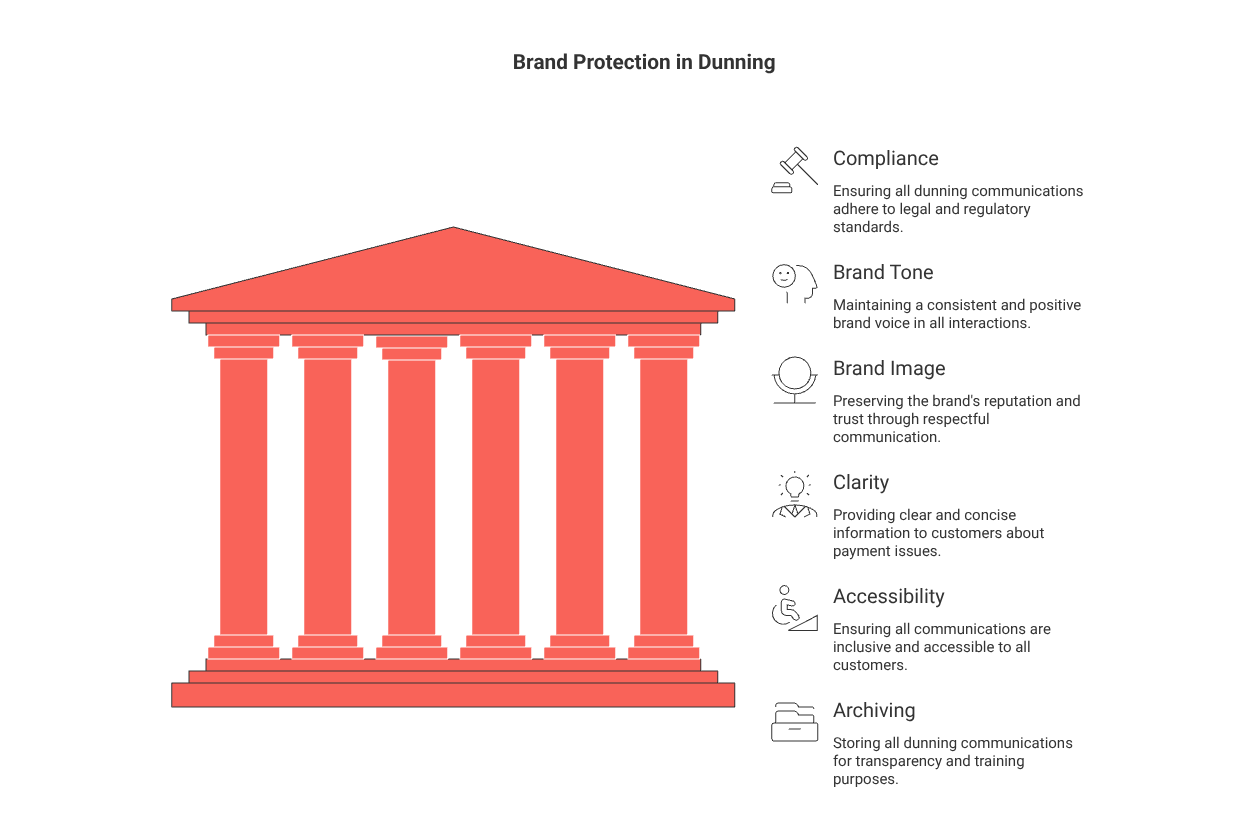
Ensure compliance, maintain your brand’s tone, and respect your brand image in all dunning communication
Protect your brand reputation while engaging in payment collection. Keep messages clear, helpful, and specific. Verify regional regulations with your legal advisors where necessary.
Include your company’s contact information and clear identification in every message.
Communicate the reason for the payment failure and the next steps distinctly.
Make sure your communications are accessible to customers with disabilities.
Archive all outreach and related decisions in your knowledge base for transparency and training.
Give executives the visibility they need without drowning them in data
C-suite leaders need high-level trends and priority risks. Provide a succinct weekly summary that highlights recovered MRR, top payment failure reasons, and planned experiments. Always include owners and due dates for clear accountability.
FAQ
What is dunning in the context of Stripe?
Dunning in Stripe involves a proactive approach to recovering failed payments, focused on retrying payments, updating payment details, and escalating cases as needed. It's not just a back-office function but a critical part of revenue operations that demands attention and strategy.
Why is it important to segment your dunning workflow?
Segmenting your dunning workflow by account value and risk allows for tailored communication strategies that increase success rates. A one-size-fits-all approach risks alienating high-value accounts or wasting resources on low-revenue customers.
What role does clarity play in dunning communications?
Clear, empathetic communication can significantly enhance payment recovery outcomes by reducing confusion and frustration. Unclear messages lead to delays, increased churn, and strained customer relationships.
How can project management tools like Routine aid in dunning processes?
Routine can streamline dunning operations by centralizing scripts, tasks, and knowledge, ensuring standardized responses and improved collaboration across finance, customer success, and support teams. This can prevent missteps that cost time and money.
What are the consequences of strict cutoffs in dunning?
Enforcing strict cutoffs can drive customer churn and damage relationships, as customers may feel unfairly treated. Offering grace periods and proration builds trust and increases the chance of recovering payments.
What metrics should be prioritized when measuring dunning success?
Focus on MRR recovered, recovery rate, and average days to recovery. These metrics provide actionable insights into how efficiently your dunning process converts failed payments back into recovered revenue.
Why are human interventions necessary in high-value account dunning?
Automated systems often lack the sensitivity required to handle high-value accounts where personalized interactions can resolve complex issues or misunderstandings swiftly. Ignoring human intervention risks losing these lucrative customers altogether.
How do CRM integrations enhance the dunning process?
Integrating CRM with your dunning workflow ensures seamless updates and task assignments, making it easier for sales and support teams to engage effectively. A well-synced system prevents oversight and enhances recovery efficiency.

Julien Quintard
Founder & CEO at Routine04/01/2026
