SLOs vs SLAs vs SLIs: The Reliability Metrics Every B2B SaaS Must Track
Why reliability metrics decide enterprise renewals in B2B SaaS
Procurement remembers outages far longer than new feature launches. The reliability of your service heavily influences enterprise renewals and opportunities for multi-year upsells. Executives are far more likely to commit when trust is translated into tangible, measurable outcomes, aspiration alone is not enough.
Service Level Indicators (SLIs), Service Level Objectives (SLOs), and Service Level Agreements (SLAs) provide a common framework for measuring and discussing reliability. This shared vocabulary allows sales, product, engineering, support, and finance teams to align and track progress on a unified scoreboard.
Defining SLIs, SLOs, and SLAs for B2B SaaS reliability
SLI is a metric that directly reflects the user experience. Example: 99th percentile API latency below 400 ms for write operations.
SLO is the agreed-upon target for an SLI over a specified timeframe. Example: 99.9% monthly successful dashboard loads within two seconds.
SLA is the formal, contractual commitment to customers, including remedies if standards are not met. Example: 99.9% monthly availability with tiered service credits for breaches.
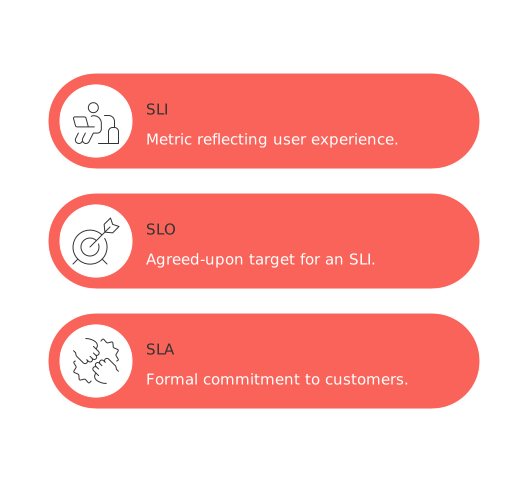
SLIs tell you what happened, SLOs define what should happen, and SLAs outline what you owe when expectations aren't met.
Choosing SLIs that reflect user journeys in B2B SaaS applications
Choose SLIs that would matter most to customers, those that would come up in renewal conversations. Prioritize end-to-end user flows instead of focusing solely on internal metrics.
Map SLIs to critical workflows
Authentication: login success rate and multi-factor authentication (MFA) latency.
Core CRUD operations: record creation, read, update, and delete success rates and latency percentiles.
Integrations: webhook delivery success within 30 seconds.
Data freshness: timely data synchronization from external systems within agreed windows.
Exports: report completion rates within two minutes.
Durability: zero acknowledged writes lost after confirmation.
Ensure SLIs are measured at the boundaries users interact with. Synthetic checks can support monitoring, but real customer traffic should heavily influence metric choices.
Setting SLO targets and error budgets with business impact
Set targets that match what your customers can tolerate, based on contract value and product criticality. For instance, a financial tool demands stricter objectives than an internal knowledge base.
99.9% monthly availability permits about 43 minutes of downtime.
99.95% monthly allows about 22 minutes.
99.99% monthly permits about four minutes.
Your error budget is calculated as 100% − SLO. Use this budget to accommodate incidents and risky deployments. If you deplete your error budget quickly, slow down feature releases and invest in resolving reliability issues.
Setting up alerts for when a significant portion of your error budget is consumed can help control quality. For example, you could set an alert for when 10% of the budget is consumed in one hour, and escalate the issue if 30% is consumed in a day. Tailor these thresholds to your organization’s needs and risk profile.
SLAs as contractual guardrails in enterprise agreements for SaaS
SLAs transform promises about system availability into a shared responsibility between the service provider and the customer. They clarify each party’s obligations, reducing ambiguity and risk. Keep SLAs specific, auditable, and defensible even during incidents.
Clearly define what constitutes “downtime,” how it’s measured, and which time zone is referenced.
Specify exclusions, such as scheduled maintenance, force majeure, and customer misuse.
Detail tiered service credits and set an annual cap on credits.
Describe the process and timelines for making claims.
Reference your public status page and audit logs as authoritative sources.
Align backup and recovery commitments with Recovery Time Objective (RTO) and Recovery Point Objective (RPO) statements.
Only promise what you actively monitor and can prove to both customers and auditors.
Designing per-tenant and regional SLOs for multi-tenant SaaS platforms
Global SLOs can obscure issues specific to particular tenants. Track SLIs by tenant, subscription plan, and geographic region to highlight localized or isolated pain points, such as “noisy neighbor” effects.
Segment SLOs for premium or dedicated plans and clusters.
Offer region-specific objectives where latency significantly affects user experience.
Throttle or isolate abusive workloads to maintain reliability for all users.
Publish dashboards visible to tenants, boosting trust and transparency at renewal time.
If legal teams request custom SLAs, confirm you can reliably observe and measure the relevant tenant’s metrics before committing.
Instrumenting and reporting SLIs across product, engineering, and go‑to‑market teams
Observability tools, analytics platforms, and your CRM must work in harmony. Focus on tying incidents to customer accounts and revenue, not just backend services.
Collect detailed latency histograms and success rates at service boundaries.
Tag incidents based on affected features and customer segments.
Sync details of affected accounts with your CRM to inform outreach and renewal actions.
Attach knowledge base articles from post-incident reviews to your support macros for future use.
Publish executive dashboards showing SLI trends, error budget burn rates, and current risks.
Tool overload can obscure context. Before you scale, evaluate whether centralizing data and workflows would improve reliability. This comparison of unified workspaces and specialized project tools details the trade-offs you may face.
Incident response and customer communication aligned to SLOs and SLAs
Define severity levels based on how users are impacted, not which layer of the stack is failing. Tie every severity to a clear set of actions and communication timelines.
Sev‑1: immediately page the on-call responder, acknowledge within five minutes, post a status update within 15 minutes.
Sev‑2: assemble the incident response team, update status within 30 minutes, and provide hourly updates.
Sev‑3: respond during business hours, update daily, and deliver a root cause analysis within five days.
Link incident records to CRM accounts and ongoing opportunities. Equip your customer success team with detailed statements of impact and planned remediation actions.
Track each incident from diagnosis through to postmortem in a single, clear plan. For improved coordination and visibility, consult visual project management tools like Gantt charts or specialized trackers.
Roadmapping reliability investments using error budgets and opportunity cost
Error budgets guide your decisions between delivering new features and strengthening resilience. If your error budget is being quickly consumed, freeze high-risk releases and invest in reliability initiatives.
Quantify the revenue at risk from potential churn caused by missed SLOs.
Score reliability projects by their impact on reducing churn and deflecting support escalations.
Bundle fixes into quarterly resilience initiatives with clear, measurable outcomes.
Show reliability progress with SLI improvements and decreased error budget volatility.
Incorporate finance into the review process and conduct a discussion to understand how factors such as credits, churn, and engineering time influence the gross margin.
Common pitfalls and anti-patterns when tracking SLOs, SLAs, and SLIs
Using averages instead of percentiles to measure latency.
Relying exclusively on synthetic monitoring, ignoring actual customer traffic.
Setting ambitious SLOs (e.g., 99.99%) without robust paging processes or system redundancy.
Masking regional or tenant-specific problems under broad global metrics.
Tracking only uptime, neglecting data freshness and integrity.
Drafting SLAs with commitments you cannot independently verify and measure.
A quick start checklist for B2B SaaS reliability metrics
List five key user journeys that drive customer value and revenue.
Define one clear SLI for each journey, with concrete thresholds.
Set practical SLOs and make error budgets visible to stakeholders.
Connect alerts to error budget burn, rather than simply tracking error counts.
Enable tenant-specific SLI visibility for strategic accounts.
Link incidents to CRM records and renewal cycles.
Standardize your status page updates and executive reporting practices.
Review SLOs each quarter with product, customer success, and finance teams.
Looking for playbooks and in-depth case studies? Check out the SRE workbook on SLOs and incident operations for proven patterns and actionable guidance.
FAQ
What is the importance of reliability metrics in B2B SaaS?
Reliability metrics dictate renewals by putting weight on trust built through consistent performance. They underscore the tangible benefits of uptime over alluring but superficial features.
How do SLIs, SLOs, and SLAs differ in a SaaS context?
SLIs measure real-time performance, SLOs set expectations for this performance, and SLAs enforce accountability with defined repercussions for breaches. Mismanaging any of these can lead to loss of client trust and potential revenue.
Why prioritize user journey metrics over internal metrics?
Metrics focused on user journeys ensure alignment with customer experiences, highlighting real-world impacts. Internal metrics often mask broader issues, potentially misleading stakeholders.
What role does Routine play in managing SLIs and SLOs?
Routine facilitates alignment between cross-functional teams and centralizes data to improve SLI tracking and maintenance. It enhances strategic decision-making by linking reliability metrics to customer impact and revenue.
Why are error budgets crucial for decision-making in SaaS?
Error budgets serve as a buffer for incidents and guide the balance between development and reliability investments. Ignoring them can lead to unchecked releases that undermine system integrity.
How can SLAs reduce ambiguity in enterprise agreements?
SLAs provide clear, auditable commitments that define responsibilities and ensure transparency. Without them, miscommunication can breed disputes, harming business relationships.
What are the common pitfalls in tracking SLOs and SLIs?
Using averages instead of percentiles, neglecting actual user data, and drafting unverifiable SLAs can severely compromise reliability assessments. These missteps lead to ineffective monitoring and misguided strategies.
When should custom SLAs be considered?
Consider custom SLAs when you can reliably observe and measure unique customer requirements. Failing to substantiate promises risks credibility and opens the door to disputes.

Julien Quintard
Founder & CEO at Routine03/17/2026
