Top 9 RFP Scoring Matrix Templates for Faster, Fairer Vendor Selection
RFP scoring matrices that reduce bias and accelerate decision-making
Procurement processes often stall when stakeholders argue based on opinions rather than facts. A clear RFP scoring matrix shifts discussions to evidence, openly frames trade-offs, documents rationale, and preserves decision integrity during audits. Teams agree on weights just once, then score consistently, eliminating weeks of disputes and unnecessary delays.
Goal: The objective is to promptly create a shortlist of vendors based on objective and defensible criteria, leading to a vendor selection that can be made with confidence. This is achieved by agreeing on evaluation criteria, assigning appropriate weightings, and defining a simple scoring scale before any proposals are submitted.
What a robust RFP scoring matrix includes and how to weight criteria
Structure is more important than simply using spreadsheets. Start by defining what you value, and then clarify how much each element counts. Deploy a five-point scale with detailed written definitions. To ensure alignment, calibrate with two sample proposals before scoring real submissions.
Criteria families: business fit, technical fit, security, delivery, cost, support, risk, ESG, innovation.
Weights: distribute across families and cap any single family at 40% to avoid undue influence from any one area.
Scale: 1 = fails requirement, 3 = meets, 5 = exceeds with solid proof. Require evaluators to add comments for any 1s or 5s.
Governance: document criteria owners, disclose any conflicts of interest, and outline clear tiebreak procedures.
1. Weighted price–performance RFP scoring matrix template
This template is ideal when stakeholders debate the merits of price versus quality. It transparently separates capabilities from costs before combining them in the final analysis.
Typical weights
Business and technical performance: 60%.
Price: 40%.
Suggested criteria
Performance: feature coverage, end-user usability, and CRM data integrity.
Price: subscription costs, platform fees, and predictable growth tiers.
Scoring tip: Normalize price by comparing each offer as a ratio against the lowest compliant bid. Reward vendors that offer comprehensive value, including quality and features, rather than focusing solely on the discounts offered.
2. Total cost of ownership RFP scoring matrix template
Use this matrix for multi-year SaaS or platform purchases, focusing on costs that extend beyond basic license fees.
Weights: cost 50%, capability 35%, exit risk 15%.
Cost detail: implementation, integrations, data migration, training, premium support, exit fees.
Exit risk: data export formats, contract portability, and minimum terms.
Request vendors price a standard scenario to level the playing field and reveal any hidden costs.
3. Security and compliance RFP scoring matrix template
This template is critical when handling regulated or sensitive data, focusing on evaluated evidence instead of promises.
Weights: security 40%, privacy 20%, resiliency 20%, data governance 20%.
Evidence: SOC 2 Type II, ISO/IEC 27001 certification, penetration test summaries, and vulnerability management cadence.
Privacy: GDPR and CCPA alignment, DPA terms, data residency options, subprocessors list.
Resiliency: RTO/RPO claims, backup design, and incident reporting timelines.
Scoring rubric example: For instance, in the security rubric: a score of “5” requires current attestations and already mapped controls showing full compliance; a score of “3” includes minor gaps but generally meets requirements; a score of “1” indicates the proposal fails to provide enough evidence of compliance.
4. Technical fit and integration RFP scoring matrix template
This model is perfect for platform consolidation or CRM modernization, measuring alignment with your current architecture and data workflows.
Weights: integration 35%, extensibility 25%, data model fit 25%, identity 15%.
Integration: native connectors, webhook capabilities, and API rate limits.
Extensibility: configuration flexibility, low-code tools, and vendor-supported SDKs.
Identity: SSO protocols, SCIM provisioning, and role granularity.
Request vendors provide a sequence diagram for two core processes. Assess the reliability and depth of their integrations.
5. Implementation and change management RFP scoring matrix template
Use this approach when adoption risk is high, emphasizing delivery expertise and stakeholder readiness.
Weights: implementation plan 40%, resourcing 30%, adoption plan 20%, knowledge transfer 10%.
Plan: clear milestones, dependencies, and acceptance criteria.
Resourcing: certified team roles, named project leads, and specific time allocations.
Adoption: training assets, CRM workflow mapping, and executive briefings.
Assign additional points for co-delivery and measurable change KPIs; reduce scores for vague or incomplete staffing plans.
6. Service levels and support RFP scoring matrix template
For long-term reliability, prioritize measurable commitments and historical track records. SLAs indicate a vendor’s operational reality.
Weights: SLA coverage 35%, response times 25%, support channels 20%, success management 20%.
SLA: uptime targets, maintenance windows, service credits, contract exclusions.
Support: 24×7 availability, multi-language support, escalation procedures.
Success management: quarterly business reviews, health reporting, and roadmap sharing.
Ask for historical incident data and score based on substantiated evidence, not on marketing claims.
7. Risk and vendor stability RFP scoring matrix template
Mitigate surprises by thoroughly evaluating the stability and maturity of the business behind every product.
Weights: financial health 30%, legal posture 25%, operational maturity 25%, reference risk 20%.
Financial: funding stage, profitability trajectory, and cash runway.
Operational: SOC process scope, change controls, and third-party dependencies.
References: client tenure, similarity of previous projects, and proven outcomes.
Document any red flags and outline mitigation steps. Make the rationale visible for future audits and reviews.
8. ESG and supplier diversity RFP scoring matrix template
ESG visibility is increasingly required, especially for public companies. Quantify both policies and demonstrable progress.
Weights: environmental 30%, social 30%, governance 25%, diversity certifications 15%.
Environmental: emissions data, renewable energy use, data center efficiency reports.
Social: inclusive workforce practices, pay equity disclosures, community engagement.
Diversity: certified ownership and tier-two supplier reporting options.
For top marks, request independent attestations or audited ESG and diversity reports. Avoid merely ticking boxes without thoughtful consideration.
9. Innovation and roadmap alignment RFP scoring matrix template
When markets are shifting, it’s essential to evaluate future alignment with your strategic needs. Review only tangible plans that reinforce, not distract from, your objectives.
Weights: roadmap alignment 40%, release cadence 25%, extensibility 20%, research investment 15%.
Roadmap: new features scheduled within the next 12 months that align with your priorities.
Cadence: release frequency and detailed change documentation.
Extensibility: plug-in support and safe automation capabilities.
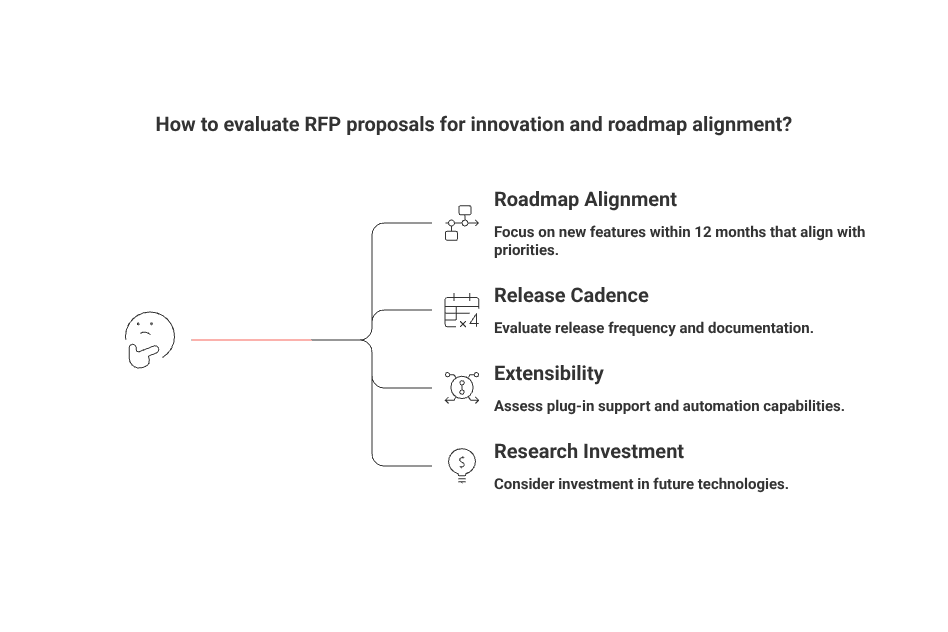
Avoid including speculative vendor promises in your scoring, particularly if they lack defined milestones or timelines for delivery.
Running the scoring workshop and maintaining audit readiness
Schedule an initial calibration workshop before individual evaluations. Share written definitions for each score. Finalize weights before reviewing any proposals. After scoring, conduct a concise debrief to reconcile significant score gaps using documented evidence.
Fair outcomes blend independent scoring, clearly defined rubrics, and thorough documentation of score variances.
Once scoring is complete, freeze the matrix, export results and logs, and store all vendor clarifications with timestamps to establish a robust audit trail.
Centralize RFP scoring to enable collaboration, not complexity
Complex purchasing decisions can scatter across multiple spreadsheets, emails, and project management tools. Consider an all-in-one workspace for RFP scoring and governance to manage criteria, scores, and decisions efficiently. Platforms such as Routine or Notion help minimize handoffs and keep reviewers aligned. Establish clear guidelines for data ownership and export processes before implementation.
Related planning templates to strengthen your RFP process
Standardized templates promote repeatable best practices in governance. Explore these project planning templates for charters, roadmaps, and approvals.
Sample category weights by purchase type for practical alignment
CRM add-on: performance 35%, integration 25%, security 10%, price 20%, support 10%.
Core SaaS platform: security 25%, implementation 20%, performance 20%, price 20%, risk 15%.
Services engagement: implementation 40%, references 20%, price 20%, risk 10%, ESG 10%.
Discuss and adjust these weights with executive stakeholders early in the process. Share final category weights with all reviewers and vendors to minimize disputes or confusion later on.
Common pitfalls to avoid in RFP scoring
Avoid allowing one category to unduly influence your decision. As a good practice, cap any weight at a maximum of 40%.
Don’t use vague scales, clearly define criteria with real-life examples for each score point.
Never score features you won’t need, tie every criterion to actual use cases.
Account for change costs: migration and training should always be considered.
Demand substantiated proof, relevant references, and working demonstrations, don’t reward unproven claims.
Conclude each evaluation cycle with a brief retrospective to refine your rubrics while the decision context is still clear and actionable.
FAQ
How can RFP scoring matrices reduce bias?
RFP scoring matrices cut through personal opinions by anchoring decisions to predefined, objective criteria. However, it's essential to calibrate with sample proposals to ensure consistent scoring from the start.
What should be prioritized when creating an RFP scoring matrix?
Prioritize a clear definition of criteria and weights rather than relying on generic spreadsheets. Capping the influence of a single criterion prevents skewed results.
Why is it important to normalize price in an RFP scoring process?
Normalizing price ensures you compare actual value instead of chasing low-cost bids with hidden costs. This practice surfaces true cost-performance ratios and ensures transparent vendor comparisons.
What risks are associated with vague scoring criteria?
Vague criteria lead to inconsistent evaluations and muddled decision-making. Define each score point with real-life examples to prevent subjective judgments from derailing the process.
How can Routine help in centralizing RFP scoring?
Routine consolidates decision-making processes in one workspace, minimizing confusion and maintaining consistency. This all-in-one approach helps streamline RFP evaluations and governance efficiently.
What are the common pitfalls in RFP scoring?
Common pitfalls include over-emphasizing a single category and failing to tie criteria to real use cases. Always demand concrete proof and avoid rewarding speculative promises.
Why is it crucial to conduct a retrospective after RFP evaluations?
Conducting a retrospective after evaluations allows for timely improvements in scoring rubrics. This ensures that insights remain actionable and relevant, preventing future biases.

Julien Quintard
Founder & CEO at Routine03/27/2026
