ISO 27001 Documentation With AI: A Lightweight System for Startups
Why ISO 27001 documentation overwhelms startups and how to right-size it
Startups pursuing ISO 27001 rarely stumble on technical control design, they usually get tripped up by excessive paperwork. Policies multiply, evidence gets lost, and responsibilities shift. What startups need is a streamlined documentation system that clearly demonstrates intent, records action, and presents a unified, coherent narrative to auditors.
Define the accurate scope. Limit your ISMS to the products and regions you actively operate. The system can be expanded later without requiring major rework.
Decide on evidence up front. For each policy area, identify a single system of record for evidence. Avoid duplicating data across multiple locations. Decide where auditors will look first for each type of proof.
Act as an ISO 27001 auditor. For a 15-person SaaS using AWS, Okta, GitHub, and HubSpot, list all mandatory ISO/IEC 27001:2022 documents and records. Group by policy, procedure, and record. For each, add: owner role, review cadence, and where evidence will live. Keep it to one page.
What ISO 27001:2022 actually expects in documents and records
Starting from March 3, 2026, auditors have relied on the specific version of the standard, ISO/IEC 27001 version 2022. This version emphasizes documented information that is well-controlled and complete. Focus on this core set:
ISMS scope statement and the primary information security policy.
Risk assessment methodology, risk register, and treatment plan.
Statement of Applicability (SoA) covering Annex A controls.
Repeatable procedures for operating key controls.
Essential records: training, access reviews, security incidents, change management, and internal audits.
Write for traceability, not poetry. Every document should clearly indicate its owner, review date, and the location of supporting evidence.
A lightweight ISMS document architecture for startups using AI drafting
Adopt a three-tier documentation structure that matches your business processes. This clearly defines responsibilities and speeds up review cycles.
Policies(stable, approved by CEO or CISO): information security, access control, vendor management, incident response, secure software development.
Standards and procedures(owned by relevant teams): password policies, joiner-mover-leaver process, change management, vulnerability handling, backup checks.
Records and evidence(generated by systems): access reviews, MDM compliance exports, CI pipeline logs, ticket resolutions, vendor risk assessments.
Use AI to draft initial versions of these documents. Afterwards, review and finalize with policy owners. Aim to keep each document concise, no more than a five-minute read.
You are a compliance editor. Draft a one-page Access Control Policy for a remote-first SaaS. Reference Okta SSO, GitHub, AWS, and least privilege. Include: purpose, scope, roles, control statements, review cadence, and linked evidence sources. Tone: plain business English.
How to map AI-generated policies to Annex A and the statement of applicability
The Statement of Applicability (SoA) is your single source of truth. It details which Annex A controls you’re adopting, how you’ve implemented each one, and the reasons behind your choices.
Label each policy section with its corresponding Annex A control IDs while drafting.
Summarize inclusions or exclusions in clear business terms.
Link each control to active evidence sources, direct system reports, not static file copies.
Produce a Statement of Applicability for ISO/IEC 27001:2022. For each selected Annex A control, write: rationale, implementation summary, evidence location (system name and report), and responsible owner role. Keep each entry to three sentences.
A simple risk assessment workflow your team will actually follow
Complex quantitative scoring models often stall out in practice. Instead, use a straightforward cadence and keep your risk register visible to all stakeholders.
Workflow
Identify risks when you update products or onboard new vendors.
Score both impact and likelihood using a consistent 1–5 scale.
Choose a risk treatment: mitigate, transfer, accept, or avoid, and assign an accountable owner.
Create a distinct task for each risk treatment, complete with due date and evidence link.
Centralizing all tasks and documentation within a single workspace can drastically cut down on context switching and confusion. See a practical comparison in this analysis contrasting all-in-one workspaces and dedicated tools.
Keeping evidence collection lean with automation across your stack
Wherever possible, automate evidence gathering from your existing systems, there’s no reason to manually screenshot dashboards each quarter.
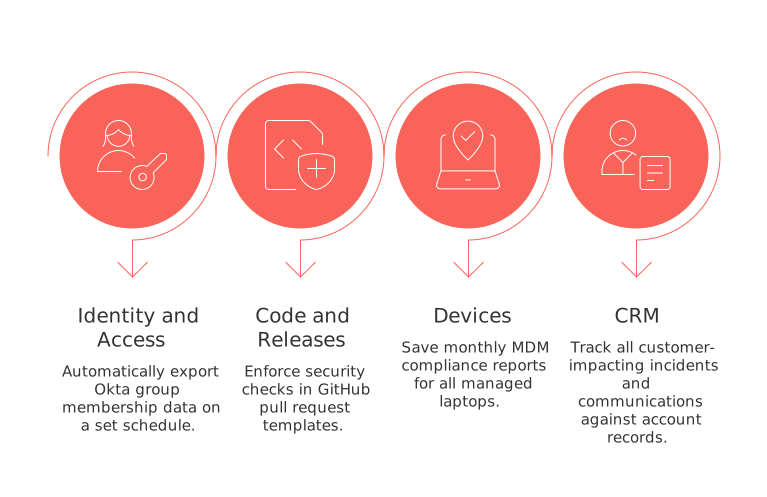
Identity and access: automatically export Okta group membership data on a set schedule.
Code and releases: enforce security checks in GitHub pull request templates.
Devices: save monthly MDM compliance reports for all managed laptops.
CRM: track all customer-impacting incidents and communications against account records.
For proving device compliance, begin with a baseline MDM setup. Consult this startup MDM policy guide for 2026 to see what auditors will require.
Create a quarterly evidence plan for ISO 27001. List automated reports to collect from Okta, AWS, GitHub, MDM, and the CRM. For each, provide the exact report name, who runs it, and where the PDF or export will be stored.
Evidence hygiene tips that save review time
Name your files with the date, system, and control ID. Example: 2026-03-Okta-A.5.15.pdf.
Incorporate timestamps and query parameters in exported reports.
Store approvals directly in their source system, not in scattered email threads.
Where AI helps, and where humans must decide, in ISO 27001
AI quickly drafts and maps content to controls while summarizing logs and building checklists. This significantly reduces the time spent on these tasks.
Executives maintain the responsibility of defining the company’s tolerance to risk, accepting residual risks, and approving policies. These critical decisions remain fully in human hands.
Data protection tip: never share sensitive information or credentials with AI tools. Always use redacted or sanitized prompts, and keep all evidence stored within securely managed systems.
Tools to centralize ISMS documents, workflows, and CRM evidence
Select a central platform that integrates projects, knowledge, CRM data, and meeting records. Common options include Routine, as well as Notion or ClickUp. For task and development tracking, connect Jira or GitHub, and for customer records, integrate HubSpot or Salesforce. More specialized GRC platforms may be suitable as your company matures.
The objective is straightforward: consolidate policies, associated tasks, and linked evidence in one place. Doing so reduces time spent preparing for audits and allows for efficient management of document versions.
Draft a workspace structure for an ISO 27001 ISMS. Create spaces for Policies, Procedures, Risk Register, Statement of Applicability, and Evidence. For each, define permissions by role and the main views the team will use.
FAQ
How can startups avoid being overwhelmed by ISO 27001 documentation?
Startups should streamline their documentation, focusing on clear scope, a single system of record for evidence, and concise documents. Leveraging platforms like Routine can help centralize documents, reducing confusion and audit preparation time.
What is the most common mistake startups make with ISO 27001?
Startups often overcomplicate their ISMS, leading to excessive paperwork. They should focus on a clear scope and automate evidence collection to avoid unnecessary administrative burdens.
Is it necessary for startups to adopt every Annex A control?
No, startups should only adopt controls that align with their specific risks and business context. Unnecessary controls add complexity without benefiting security posture.
How frequently should ISO 27001 documents be reviewed?
While annual reviews are standard, areas posing higher risks should be reviewed quarterly. Staying proactive prevents compliance gaps and aligns with dynamic business changes.
Can startups achieve ISO 27001 certification before a Series A funding round?
Yes, many startups do achieve certification before Series A by keeping their ISMS scope narrow and automating evidence collection to streamline the process.
What types of evidence are acceptable for ISO 27001 compliance?
Acceptable evidence includes system exports, audit logs, and formal approvals. They should be reproducible and easily accessible to validate compliance efforts.
Which startup roles should focus on upskilling for ISO 27001?
Security leads, engineering managers, and those handling vendor relationships and CRM data should prioritize upskilling. These roles are crucial to maintaining and developing effective ISMS practices.
How can automation benefit ISO 27001 documentation for startups?
Automation reduces manual tasks, minimizes human error, and ensures consistent evidence collection. It is critical for startups aiming for efficient and practicable ISO 27001 compliance.

Julien Quintard
Founder & CEO at Routine03/10/2026
