How to Implement Scrumban in 2026 Using ChatGPT
Why Scrumban in 2026 bridges the planning-to-delivery gap
Sprints can slip. Tickets may stagnate. Handovers often stall. Scrumban unites structured cadence with continuous flow, leading to faster work completion. ChatGPT streamlines this process by drafting clear team policies, shaping tickets, and producing concise updates. Executives benefit from more reliable forecasts, without overhauling existing processes.
Understanding Scrumban: where Scrum’s cadence meets Kanban’s flow
Scrumban retains the short planning cycles of Scrum but adopts Kanban’s pull system for workflow management. Teams make their work-in-progress (WIP) visible and set explicit operating rules. Tasks move continuously across the board, anchored by scheduled reviews and replenishment sessions.
Cadence: Regular cycles for replenishment, demos, and retrospectives.
Flow: Pull new work only when capacity allows, rather than scheduling by date.
Explicit policies: Transparent, shared rules guiding quality and handovers.
WIP limits: Constrain the number of active tasks, helping finish more, faster.
Designing a Scrumban board tailored to your value stream
Begin by mapping the genuine steps from initial request to delivered value. Avoid unnecessary columns that do not signify meaningful changes. The different stages in your work process should be discernable and able to be tracked effectively. Instead of assigning swimlanes (individual pathways of tasks within a project's Kanban board) to team members, organize them by different classes of service to streamline workflow.
Sample columns for product, ops, and revenue teams
Product/Engineering: Ready → In Progress → Review/Test → Ready to Release → Released
Operations: Intake → Triage → Doing → Peer Check → Completed
CRM/Revenue: Qualified → Discovery → Proposal → Negotiation → Closed
Include a narrow Expedite lane for handling urgent, high-impact work, but restrict its use strictly.
Clarifying Scrumban policies, WIP limits, and classes of service
Clear policies eliminate guesswork. Write rules in concise, testable sentences. Base WIP limits on actual team capacity, not optimistic forecasts. Start with modest limits and review them weekly.
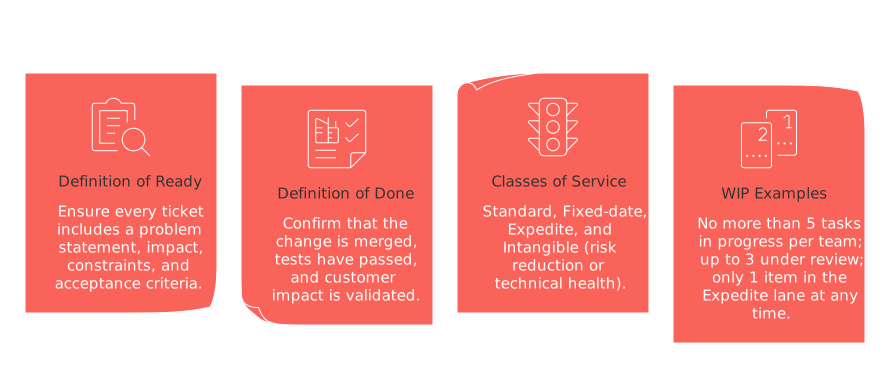
Definition of Ready: Ensure every ticket includes a problem statement, impact, constraints, and acceptance criteria.
Definition of Done: Confirm that the change is merged, tests have passed, and customer impact is validated.
Classes of service: Standard, Fixed-date, Expedite, and Intangible (risk reduction or technical health).
WIP examples: No more than 5 tasks in progress per team; up to 3 under review; only 1 item in the Expedite lane at any time.
We only pull new work if WIP is below the limit. Expedite can preempt just one item at a time, and every expedite gets a root cause review.
How ChatGPT enhances backlog refinement and ticket shaping in Scrumban
ChatGPT transforms vague requests into clear, manageable items. It can suggest acceptance criteria, highlight risks or edge cases, and recommend smaller task splits that fit your WIP limits. Always keep a human in the loop for final review and estimation.
Break down large workstreams into vertical slices that deliver user value.
Phrase objectives in business terms to ensure clarity across teams.
Identify missing information, dependencies, or compliance issues.
Standardize labels and taxonomy for easier tracking and reporting.
Running Scrumban ceremonies and meetings efficiently with AI
Reduce meeting time and boost productivity. ChatGPT can generate pre-meeting readouts from your boards and CRM fields, and summarize meeting outcomes automatically. Reserve live sessions for critical decisions, not status reporting.
Daily flow check: Focus on blockers and aging cards, not every individual task.
Replenishment: Pull the highest-value items into the Ready state.
Review: Showcase outcomes and lessons learned, skipping unnecessary presentations.
Retrospective: Center discussion on a single major bottleneck with clearly assigned action owners.
For workshop formats and time-saving templates, see these templates for meetings and recaps. Customize only what fits your team’s needs.
Visualizing Scrumban progress and aligning dependencies across teams
Use Kanban boards to track progress and flow, while maintaining high-level roadmaps to communicate intent. Supplement with trackers for cross-team dependencies and risks. Keep views simple, timely, and focused on decision-making.
To compare tracking options, this guide details when to choose Gantt charts versus agile-friendly project trackers. Always favor the simplest tool that answers stakeholders' questions.
Measuring cycle time, throughput, and work aging with streamlined metrics
Focus on three key metrics: cycle time (how long each item takes to complete), throughput (number of items finished weekly), and work aging (elapsed time since an item started). Establish service level expectations, such as expecting 85% of tasks to be completed within an 8-day timeframe.
Monitor aging items closely, they are the biggest threat to meeting service level expectations (SLE).
Review cumulative flow diagrams to spot where queues might be growing.
Let ChatGPT summarize trends and recommend incremental experiments. Change only one variable at a time, then measure impact.
Expanding Scrumban into CRM, marketing, and customer success by 2026
Scrumban works for revenue teams too. Limit the number of live deals per rep, protect time for customer discovery, and standardize policies for Fixed-date proposals. Track cycle time from qualification to close. You can utilize AI like ChatGPT to automate routine tasks such as generating discovery questions, proposal outlines, and follow-up checklists aligned with the specific stage of the deal.
Customer success teams can use Scrumban to manage renewals as a continuous flow. Alerts for aging tickets trigger proactive outreach, giving executives earlier signals about potential churn.
Scaling Scrumban: clear roles and lightweight governance
Assign clear responsibilities for setting policies, evolving process, and owning delivery outcomes. Make governance visible on a single, accessible page. Executives should focus on inspecting results, not micromanaging tasks.
Policy owners: Adjust WIP limits and classes of service as needed.
Flow coaches: Lead process experiments and share best practices.
Service owners: Ensure all completed work aligns with customer expectations.
Escalation rule: Expedite actions require approval and a post-mortem review.
Common pitfalls in Scrumban adoption, and how to avoid them
Excessive columns: Merge unnecessary states that don’t prompt decisions.
Disregarded WIP limits: Enforce tighter limits and stick to the pull policy.
Endless status meetings: Replace with focused board reviews and quick decisions.
Tracking vanity metrics: Concentrate only on cycle time, throughput, and work aging.
Obscured dependencies: Mark upstream and downstream links directly on cards.
A 90-day rollout roadmap for Scrumban with ChatGPT in 2026
Weeks 1–3: Map your value stream, draft initial policies, and set WIP limits. Launch a single board for one team.
Weeks 4–6: Conduct daily flow checks and weekly replenishment. Use ChatGPT to refine tickets and adjust policies.
Weeks 7–9: Start tracking cycle time, monitor aging work, and test the expedite lane with strict rules.
Weeks 10–12: Expand to a second team. Build cross-team dashboards for dependencies and publish your one-page governance model.
For further background, consult the official Kanban Guide for Scrum Teams. Keep practices simple. Continuously inspect, learn, and adapt using your data.
FAQ
What makes Scrumban superior to traditional Scrum or Kanban alone?
Scrumban excels by merging Scrum's regular planning with Kanban's flow efficiency, minimizing stagnation and bottlenecks. This hybrid model allows teams to adapt and scale without overhauling processes, ensuring quicker delivery without sacrificing quality.
How does Scrumban address work-in-progress (WIP) management?
Scrumban enforces strict WIP limits that reflect actual team capacity, reducing multitasking and speeding up completion. Ignoring these limits can dilute focus and delay delivery, challenging productivity assumptions.
In what ways can ChatGPT enhance Scrumban workflows?
ChatGPT refines vague tasks into actionable items and suggests criteria and risks, enhancing alignment and communication. Yet, blindly trusting AI can overlook nuanced team dynamics—always keep human oversight in final decisions.
Why incorporate an Expedite lane in Scrumban?
An Expedite lane handles critical tasks but must remain restricted to prevent systemic chaos. Misusing it can erode process consistency, disrupting overall workflow discipline.
What are common pitfalls when adopting Scrumban?
Avoid excessive workflow complexity and neglected WIP limits, which can stagnate progress and lead to endless status meetings. Prioritize actionable insights over vanity metrics for genuine improvement.
How does Routine fit into a Scrumban framework?
Routine enhances Scrumban with AI-driven insights and tools, optimizing workflows and coordination. Still, reliance on technology should not replace the need for adaptable human strategies and clear governance.

Julien Quintard
Founder & CEO at Routine03/19/2026
