How to Deduplicate Your CRM With AI Matching, Fuzzy Logic, and Merge Rules
Why CRM duplicates happen across modern B2B stacks
Duplicates rarely have a single origin. They appear when marketing forms, sales imports, partner handoffs, and product signups each use their own definition of “customer.” Team members map fields inconsistently. Systems sync bi-directionally. Naming conventions evolve. Data naturally decays.
The result: split customer histories due to inconsistent data entries, missed renewals when multiple records sow confusion, duplicate outreach as identical customers are contacted more than once, and skewed segmentation because duplicate records inflate numbers. Executives see artificially inflated pipelines since duplicate records increase apparent customer counts. Finance chases inaccurate ARR figures when projections are calculated on duplicated customers. Support teams process repeated tickets for the same company, as separate records generate multiple tickets for the same issue.
Duplicates aren’t just a nuisance, they are hidden operating costs.
What a golden customer record means for executives and ops teams
A golden record is the unique, unified profile for a customer account or contact, accepted by all departments. This record consolidates every data point, identity, historical interaction, and preference, collected from multiple tools and sources into a single profile. It always maintains a stable canonical ID that downstream systems and tables can consistently reference as the “truth” for that customer.
Executives benefit from accurate forecasts and trustworthy segment performance.
RevOps enjoys simplified lead routing, more logical territory management, and faster reporting.
Marketing can target precise audiences and eliminate over-sending to the same contact.
Customer Success sees full health signals and renewal risks for each customer, all in one place.
Build a data contract that prevents duplicates at the source
Prevent duplicates from entering your CRM by establishing a cross-team “data contract” that formally defines the identity keys, data formats, and authorized data sources. This contract should be brief, widely visible, and regularly reviewed.
Minimum identity keys to define
Contact identity: use business email as a primary key; normalize phone numbers to E.164 standard; use controlled lists for role and department.
Account identity: verify website domain; use the registered legal name; specify country; denote billing entity separately from brand, if applicable.
Relationships: define parent–child account relationships; link contacts to accounts; assign product instance IDs.
Source controls to deploy
Block personal email domains on B2B forms except when explicitly required.
Use domain capture to automatically associate new contacts with existing accounts.
Throttle bulk imports, requiring mapped field reviews and sandbox tests.
Enforce picklists for industry and employee count bands to minimize input drift.
For practical steps on consolidating customer data across inbox and support tools without code, see this detailed guide to merging data from Intercom, Front, and email.
Establish deterministic and fuzzy matching hierarchy for CRM deduplication
Apply a layered approach: run strict, deterministic (exact) matching first, then apply fuzzy (probabilistic) logic to the remaining records. This hierarchy reduces false matches and accelerates the deduplication review process.
Deterministic (exact) rules
Contacts: exact or hashed email matches; exact external IDs.
Accounts: exact website domain match; use tax or registration IDs if available.
Phones: require normalized E.164 exact matches.
Fuzzy (probabilistic) signals
Company names compared using suffix stripping (e.g., Inc, LLC) and punctuation normalization.
Physical addresses checked for proximity within a defined radius plus street normalization.
Website homograph and redirect checks to ensure variations like www and non-www are treated the same.
Contact names evaluated with nickname dictionaries and tolerance for transpositions.
Weight these matching criteria according to your business model: enterprise teams may value domain and address more highly, while product-led teams may prioritize email and signup information.
Configure AI matching that respects business context across your accounts and contacts
AI can uncover connections that traditional rules miss, such as synonym company names, merged brands, or records in different languages. However, it should be grounded in your business definitions and risk tolerance.
Feed sector-specific dictionaries, including known brand-to-legal mappings, prior acquisitions, and local language scripts.
Weight matching signals differently by segment (e.g., partner vs customer or reseller vs end user).
Set a “review queue” threshold where AI suggestions are sent for manual confirmation.
Store and display the reasons for every AI-driven match, highlighting the match features behind each decision.
Let AI recommend merges, but let your governance process make the final decision. Keep human review in place for high-impact merges and emerging duplication patterns.
Design merge rules that preserve revenue-critical fields without losing history
Merging records is not about one record “winning.” Instead, use selective survivorship, choosing which values to keep from each record, while maintaining a full audit trail. Define your rules by object type and field sensitivity.
Field-level survivorship patterns
Keep the most recent value for titles, phone numbers, and meeting owners.
Retain the most complete mailing address, with the most data-filled components.
Preserve key fields such as Do Not Contact, consent flags, and opt-outs without fail.
Union lists like product SKUs, user seats, or tags to combine them without duplication.
Allow certain fields (e.g., billing entities) to be sourced from higher-priority systems like finance instead of CRM.
After merging, re-link all related records, opportunities, subscriptions, support tickets, and product events, to the surviving customer profile. Maintain the external IDs from the non-surviving record as aliases for future integrations.
Govern audit, compliance, and rollback for CRM merge operations in 2026
Data regulations are tightening. In the U.S., state-level privacy laws now accompany GDPR. Starting March 3, 2026, you must maintain clear audit logs to meet access, correction, and deletion requests.
Store pre-merge snapshots and provide a reversible mapping from old IDs to new survivor IDs.
Document who approved each merge, as well as the business or AI rationale for the decision.
Propagate opt-outs and consent changes to all integrated child systems immediately.
Set a rollback window of 30–90 days for high-priority or sensitive merges.
A 30-day rollout plan to deduplicate a CRM safely
Week 1: Assess and model
Analyze and profile duplicates by object type, business segment, and source system.
Reach agreement on identity keys and survivorship rules with Sales, Marketing, and Success teams.
Week 2: Prototype and test
Execute deterministic matching runs in a sandbox environment.
Pilot AI-based matching on a sample of 5,000 records, followed by human review.
Week 3: Harden and train
Publish the finalized data contract and clear escalation paths for unresolved cases.
Train record owners how to review suggested merges and how to recognize and handle edge cases that don’t fit normal rules, such as tricky brand mergers or records with conflicting identity information.
Week 4: Deploy and monitor
Implement rolling merges during low-traffic periods.
Track metrics daily: match precision, volume of merges completed, and rate of rollbacks.
Pair these actions with high-impact sales automations. Find recommended workflows in automation playbooks for B2B sales teams that help prevent future duplicates and missed handoffs.
How to measure ROI and data quality after deduplication
Build a concise scorecard, and review it continuously as part of your operating rhythm.
Track duplicate rate by object and business segment.
Measure lead-to-opportunity conversion speed and improvements post-deduplication.
Assess marketing email volume against engagement rates after merging.
Monitor consolidation of support tickets and first-response improvements.
Observe the delta in forecast accuracy and reduction in opportunity reassignments.
Translate these results into concrete business value, such as hours saved and revenue protected. Finance teams will care most about ARR regained, not the number of duplicates found and merged.
Tooling choices for AI matching and merge management in 2026
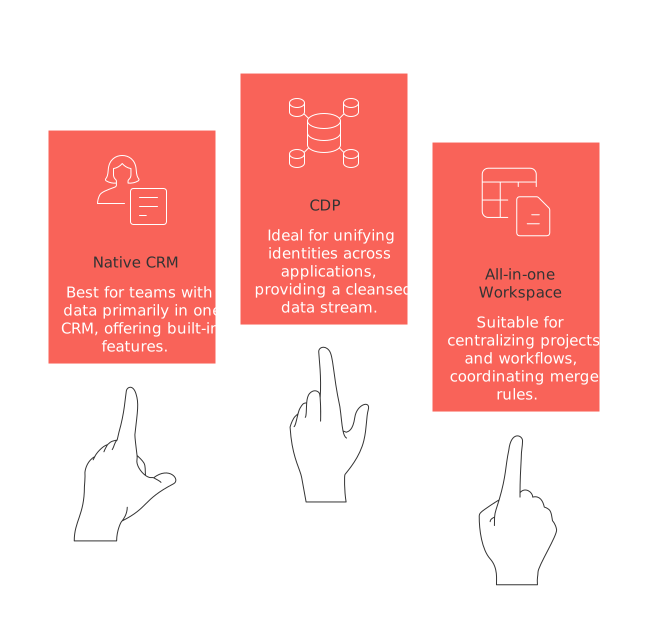
The way you implement deduplication depends heavily on your stack. Native CRM features from platforms like Salesforce or HubSpot, customer data platforms like Segment or mParticle, and all-in-one workspaces such as Routine or Notion, each offer different approaches for AI-powered matching and merge management. Choose based on where your data lives, the complexity of your workflows, and your team’s technical skills.
Native CRM: Salesforce and HubSpot offer built-in duplicate rules, matching engines, and merge flows. These options suit teams whose data primarily resides in one CRM.
Customer Data Platform (CDP): Segment or mParticle can unify identities across applications and deliver a cleansed stream to your CRM.
All-in-one workspace: Platforms like Routine or Notion can centralize projects, CRM data, and meeting workflows, helping coordinate merge rules across departments. Always validate the configuration against your organization’s review processes.
As your go-to-market systems multiply beyond your team’s capacity, centralizing data and workflows becomes essential. Once CRM data is clean, use pragmatic project views and trackers for ongoing management and visualization.
Common pitfalls and how to avoid them when merging records
Scheduling merges during busy sales periods. Always merge in off-hours and temporarily pause lead routing.
Allowing AI to auto-merge high-value accounts. Always require human review for merges above a specific priority or similarity score.
Forgetting to reparent child records. Ensure that activities, subscriptions, and entitlements are all reassigned before deleting duplicate profiles.
Neglecting opt-outs. Protect consent status and ensure it is reflected across all systems before finalizing merges.
Overlooking integrations. Update connected platforms with new and alias IDs after every merge operation.
Read this step-by-step walkthrough for merging customer data from support and email systems without engineers. It’s designed to complement the merge strategies discussed here.
Final thought: Clean data isn’t a one-time project, but a continual practice. Start with a focused scope, carefully document your processes, and refine your deterministic, fuzzy, and AI-powered rules to reflect the way your business actually transacts and serves customers.
FAQ
How does duplicate data impact CRM efficiency?
Duplicate data can create inflated metrics, unreliable forecasts, and chaotic workflows, leading to missed opportunities and increased costs. It disrupts clear communication across departments, making it an invisible drain on resources.
What is a 'golden customer record' and why is it important?
A golden customer record is a single, unified profile recognized across departments. By consolidating all interactions and data points, it ensures consistent, accurate information, enhancing decision-making and operational efficiency.
Why should teams use a 'data contract' for their CRM?
Implementing a data contract aligns all departments on data standards and sources, reducing discrepancies that lead to duplicates. It's a proactive measure to ensure data integrity and eliminate operational hiccups from day one.
What role does AI play in CRM deduplication?
AI can detect subtle patterns and connections overlooked by traditional methods, but it must align with business definitions and risk levels. AI recommendations should be vetted by trusted governance processes to prevent high-stakes errors.
How can businesses ensure data integrity post-deduplication?
Continuous monitoring and robust auditing processes are critical. Maintain clear logs for every merge activity and employ tools like Routine to centralize and streamline ongoing data management procedures.
Why is human review necessary in the deduplication process?
AI and automated systems can pre-screen and propose merges, but human oversight is crucial for validating matches, especially in complex cases. Human judgment prevents costly missteps in high-value account handling.
How can Routine help in CRM deduplication efforts?
Routine centralizes data management, offering collaborative tools that ensure uniform practices across sales, marketing, and support functions. Its integration capabilities align departmental procedures, minimizing the risk of duplication.

Julien Quintard
Founder & CEO at Routine03/06/2026
