CSAT vs NPS vs CES in B2B SaaS: When Each Signal Matters
Why CSAT, NPS, and CES measure different customer truths in B2B SaaS
No single metric captures the complete customer narrative. CSAT, NPS, and CES each illuminate a particular aspect: satisfaction with a specific task, willingness to advocate for your brand, and the perceived effort required to derive value. When viewed together, these metrics provide a comprehensive view of sentiment, loyalty, and friction.
Buying committees add layers to B2B SaaS signals. Day-to-day users experience the product. Executives focus on ROI and risk. Procurement teams prioritize price and compliance. As a result, the same account might report high CSAT, neutral NPS, and fluctuating CES scores, each reflecting a different perspective that is accurate in its own context.
What CSAT means in B2B SaaS and how to use CSAT correctly
CSAT gauges satisfaction with a recent interaction. It’s useful to send surveys after support closures, feature launches, or training sessions. When formulating the questions, keep them short, neutral, and directly linked to the relevant event.
Trigger surveys after ticket resolution or onboarding milestones.
Use a 1–5 or 1–7 scale and include an open text field for comments.
Route any low scores to the account owner for immediate follow-up.
CSAT reveals customer feelings about the latest interaction, not the overall relationship.
Good for: assessing support quality, evaluating content usefulness, and determining feature readiness.
What NPS means in B2B SaaS and when NPS sends the right signal
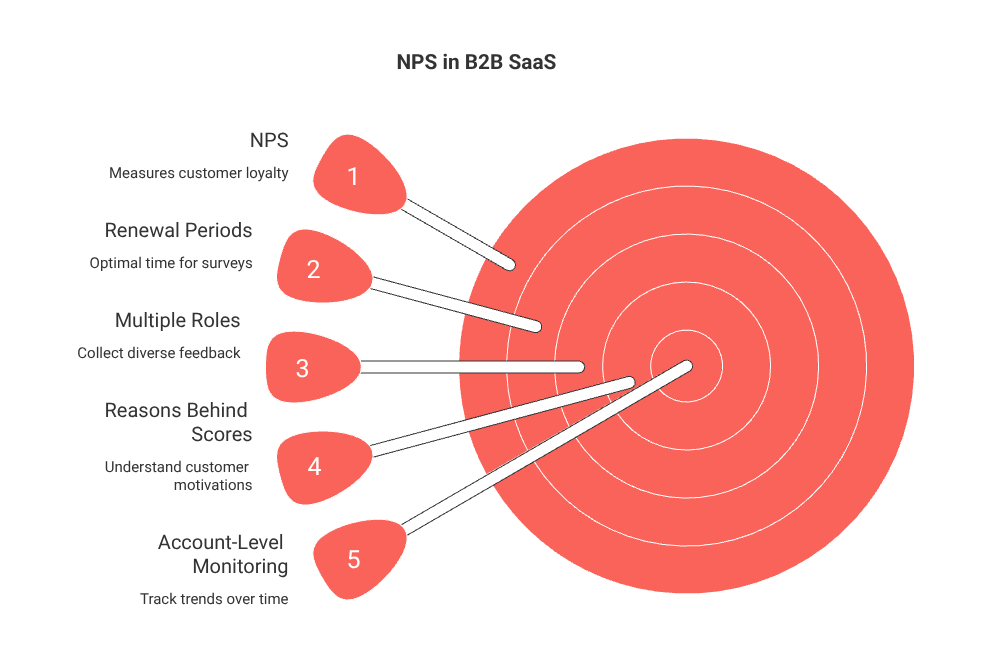
NPS measures the likelihood that someone would recommend your product, signaling the health of your relationship across multiple stakeholders. These surveys are best timed around renewal periods or executive business reviews, not merely after a single support ticket.
Survey multiple roles within the account, administrators, champions, and executive sponsors.
Collect the reasons behind the scores. Tags on drivers are more telling than the score alone.
Monitor account-level NPS over periods or cohorts rather than reacting to isolated spikes.
Good for: identifying opportunities for expansion, recruiting references, and evaluating renewal risk.
What CES means in B2B SaaS and how CES predicts repeat usage
CES quantifies how much effort a customer feels is required to complete a task. In B2B SaaS, this predicts future adoption: today's high effort translates to potential churn tomorrow, even when users generally like your team.
Trigger CES surveys at onboarding steps, integrations, or during completion of essential workflows.
Combine CES insights with data on time-to-first-value and critical activation events.
Analyze results by persona, since administrators and end users will experience different types of friction.
Good for: improving onboarding process design, prioritizing UX enhancements, and identifying gaps in documentation.
How to map CSAT, NPS, and CES to the B2B customer lifecycle
Onboarding (weeks 1–6)
Use CES surveys to assess set-up tasks and initial workflows. Follow up with CSAT after onboarding or training sessions. Hold off on NPS until the customer has realized some value.
Adoption (months 2–6)
Continue using CES for frequent jobs-to-be-done. Send CSAT surveys after support engagements and new releases. Begin sending quarterly NPS surveys to champions and sponsors within the account.
Expansion and renewal (months 7–12)
Distribute NPS surveys to all relevant roles in the account about 90 days before renewal. Surround success reviews with CSAT surveys. Track CES on any new modules or features being introduced.
How to design fair surveys without bias or fatigue
Use neutral language. Avoid leading questions like, “How great was our support?”
Be strategic in sampling. Limit to one survey per user every 30 days to minimize fatigue.
Localize survey content where necessary and keep scales consistent across different languages.
Include a “not applicable” option to avoid forcing inaccurate responses.
Keep the survey concise, ideally, all questions visible on a single screen.
How to connect CSAT, NPS, and CES to revenue reporting in your CRM
Scores become more significant when tied to the sales pipeline and the Annual Recurring Revenue (ARR). Push each survey response into your CRM as a timeline event, tagging details such as feature, persona, and product area. Route low CSAT and high CES to actionable tasks with due dates. Link NPS results to reference eligibility and renewal forecasts.
Most teams map survey IDs to relevant accounts and contacts in their chosen Customer Relationship Management systems, such as Salesforce or HubSpot. Add fields for response date, driver tag, owner, and next action. Employ straightforward automation rules: a detractor triggers a task within two hours, a promoter leads to a reference invite, and rising CES prompts the creation of a UX ticket (ideally with a screen recording).
How to operationalize follow-ups from CSAT, NPS, and CES signals
Detractors (NPS 0–6): Respond quickly. Provide a clear recovery path. Set up a value review meeting.
Passives (NPS 7–8): Ask what changes would move their score to a 9. Share your feature or service roadmap with timeframes.
Promoters (NPS 9–10): Request reviews or case study participation. Consider inviting them to your customer council.
Low CSAT: Reopen the identified ticket and communicate a clear next step, including who will own the follow-up.
High CES: Document the friction points. Prioritize fixes likely to impact the most users.
Set Service Level Agreements (SLAs). Aim for same-day contact for detractors and those with low CSAT. Provide weekly summaries to executives with trends and actionable insights.
How to choose the right tool stack to centralize feedback data in B2B SaaS
Survey capture, identity resolution, and workflow routing are commonly preferred features for effectively managing customer feedback. Many teams choose an all-in-one workspace to reduce data silos. Review this comparison of all‑in‑one workspaces and dedicated project tools to help evaluate trade-offs when centralizing customer signals.
Platforms such as Routine and HubSpot facilitate the connection of survey data with tasks, documentation, and sales opportunities. Pair these with product analytics tools and your help desk to create a unified approach. If your customer data resides in multiple sources like Intercom, Front, and email, consult this guide to merging customer data from Intercom, Front, and email without code to ensure identity alignment for accurate score analysis.
Automation can further streamline your processes. Explore the “Top 5 Automations Every B2B Sales Team Should Set Up Today” for ideas on routing feedback and managing alerts throughout your stack.
How to visualize trends and outliers for executive decisions
Executives prefer to see changes with strong, meaningful outcomes over irrelevant or insignificant data. Visualize rolling 4‑week CSAT averages, cohort CES results by workflow, and NPS segmented by role. Overlay these trends with data on product releases and support volume. Highlight three main takeaways: what changed, why it happened, and what actions will follow.
FAQ
Why should B2B SaaS companies use CSAT, NPS, and CES together?
Using CSAT, NPS, and CES together provides a holistic view of customer engagement. Executives often neglect individual metrics as they offer limited insights; a combined approach captures satisfaction, loyalty, and potential areas of friction.
How can CSAT surveys be effectively deployed in a B2B SaaS context?
Deploy CSAT surveys after specific interactions, like support closure or launch events. The immediacy helps capture fresh customer sentiment, but overemphasizing it risks missing the bigger relationship picture.
What are common pitfalls when using NPS in B2B SaaS?
Sending NPS surveys too early or on isolated events can distort insights. It's crucial to aggregate data across stakeholders and timeframes, considering it a relationship measure, not just a single transaction metric.
How does CES influence future product adoption in B2B SaaS?
High CES scores can predict potential churn despite user satisfaction, as they highlight friction points. Ignoring CES signals can lead to overlooked UX flaws that sabotage user retention and product stickiness.
What’s a common mistake when integrating feedback data into CRM systems?
Failing to connect feedback data with actionable sales metrics turns insights into isolated facts. Rather than mere data entry, effective CRM integration requires Routine's automation and task routing for proactive sales strategies.
How do you prevent survey fatigue in feedback collection?
Survey fatigue is circumvented by strategic sampling and limiting frequency to prevent user disengagement. Over-surveying reflects a lack of respect for the customer's time, ultimately skewing and reducing response rates.
Why is it important to tailor surveys to different personas?
Different personas experience varied interactions with the product, making generic surveys misleading. Understanding these nuances can uncover unique challenges or opportunities, transforming feedback into meaningful strategy.
How does using Routine streamline feedback processing in B2B SaaS?
Routine centralizes diverse customer inputs, facilitating seamless action and integration across CRM and task management systems. This approach minimizes data silos and ensures feedback translates directly into strategic decisions.

Julien Quintard
Founder & CEO at Routine03/26/2026
