How to Build a Customer Health Score That Actually Predicts Churn
Define churn in your business model before designing a health score
Your customer health score should predict a clearly defined event, not just a general sentiment. Start by establishing what churn means for your business model.
Churn event: Is it the loss of a customer logo, a non-renewal, or a drop in revenue below a certain threshold?
Entity: Focus on the account level, unless your model serves individuals, in which case the user level is appropriate.
Window: Identify the “prediction horizon”, for example, 30, 60, or 90 days ahead.
Success counterweight: Consider positive outcomes like expansions or multi-year renewals to keep your model balanced and avoid unnecessary alarms.
Write these definitions down. Every decision you make later should trace back to these foundational points.
Select outcome-leading signals for a predictive customer health score
Choose signals that meaningfully explain customer behavior before renewal or churn decisions. Combine data from your product, service delivery, and CRM systems for a comprehensive view.
Product usage and value realization
Breadth: Percentage of seats active in the last 7 and 30 days.
Depth: Usage of core features tied directly to customer value moments.
Stickiness: The ratio of weekly active users to monthly active users.
Time to first value: How long it takes a user or account to complete their first workflow after kickoff.
Integration health: Status and data freshness of crucial integrations.
Project delivery and service signals
Delays in reaching onboarding milestones compared to the original plan.
Number of open support tickets and average time to resolution.
Escalations in the last 14 days.
CRM and relationship signals
Level of engagement with executive sponsors in the past 30 days.
Procurement or billing risk indicators.
The proportion of contracted seats utilized and any upcoming requests for seat reductions.
Customer success manager (CSM) sentiment, measured using a clear and consistent rubric.
If a signal never results in a meaningful action, remove it. Extra complexity slows teams down without adding value.
Balance leading and lagging indicators within the scoring model
Give greater weight to leading indicators, they help anticipate risk. Lagging indicators should confirm, not drive, the score.
Organize signals into groups: value use, delivery, and relationship.
Assign provisional weights to each group so the total adds up to 100.
Normalize each metric to a 0–100 scale, setting clear thresholds for each.
Calculate a weighted average to generate the overall account score.
Maintain transparency by displaying all calculations to relevant teams. Concealing formulas or processes can lead to mistrust.
Design a transparent scoring rubric executives trust
Executives need not just a health status but also a clear rationale. Start with a simple three-tier rubric:
Green (80–100): Strong usage of core features, active sponsor engagement, and no service delivery risks.
Yellow (60–79): Customer achieving value, but usage trends are weakening or there is a single warning signal.
Red (<60): Usage is declining, key milestones have stalled, or the sponsor is no longer engaged.
Document what causes an account to move between status tiers. Connect each move to a specific strategy or set of actions that your team can execute.
If the score cannot trigger a play within 24 hours, it is a vanity score.
Calibrate the customer health score against historical churn
Test your scoring model against the past 6–12 months. You’re aiming for clear separation between those who churned and those who remained, not perfect prediction.
Assess the percentage of churned accounts that were marked as Red within the 60 days prior to leaving.
Analyze false positives: accounts marked Red that actually renewed and expanded.
Compare the model’s results to a simple baseline, such as seat utilization alone.
Refine thresholds based on customer segment. Remember, enterprise customers and SMBs often have very different renewal rhythms.
Operationalize the health score inside CRM and project workflows
The real value of health scores comes from integrating them into your daily processes. Place scores wherever your teams work.
CRM: Display the health score on account, renewal, and opportunity records.
Playbooks: Link Red signals to clear, prescriptive actions with owners and deadlines.
Alerts: Set up notifications for account owners when a health driver changes state, rather than relying on scheduled updates.
Renewals: Require that any discount approvals are tied to a documented recovery strategy.
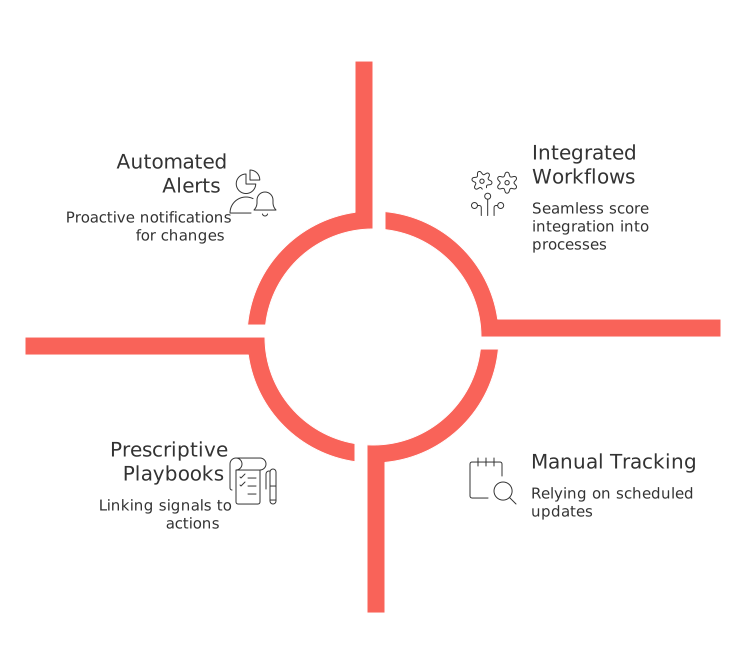
Automate repeatable actions where possible. For ideas, check out these five B2B sales automation strategies for timely, reliable follow-ups.
Regardless of whether you use Salesforce, HubSpot, platforms like Routine, or alternatives such as Gainsight or Totango, ensuring the health fields are consistently named across systems can be beneficial for consistency and can help to avoid lock‑in.
Instrument reliable data pipelines and entity resolution for accounts
Without clean account identities, your health scores lose predictive power. Aim to create a consistent account ID that works across all systems, product, support, and billing.
Standardize domains and legal names using clear determinative rules as your first step.
Link users to accounts by validated emails or through single sign-on (SSO) claims.
Backfill historical events to ensure a smoother transition and better continuity for existing customers.
For a practical walkthrough, follow this step-by-step guide to unify Intercom, Front, and email data without code before establishing your health scoring process.
Create segment-specific thresholds that reflect different customer journeys
Uniform thresholds can penalize healthy enterprise customers with longer adoption cycles, and over-reward smaller customers with noisier data.
Create separate categories based on pricing plan, annual contract value (ACV) band, and the depth of product deployment.
Set activation and adoption targets appropriate for each segment's typical journey.
Adjust the importance of different drivers for each segment; for example, integration health may matter more for enterprise customers.
Review and update segment definitions and thresholds every quarter to keep pace with product and customer evolution.
Explain the score with human-readable drivers and next steps
A single score is never enough. Always provide context, show which factors shifted and what actions should follow.
Driver summary: Highlight specifics, such as integration failed on 3/10, executive sponsor inactive, or usage depth down 22%.
Playbook: List clear recovery steps with assigned owners and target dates.
Context: Reference last renewal notes, active projects, and upcoming milestones to give full visibility.
Support the score with a concise narrative, people are more likely to act when data is embedded in a clear, actionable story.
Measure impact and prevent model drift over time
Evaluate your health score’s real business value, not just the dashboard metrics.
Track changes in churn rates for accounts receiving targeted interventions versus those that did not.
Measure the time it takes to recover accounts from Red status back to Yellow or Green.
Check coverage, what percentage of at-risk accounts have an active, documented recovery plan?
Monitor for model drift by reviewing the distribution of scores by segment each month.
When signals lose their predictive power, replace them quickly. Keep the overall scoring framework stable as much as possible.
Choose the right workspace to centralize scoring, insights, and plays
Relying on scattered tools makes customer success more difficult. Consider whether one workspace can centralize your health metrics, key drivers, and action plans.
For a structured comparison, see this analysis of all-in-one workspaces versus specialized project tools for operational teams. Centralizing these elements ensures your health score drives action, not just reporting.
FAQ
What defines a churn event in a business model?
A churn event could be the loss of a customer logo, non-renewal, or a revenue drop below a certain threshold. Defining it precisely is crucial, as this metric should drive your health score predictions.
Should customer health scores focus on accounts or individuals?
Focus on accounts unless your business model is geared towards individual users. Misalignment here could lead to ineffective predictions and wasted resources.
Why are both leading and lagging indicators important in a health score?
Leading indicators anticipate risk, giving you a proactive edge, while lagging indicators validate your insights. Neglect either, and you risk reactive firefighting rather than strategic interventions.
How should you use CRM and project workflows for customer health scores?
Integrate health scores into CRM and project workflows for actionable insights, not vanity metrics. Use platforms like Routine to centralize and automate actions based on health scores.
What is the risk of using uniform thresholds for all customer segments?
Uniform thresholds can misrepresent enterprise and SMB customer health due to differing adoption cycles and data noises. Segment-specific thresholds avoid these pitfalls, enabling nuanced, effective intervention strategies.
How can a company prevent model drift over time?
Constantly evaluate the predictive power of your signals and update them as necessary. Regularly review score distributions by segment to maintain relevance and effectiveness, ensuring they align with business objectives and market changes.

Julien Quintard
Founder & CEO at Routine03/20/2026
