BANT vs MEDDIC vs SPICED: Qualification Frameworks Compared With Field Examples
Sales qualification frameworks: The true driver of reliable revenue
A robust pipeline doesn’t always yield strong revenue. Gaps often emerge from fragile qualification steps. Adopting a framework unifies how marketing, sales, and customer success discuss deals. This leads to sharper forecasting for leadership and focused discovery for sales reps, while product and implementation teams experience fewer hiccups post-sale.
But which framework really fits your process? The best choice depends on your deal value, the number of decision makers, and how risky or complex your sales cycle is. Let’s break down BANT, MEDDIC, and SPICED, and illustrate each with actionable field examples.
BANT in action: Fast qualification with sample questions and warning signs
BANT, Budget, Authority, Need, and Timeline, shines in transactional or mid-market sales. SDRs often use it for rapid qualification, keeping their focus sharp. For AEs, it’s a springboard for conducting a deeper dive after initial outreach.
Example BANT questions for each element
Budget: What budget is currently set aside? What price range feels viable?
Authority: Who has final sign-off? Who else influences the buying decision?
Need: What’s at stake if this issue persists beyond this quarter?
Timeline: What event drives your decision? What if the deadline is missed?
First-call scenario: 30–60 day sales cycle
SDR: We see teams lose time to manual reporting near quarter-end. What’s at risk if nothing changes? Prospect: Operations burns two days a month on spreadsheets. SDR: Is there a budget to automate that away this quarter? Prospect: Ops has $25k. COO gives final approval. SDR: Anyone else involved before COO signs? Prospect: Finance checks contracts, IT reviews security. Goal is to wrap up by April 15.
Warning signs: Unclear approvers, no concrete budget, or a “maybe this year” timeline. If you spot these, escalate your questions to MEDDIC depth or disqualify early.
How MEDDIC helps you win complex sales
MEDDIC brings discipline to multi-stakeholder, enterprise deals. Its components, Metrics, Economic Buyer, Decision Criteria, Decision Process, Identify Pain, and Champion, help you navigate long cycles and complicated procurement. Some companies use “MEDDICC” to also cover Competition. Choose MEDDIC for lengthy, procurement-heavy deals where compliance is involved.
MEDDIC prompts that move deals forward
Metrics: How will you measure success? What’s the before-and-after impact?
Economic Buyer: Who controls the budget and business case?
Decision Criteria: Which technical and commercial points are non-negotiable?
Decision Process: Can you map all the necessary approvals, from InfoSec to legal?
Identify Pain: How does the problem create financial risk or loss?
Champion: Who inside the company benefits most from this project’s success?
Enterprise opportunity example: 6–9 month process with procurement
AE: You aim to reduce churn by two points. What does that protect in revenue? VP CS: Roughly $3.6M annually. AE: If we achieve that, who can greenlight the funding? VP CS: CFO is the decision maker, with procurement managing the process. AE: What requirements will InfoSec and finance focus on? VP CS: SOC 2, residency, three-year TCO, and ROI within 12 months. AE: Who will champion this internally with the CFO? VP CS: COO is pushing to show progress by September’s board meeting.
Result: You capture measurable impact, a clear buyer, sponsor, and step-by-step approval.MEDDIC lets you identify information gaps, building stronger coaching and forecasting.
SPICED: Consultative selling anchored in customer pain and impact
SPICED starts with the customer’s current story. Covering Situation, Pain, Impact, Critical Event, and Decision, SPICED is best for consultative teams or when selling transformation, not just technology.
SPICED discovery: Practically applying each step
Situation: What’s their present process, stack, or team configuration?
Pain: What is stopping them from hitting goals now?
Impact: What gains or losses can they expect from this investment?
Critical Event: When does action become a mandate?
Decision: Who decides, how, and what evidence do they need?
Consultative mid-market deal
AE: What happens if reps miss their account plans? Head of Sales: Pipeline commitments fluctuate up to 20% weekly. AE: How would predictable commits help you? Head of Sales: I’d present more confidently at the Q2 board review. AE: What event nails down your timeline? Head of Sales: The Q2 operating review, June 10. AE: Who makes the final call? Head of Sales: CRO signs after RevOps validates our data.
How to select BANT, MEDDIC, or SPICED by sales complexity and timeline
Match your qualification rigor to both risk and stakeholder count. Here’s a simple guide:
Simple, fast deals: BANT for quick filter and time savings.
Complex, multi-stakeholder cycles: MEDDIC for full-process mapping.
Consultative, change-heavy cycles: SPICED to highlight value early.
Hybrid: Use BANT as a first screen, then deepen with SPICED or MEDDIC for qualified deals.
Tip: SPICED and MEDDIC often work well together, SPICED for early discovery, MEDDIC for navigating approvals.
Side-by-side SaaS field comparison: BANT vs MEDDIC vs SPICED
Scenario:$60k SaaS deal with IT, RevOps, and Finance involved. ERP integration required by September 30.
BANT in this scenario
Budget: $80k set aside by RevOps.
Authority: CRO signs, CFO co-approves.
Need: Commit accuracy, ERP integration.
Timeline: Contract signed by July 15 for onboarding.
MEDDIC for the same deal
Metrics: Move forecast accuracy from 60% to 85% by Q4.
Economic Buyer: CFO holds budget.
Decision Criteria: SOC 2, ERP connector, three-year TCO, sub-12-month ROI.
Decision Process: Steps, security, legal, finance, CFO, procurement PO.
Identify Pain: Unpredictable commits risk cash management.
Champion: VP RevOps wants stability.
SPICED view
Situation: Using Salesforce, NetSuite ERP, six-person RevOps team.
Pain: Duplicated data, manual aggregation.
Impact: Saves 40+ hours/month, prevents revenue disruptions.
Critical Event: Board review set for September 25.
Decision: CRO approves after a four-week pilot.
Key lesson: BANT ensures minimum viability, SPICED clarifies urgency and value, and MEDDIC secures organizational buy-in and process clarity.
Embedding qualification into CRM and sales-to-delivery workflows
Frameworks falter without operational support. Make your fields, sales stages, and handoff processes crystal clear. Tie your CRM, knowledge base, and delivery handover together, minimizing the risk of critical insights getting lost post-signature.
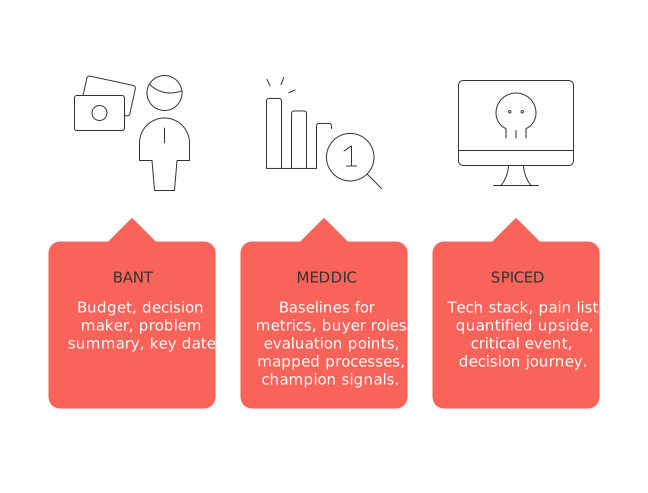
CRM field essentials for each framework
BANT: Budget, decision maker, problem summary, key date.
MEDDIC: Baselines for metrics, buyer roles, evaluation points, mapped processes, champion signals.
SPICED: Tech stack, pain list, quantified upside, critical event, decision journey.
Workflow strategies to connect sales and delivery
Turn CRM fields into actionable tasks (e.g., “Schedule CFO discussion” after identifying buyer).
Link discovery notes to the project record upon closing a deal.
Deliver a concise summary for customer success and solutions teams.
Automate notifications and key handoffs. For more practical automation tips, see this B2B sales automation guide. And for keeping your customer data unified, leverage advice on how to merge data from various tools seamlessly. As you scale, reassess whether a consolidated workspace or specialized apps suit your process and governance best.
On tools: Some teams manage everything in unified workspaces like Routine or ClickUp, while others use a CRM/project management combo. Pick what fits your operational discipline.
Tracking metrics for qualification success by Q2 2026
Monitor leading indicators for qualification rigor, strong revenue follows from tight early signals.
Stage acceptance rate: Percentage of SDR-qualified meetings accepted by AEs.
Early exit rate: Disqualifications within the first week.
MEDDIC completeness: All essential fields filled before proposal stage.
SPICED quantified impact: Proportion of opportunities with a defined dollar impact.
Cycle time by defined criteria: Days from initial discovery to proposal when decision criteria are clearly stated.
Forecast accuracy at 30 days: Deals closed within 10% of the committed forecast.
Segment your results by ICP, channel, and sales rep tenure. Share dashboards monthly with executive leadership, alignment drives better decisions.
Common mistakes when deploying qualification frameworks cross-functionally
Going through the motions: Reps fill out CRM fields without lived conversations. Coach using real call recordings.
Single-threading deals: Only one contact per account is engaged. Require engagement with at least two stakeholders before proposals.
Slippery dates: Vague timing like “next month.” Tie to hard deadlines and consequences.
No champion verification: Real champions arrange internal meetings. Test their influence directly.
Lost context after close: Discovery insights don’t reach implementation. Standardize a one-page handover on won deals.
FAQ
What is the primary advantage of using a sales qualification framework?
A sales qualification framework ensures consistent evaluation across teams, leading to better forecasting and a streamlined process. It minimizes post-sale issues by aligning expectations across sales, marketing, and customer success from the get-go.
How does BANT differ from MEDDIC and SPICED?
BANT is ideal for quickly qualifying straightforward deals, focusing on budget, authority, need, and timeline. In contrast, MEDDIC suits complex sales by mapping detailed processes, while SPICED excels in pinpointing customer pain points within consultative selling cycles.
When should a business use the SPICED framework?
The SPICED framework is perfect for consultative sales where understanding the client's situation and the impact of solutions is crucial. It helps to identify critical events and decision processes in environments requiring transformational change rather than quick tech solutions.
How can Routine help in sales qualification?
Routine provides unified workspaces to embed qualification frameworks seamlessly into workflows. By integrating CRM, project management, and knowledge bases, it ensures no crucial insights are lost, supporting effective collaboration and execution post-sale.
Why is it risky to rely on single-threaded deals?
Single-threaded deals engage only one contact, risking loss of momentum if that person exits the process. Engaging multiple stakeholders early diversifies input and strengthens internal buy-in, reducing the risk of deal failure due to delays or decision-maker changes.
What common pitfalls should be avoided when implementing these frameworks?
Common pitfalls include superficial CRM updates, vague deadlines, and failing to verify champions. These can result in pipeline inaccuracies and lost deals; combat these by ensuring thorough documentation and stakeholder validation throughout the sales cycle.
How should sales teams adjust to ensure framework success?
Teams should embed frameworks into routine conversations, ensuring CRM data reflects genuine insights rather than box-ticking exercises. Continuous training and cross-department collaboration are critical to adaptively refining processes and maximizing the frameworks' benefits.
What metrics should be tracked to evaluate qualification success?
Key metrics include stage acceptance rate, early exit rate, and forecast accuracy. Monitoring these metrics provides insights into the effectiveness of your qualification process, allowing for data-driven optimization and ensuring tighter alignment with revenue goals.
Why is it essential to tie discovery insights to post-sale processes?
Failure to do so can lead to misaligned expectations and resource wastage post-sale. Embedding these insights into handoff processes ensures alignment and continuity between sales, implementation, and customer success, reducing friction and enhancing customer satisfaction.

Julien Quintard
Founder & CEO at Routine03/16/2026
