Automating Earned Value Management With AI for CPI and SPI You Can Trust
Why automating earned value management matters for finance and delivery alignment
Executives want a single source of truth, while project teams are eager for less administrative overhead. Automated EVM offers both: it standardizes how progress translates into numbers, consistently pushing accurate data wherever decisions are made.
Finance teams can close faster as actuals automatically map to control accounts, reducing manual effort.
Project Management Offices (PMOs) can compare programs without the need to sift through complex and layered spreadsheets.
Executives have access to CPI and SPI in clear context, eliminating guesswork from performance reviews.
If it isn’t in the baseline, it isn’t real progress.
Defining the EVM data model your AI can reliably ingest
Start with a clean and consistent data structure, AI relies on this consistency for effective operation. It’s essential to make these structural decisions early in the process to ensure automation can work seamlessly.
Work breakdown structure: Name control accounts and work packages consistently across programs.
Measurement methods: Choose standardized progress measurement (0/100, 50/50, fixed milestones, or percent complete by deliverable).
Baselines: Capture planned value at the lowest controllable level and freeze it for reference.
Cost structure: Define how you’ll treat labor, materials, subcontracting, and overhead.
Change authority: Specify who is authorized to revise baselines and document all approvals.
Be precise with unit definitions. Decide in advance how to handle rework, learning curves, and multi-currency projects before automation takes over data flows.
Capturing planned value, earned value, and actual cost from existing systems
Automate data collection inputs rather than focusing solely on automating calculations. Map each data source to your EVM model and schedule regular, consistent extracts for reliability.
Planned value (PV): Pull directly from your project management tool, ensuring all relevant task IDs, planned dates, and budgets are included.
Earned value (EV): Calculate from defined status rules and acceptance events rather than relying on subjective reporting.
Actual cost (AC): Extract actual costs from ERP systems and timesheets, reconciling to control accounts daily or weekly.
Thoroughly document every data mapping. Store all transformation logic in version control to simplify audit trails and reviews.
Calculating CPI and SPI with governance you can audit
Trust in your EVM results is built on repeatable and transparent steps. Create a controlled calculation pipeline with clear checks and balances, avoiding shortcuts.
Essential controls for CPI and SPI you can stand behind
Implement freeze windows: no retrospective edits after period close unless supported by an approved change record.
Use automated outlier checks to flag sudden, unexplained changes in EV or negative AC values.
Maintain data lineage: provide visibility into each CPI/SPI value’s origin and status approval.
Enforce role-based access controls to restrict changes to methods, baselines, or rates.
Publish the calculation log with every dashboard refresh to ensure transparency and build trust in the data.
Forecasting outcomes and EAC with explainable models executives accept
Forecasts should be clear and easily interpretable. Combine standard EVM formulas with machine learning methods that offer transparency in how results are derived.
Trend-based projections rely on recent CPI and SPI trajectories for realistic expectations.
Run scenario tests for evaluating effects of staffing changes, procurement delays, or scope expansions.
Highlight feature importance so stakeholders understand the primary drivers of forecast changes in plain language.
Keep it simple and show the baseline-to-forecast gap on one chart to provide a quick, at-a-glance view of project progress and forecasting accuracy. Supplement the chart with written rationale to focus approvals on critical decisions, not just minor discrepancies.
Detecting anomalies and gaming in reported progress before it spreads
CPI and SPI can drift unnoticed until major surprises occur at quarter-end. Detect subtle problems early with targeted, automated tests.
End-of-month “cliffs” in EV may indicate rushed acceptance or sandbagging.
Flat EV with rising AC often signals hidden rework.
Repeated 50% EV on milestones suggests possible misuse of measurement methods.
Supplier variance reports that never change may be masking real project issues.
When anomalies are found, escalate with full context: detail affected control accounts, suggest root causes, and identify a recommended owner for resolution.
Designing dashboards for executives, PMOs, and finance that drive action
No single dashboard fits every role. Provide tailored views for each stakeholder group while keeping underlying definitions consistent.
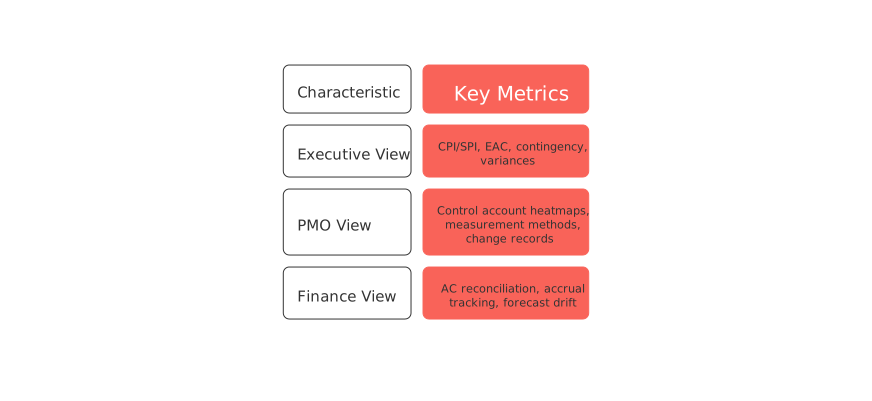
Executive view: Portfolio-level CPI/SPI, risk-adjusted EAC, contingency usage, and top five variances.
PMO view: Control account heatmaps, tracking of measurement methods, and audit-ready change records.
Finance view: AC reconciliation status, accrual tracking, and analysis of forecast-to-actual drift.
Combine trend lines with organized structure. For additional schedule context, explore these project timeline visualization tools to help stakeholders quickly interpret progress.
Integrating EVM automation into your project lifecycle and governance
Integrate EVM earlier than you might think. Make it a part of initiation, planning, delivery, and project closeout, not just post-delivery reporting.
If you need a quick refresher on project phases, review the practical guide to project lifecycle phases and link your EVM artifacts to each key stage.
Standardize templates for charters, budgets, and baselines to limit confusion across programs. Set up these templates once and keep them consistently updated.
Where centralized workspaces fit and what to evaluate
Centralized platforms make EVM adoption smoother. Consider platforms like Routine, ClickUp, or monday.com, which connect tasks, budgets, and approvals in one workspace. Evaluate each based on their connectors, permission granularity, audit capabilities, and compatibility with your processes. Favor systems that integrate project management, knowledge sharing, CRM data, and meeting notes as connected elements, your CPI and SPI get more robust with unified underlying data.
Governance checklist your PMO can circulate today
Maintain a single, up-to-date EVM playbook with method rules and sample cases.
Ensure clear ownership for baseline changes and period closes.
Automate reconciliation between ERP actuals and control accounts.
Establish alert levels based on variance size and business impact.
Archive all dashboards, logs, and approval records in an accessible format.
If you need more structure on baselines and project charters, consider referencing a shared template library to standardize terminology across your portfolio.
Further reading and a practical next step
Need an in-depth reference for EVM and governance? The PMI Practice Standard for Earned Value is a comprehensive resource. Share it with your finance and PMO colleagues to unify language and understanding.
Review PMI’s Earned Value Management guidance and compare it to your organization’s current playbook. Then, run your first automated CPI/SPI calculation for a pilot program and analyze the gaps for improvement before scaling up.
FAQ
What is the primary benefit of automating Earned Value Management (EVM)?
Automating EVM offers a unified approach to tracking project progress with less manual intervention, ensuring data accuracy and consistency across finance and project management decisions.
How does an automated EVM system assist finance teams?
Automated EVM eliminates the need for manual data mapping to control accounts, allowing finance teams to close out financial periods faster and more efficiently.
What steps should be taken when setting up an EVM data model?
A consistent data structure is critical; define clear naming and measurement standards from the outset to ensure that AI tools can operate effectively without the risk of discrepancies.
How can anomalies in EVM metrics be detected early?
Employing targeted, automated tests can uncover issues in EVM metrics such as inflated earned value or hidden costs, allowing for early intervention and problem resolution.
Why is it important to maintain data lineage in EVM calculations?
Data lineage provides transparency in CPI and SPI calculations, ensuring stakeholders can trace each value back to its source, which is crucial for auditability and trust.
What role do centralized platforms like Routine play in EVM automation?
Centralized platforms streamline EVM processes by connecting tasks, budgets, and approvals, thereby enhancing data integration and reducing silos that can lead to inconsistent metrics.
How should dashboards be tailored for different stakeholders in EVM?
Dashboards should provide role-specific insights; executives need high-level KPIs, while PMOs and finance require detailed control accounts and variance analysis to drive precise actions.
What are the risks of not automating EVM processes?
Without automation, organizations face increased manual workload, higher chances of error, and delayed decision-making due to scattered and inconsistent data.
How does EVM automation improve project forecasting?
Automated EVM systems combine trend analysis with machine learning, offering clear, explainable forecasts that enhance the accuracy and credibility of project outcome predictions.

Julien Quintard
Founder & CEO at Routine03/11/2026
