ARR Forecasting for Early-Stage SaaS Using Cohorts and AI-Assisted Models
Why cohort-based ARR forecasting outperforms for early-stage SaaS
Investors want reliable ARR forecasts well before a company reaches scale. Relying on straight-line growth masks underlying risks, while cohort analysis draws them into the open. By grouping customers based on a shared starting event and tracking their revenue over time, you’ll quickly identify which segments expand, persist, or churn. This approach transforms small datasets into actionable insights.
Reduces noise: Cohort analysis filters out seasonality and temporary spikes from campaigns.
Sharpens decisions: See the effects of changes in pricing, packaging, or onboarding with clarity.
Pinpoints durable segments: Learn which channels and plans truly drive sustainable revenue.
Cohort-based forecasting interlinks acquisition, product usage, and billing for early-stage teams. This creates projections based on tangible results, not wishful thinking.
Clarifying ARR at seed and Series A, and traps to avoid
ARR refers to the annualized value of recurring contracts. Keep definitions strict: exclude setup fees, one-time services, and unpredictable usage overages. Multi-year prepaid contracts should be counted at their annual value, not total cash received.
Exclude free plans and trials from ARR calculations.
Avoid annualizing discounts as if they instantly disappear.
Track grandfathered pricing or regional plans separately.
Split bundled products to prevent muddling your unit economics.
Clean ARR outweighs inflated ARR. Boards will fund consistency, not rounding up.
At this stage, consistency matters most. Define your ARR policy clearly, enforce it every month, and make it a joint responsibility between executives and finance.
Building a reliable cohort table from CRM and billing data
Establish sources and units of account
Leverage your CRM for sales activity and your billing platform for financial flows. Decide whether your focus is at the account or seat level, and apply this unit across every cohort, retention metric, and revenue calculation for full alignment.
Organize your table
Establish monthly signup cohorts at the account level.
Add dimensions like acquisition channel, pricing plan, region, and ICP alignment.
Record MRR for every cohort at months 0, 1, 3, 6, 9, and 12.
Tag each event: new business, expansion, contraction, or churn.
Align CRM close dates with the date of the first invoice.
Expect small sample sizes. If a single month yields too few entries, aggregate into quarterly cohorts, but always keep the raw data for future audits.
Integrate support, customer success, and product interactions with sales records to uncover churn and expansion causes. If your data is fragmented, you can merge customer data from tools like Intercom, Front, and email without needing to code, significantly accelerating your build.
Modeling retention, churn, contraction, and expansion using cohorts
Apply an explainable retention curve
Chart remaining MRR for each cohort by month. A typical curve drops sharply in the first two months, then tapers off. Smooth volatile data with a moving average, but avoid over-complicating your analysis.
Track expansion and contraction
Monitor upsells and downgrades for every cohort each month. Express changes as a percentage of the starting MRR. Expansion generally increases as product maturity grows, while contraction often rises with abrupt price hikes unaccompanied by value increases.
Illustrative scenario
Month 0 new MRR across all cohorts: $40,000.
Logo retention at 12 months: 78% for ICP-aligned customers, 62% for the rest.
Net monthly expansion after month 3: +2% for ICP segments, 0% for others.
Project each cohort forward with its unique retention curve and expansion rate. Aggregate these results to arrive at future MRR, then multiply by twelve to annualize. Maintain separate base, downside, and upside scenarios for clarity.
Tip: With tiny datasets, group adjacent cohorts with similar plans and channels to protect valuable signals. Avoid generic averaging.
How AI-assisted models accelerate speed, scenarios, and clarity
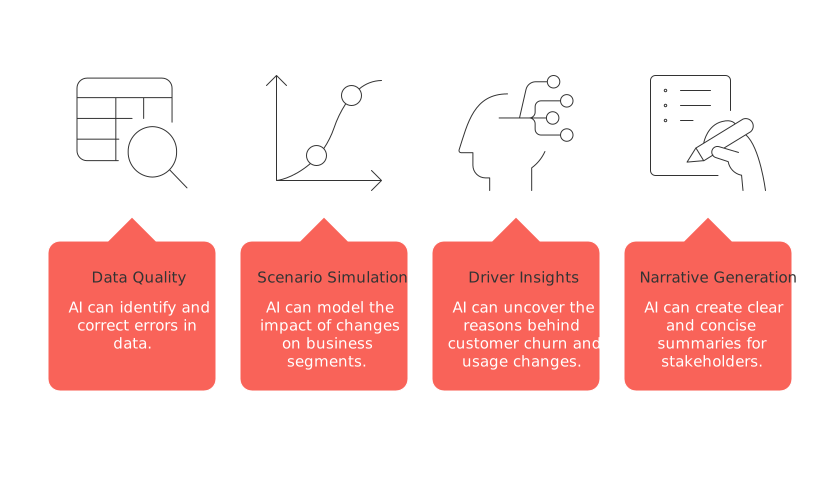
AI tools can automate data cleaning, challenge assumptions, and narrate key metrics. However, AI should never supersede established finance policies, a human should approve any ARR reporting changes.
Data quality: AI can flag duplicates, gaps in invoices, or misclassified upgrades.
Scenario simulation: Evaluate how pricing changes or onboarding adjustments could affect segments.
Driver insights: Correlate churn spikes to support tickets and drops in usage.
Narrative generation: Deliver concise, board-ready summaries in minutes.
Begin with core data points: ICP status, channel, plan, region, and time-to-implementation. Gradually introduce product usage metrics. Log all model assumptions, and save AI prompts and decision audits in your knowledge base.
Choose workflow tools that match your setup, Routine, Notion, or ClickUp are strong options for documentation; HubSpot or Pipedrive work well for CRM. Restrict all model write access to accounting data, and make sign-off mandatory before any forecast is finalized.
Connecting forecasts to pipeline, pricing, and operations
Improve forecast reliability with pipeline discipline
Forecasts are compromised when pipeline stages are vague or inconsistent. Standardize your stages and probability indicators for each segment. Track conversion rates by acquisition channel, ACV tier, and source of the initial meeting. Automate seamless handoffs from marketing to sales to customer success for cleaner data flow.
Reduce manual work by deploying automations that trigger with stage changes and send timely alerts. It’s easy to deploy core B2B sales automations that reinforce your pipeline and ensure assumptions remain current.
Close the loop with product and customer success
When testing prices, clearly state expected ARPA impacts and the target cohorts.
Onboarding initiatives should articulate a retention hypothesis and timeline.
Customer success programs should focus on expansion triggers, not generic touchpoints.
Translate forecast insights into staffing and operational decisions. If churn risk climbs in SMB cohorts, shift customer success coverage there. If enterprise expansion accelerates, prioritize roadmap investments to amplify those use cases.
Running governance, documentation, and access across teams
Institute a monthly forecast cadence with well-defined roles. Finance manages the model; sales, product, and success update inputs by a set deadline; executives review changes and decide next steps promptly.
Version-control every forecast model and dataset.
Document each assumption and the thinking behind it.
Restrict editing privileges and keep read-only access broad.
Archive scenario outputs after every board meeting.
Store cohort tables, supporting assumptions, and decisions in a shared workspace. Solutions like Routine or Notion are ideal for central recordkeeping, while ClickUp or monday.com can power project and workflow follow-through. Select one “home of truth.” Don’t spread vital data across ad hoc spreadsheets.
ARR forecasting checklist for executives and FP&A leaders
ARR excludes one-offs, temporary discounts, and services revenues.
Cohorts are created monthly or quarterly, based on account sign-up date.
Cohort attributes tracked: channel, plan, region, ICP fit.
Retention curves are transparent, simple, and thoroughly documented.
Expansion and contraction are monitored separately from logo churn.
Pipeline inputs reflect real conversion rates by stage.
Base, downside, and upside scenarios are always updated.
AI usage is audited, and policy updates have human sign-off.
Forecast, decision records, and results are housed in a single shared system.
Board narratives always highlight drivers, risks, and recommended actions in plain speech.
Final thought: Early forecasts aren’t about pinpoint accuracy, they’re about discipline. Cohorts reveal where growth is truly sustainable, while AI helps you quickly iterate potential moves. Together, these methods empower leaders to invest with intention and confidence.
FAQ
What is ARR and why shouldn't setup fees or one-time services be included?
ARR is the annualized value of recurring contracts, focusing on predictable revenue streams. Including setup fees and one-time services distorts ARR by inflating numbers with non-recurring income, misleading stakeholders about true financial health.
Why is cohort-based forecasting preferred over straight-line growth for early-stage SaaS companies?
Cohort-based forecasting uncovers expansion and churn risks hidden by straight-line growth models. It turns limited data into actionable insights by tracking customer segments over time, highlighting which customer groups provide sustainable revenue.
How does AI enhance ARR forecasting and should it replace human oversight?
AI accelerates data cleaning and scenario modeling, offering quick insights into pricing changes and customer behavior patterns. Yet, it should never replace human judgment; all AI-driven changes must receive human approval to ensure alignment with financial policies.
What is the risk of annualizing discounts in ARR calculations?
Annualizing discounts inflates ARR by assuming temporary price reductions vanish instantly, skewing revenue projections. This practice can lead to overoptimistic forecasts, compromising the integrity of financial strategies and investor confidence.
How should a SaaS company handle multi-year prepaid contracts in ARR calculations?
Multi-year prepaid contracts should be recorded at their annual value to maintain ARR accuracy. Counting the total cash received upfront misrepresents recurring revenue, leading to financial misinterpretations and poor strategic planning.
Why is it important to separate bundling products in revenue calculations?
Bundling masks true unit economics, distorting revenue clarity and complicating the understanding of each product's contribution to growth. By separating bundled products, companies can clearly assess profitability and optimize each offer's strategy.
How can Routine aid in managing ARR forecasting processes?
Routine facilitates CRM integration and financial flow management, aiding teams in building coherent cohort tables. It centralizes documentation and automations, ensuring a seamless interface between sales, customer success, and financial insights.

Julien Quintard
Founder & CEO at Routine03/09/2026
