AI-Assisted Technical Debt Register: Prioritize, Score, and Pay Down Faster
The missing ledger in your roadmap: a live, AI-assisted technical debt register
Technical debt is an often-invisible force that slows down delivery, reliability, and erodes customer trust. By introducing a visible, AI-assisted technical debt register, you transform hidden friction into clear, manageable choices. This tool gathers debt items, evaluates their impact, and organizes work by aligning priorities with business outcomes that matter most to your leadership team.
Think of this register as a simple ledger with advanced context. It connects code issues, incidents, contracts, and customer concerns, and automatically updates as your systems and teams evolve.
What to log in an AI-assisted technical debt register
Only track information you will act upon. Begin with essential fields, then expand based on real-world outcomes.
Title and concise summary in clear business language.
Owner of the relevant system, service, or module.
Debt type: reliability, security, performance, data, or scaling issues.
Customer impact: affected accounts, ARR at risk, and support ticket volume.
Operational signals: incident frequency, MTTR, alert count, and regression trends.
Interest rate: the pace at which pain grows if left unresolved.
Effort estimate: S, M, L, with an added confidence score.
Dependencies: upstream and downstream links to consider for resolution.
Supporting evidence: stack traces, SLA breaches, or audit results.
Responsible owner and an expected completion window.
A practical scoring model for technical debt items
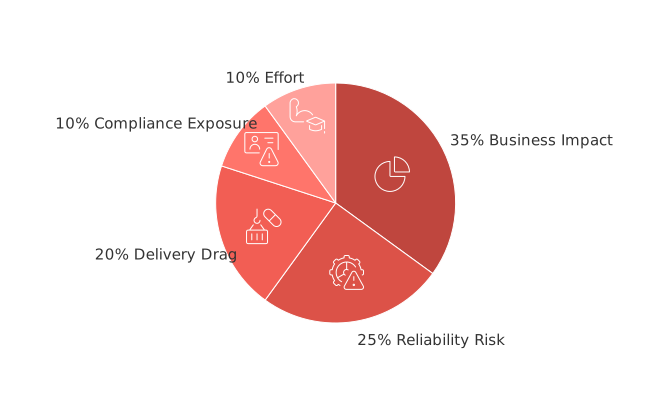
Apply a handful of weighted, easily repeatable factors. Keep the calculations straightforward and stable every quarter.
Business impact(35%): measures potential revenue loss and risk of customer churn.
Reliability risk(25%): considers the likelihood and reach of incidents.
Delivery drag(20%): quantifies the delay imposed on critical roadmap initiatives.
Compliance exposure(10%): evaluates regulatory or audit risk.
Effort(10%): smaller, high-impact items are given greater priority.
Score each factor from 1 to 5, multiply by the assigned weights, and sort for prioritization. Revisit and adjust weights semi-annually with input from product, engineering, and finance leaders.
How AI enhances identification, grouping, and de-duplication of technical debt
AI excels at reducing noise and organizing technical debt into actionable insights. Its role is to speed up triage, not to replace sound engineering judgment.
Ingestion: aggregate issues, incidents, pull requests, and support tickets into a unified queue.
Clustering: group similar or duplicate items and label clusters (e.g., retry storms, schema drift).
Summarization: condense lengthy tickets into concise business-relevant statements.
Attribution: link items to their owners, impacted services, and key accounts.
Auto-scoring: generate impact scores based on telemetry and customer data.
Change tracking: highlight increased risks after new deployments.
Start testing with a small sample size before scaling up. Measure metrics like false positives and missed clusters to validate effectiveness.
Prompt: You are an engineering program manager. Given the following 60 issue titles, incident notes, and support tags, group near-duplicates, assign each cluster a short business label, identify the owning service, estimate Business impact (1–5) from ARR and ticket volume, and list the top three representative items per cluster. Return a table with columns: Cluster label, Service, Representative items, ARR affected, Ticket count, Proposed impact score.
Prioritization rules accepted by both executives and engineers
Align on the rules once, and apply them consistently every week.
Address safety and regulatory issues before starting new features.
Resolve low-effort, high-impact items as soon as possible.
Improve the success rate of major roadmap items (epics) by resolving their most critical dependencies first.
Protect customer renewals projected for the current quarter.
Time-box medium-sized items; split them if estimates become uncertain.
Escalate any item that shows a rise in incident frequency.
Consistency beats heroics. A stable rulebook prevents chaos and untracked work.
Turning scores into quarterly plans and sprint backlogs
Assess and document the register based on available resources and capacity, not merely on aspirations. Clearly communicate the accompanying tradeoffs.
Set a quarterly allocation for debt remediation, e.g., 20–35% of total effort.
Create a top-N priority list using the weighted scoring model and prioritization rules.
Group related debt items as a single initiative, and assign a responsible owner.
Attach supporting evidence and outline the expected outcomes for each initiative.
Keep a buffer in reserve for urgent, emergent technical debt.
For greater structure and communication, use project planning templates and roadmaps to track initiatives. Link each to measurable business outcomes and a scheduled review date.
Dashboards to make technical debt visible to non-engineers
Executives care most about trends and business context, not individual card counts. Focus on actionable metrics and visualizations.
Technical debt burn-up: items resolved vs. added each month.
Incident trends for affected services post-remediation.
ARR at risk, tracked before and after debt is addressed.
Cycle time comparison for debt vs. feature delivery to expose bottlenecks.
Leading technical debt themes, ranked by their impact growth rate.
Position these metrics alongside roadmap progress visuals to provide instant business context. This approach aligns well with the five-phase project lifecycle and prevents unnecessary complexity.
Connecting the register to CRM systems and customer health
Technical debt isn’t limited to engineering, it influences retention and expansion.
Link debt items to relevant accounts and opportunities within your CRM.
Highlight renewals at risk due to unresolved technical debt and provide anticipated resolution dates.
Share progress updates with account managers in clear, customer-centric language.
Invite top customers to participate in beta tests when fixes are deployed.
When a high-value account is impacted, re-prioritize the associated task, even if the effort required is significant. Document the decision and its tradeoffs in the register to ensure transparency.
Governance: clear owners, service levels, and definitions of done
Clarity is critical to prevent the register from becoming an unmanageable backlog.
Appoint a single responsible owner for each item.
Establish regular review cycles: weekly triages and monthly rescoring.
Adopt concrete completion criteria: code merged, risk mitigated, SLOs trending positively.
Verify outcomes using incident logs and support statistics following remediation.
Tooling options: managing a centralized technical debt register
You can manage a technical debt register using an all-in-one workspace or through specialized tools. Centralized platforms make it easier to track ownership and reporting, while specialized solutions may suit advanced workflows. For more details, see this comparison of all-in-one workspaces and project management tools tailored for B2B teams.
Popular platforms like Routine, Notion, or ClickUp can hold your register alongside roadmaps and customer data. Integrate with Jira or Linear for detailed execution, and incorporate observability platform data for scoring.
Common pitfalls and how to avoid them
Vague entries: Always describe items in terms of business outcomes, not just error messages.
Score drift: Keep scoring weights fixed for each quarter.
Orphaned work: Ensure every item has a clear, accountable owner.
Unrecognized toil: Treat recurring operations work as technical debt.
Over-automation: Maintain a human check for all final scoring decisions.
KPIs for monthly executive reporting
Focus on a few key numbers that tie directly to strategy and customer outcomes.
Debt resolved vs. new debt, shown with a three-month trend.
Change in ARR at risk associated with technical debt.
Reduction in incidents for remediated services.
Cycle time impact on roadmap items after debt fixes.
Security and data boundaries for AI scoring
Protect sensitive information during any AI-based scoring process.
Remove personally identifiable information (PII) before ingestion and storage.
Enforce role-based permissions for all register access.
Maintain audit trails for every AI-generated or assisted change.
Clearly document AI model limitations in your playbook.
When to pay down technical debt immediately versus later
Let the scores, prioritization rules, and short-term revenue guides inform decisions. If the business impact is high and the fix is small, act quickly. For moderate-impact items with significant effort required, bundle and schedule for later, but always document the decision and anticipated review date.
Pair your register with intuitive trackers and roadmap visualizations for transparency and clear communication with stakeholders. For advice on selecting visualization tools, review this guide to Gantt charts and project trackers.
FAQ
What is a technical debt register?
A technical debt register is a tool that makes hidden inefficiencies visible by logging and assessing issues that impact delivery and reliability. It helps prioritize actions based on business outcomes, effectively transforming invisible roadblocks into manageable tasks.
How does AI assist in managing technical debt?
AI enhances technical debt management by reducing noise and organizing issues into actionable clusters, expediting triage without replacing human judgment. Tools like Routine use AI for auto-scoring impacts and tracking changes post-deployment.
Why should technical debt be prioritized over new features?
Left unmanaged, technical debt erodes project stability and customer trust, posing a greater risk than delaying new features. Addressing critical debt first ensures reliability and avoids costly setbacks in the future.
How do you determine the business impact of technical debt?
Business impact is scored based on potential revenue loss and customer churn risk. Routine provides a structured approach by incorporating factors like affected ARR and support ticket volume to quantify the stakes.
What are common pitfalls in maintaining a technical debt register?
Common mistakes include vague entries, score drift, and orphaned tasks. Address these issues by ensuring clarity, consistency in scoring, and assigning clear ownership for action items.
How can visualization tools aid in managing technical debt?
Visualization tools like Gantt charts and project trackers elucidate progress, highlight bottlenecks, and offer business context essential for decision-making. They prevent complexity and align technical efforts with strategic objectives.
When should technical debt be addressed immediately?
If a debt item has a high business impact but requires minimal effort to resolve, act swiftly. Deferred action increases risk and potential losses, disrupting project timelines and stakeholder confidence.
How does Routine enhance the management of technical debt?
Routine integrates debt management with broader business objectives through tools that connect roadmaps, CRM systems, and project data. This holistic approach ensures technical debt decisions are strategic and align with company goals.
What considerations should be taken when using AI for debt management?
Ensure data privacy by removing PII and enforcing role-based access. While AI can streamline operations, maintain a human check to prevent over-automation from leading to poor judgment and unchecked risks.

Julien Quintard
Founder & CEO at Routine03/30/2026
