Why a 30-minute Meeting Actually Costs a Solo Founder 2 Hours
The hidden two-hour tax behind a 30-minute meeting
A short meeting is rarely just the meeting itself, it sends ripples through your entire workday. When you total up the hidden time before and after, a quick meeting often absorbs about two hours.
Pre-work: Reading and gathering context: 15 minutes.
Last-minute context shift: Losing focus right before the call: 10 minutes.
The call itself: 30 minutes.
Focus recovery: Regaining your workflow after: 25 minutes.
Follow-up: Writing emails and updating your CRM: 20 minutes.
Re-prioritize: Adjusting tasks after the interruption: 20 minutes.
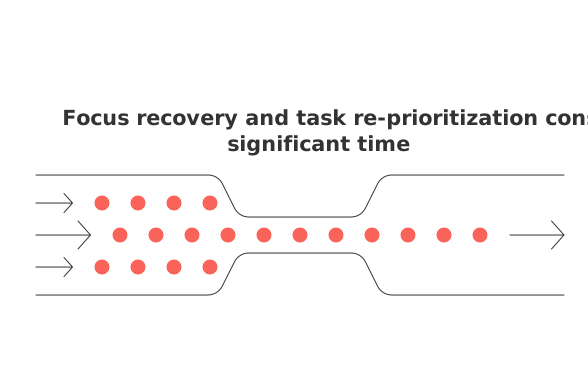
Total: about 120 minutes. That is the actual time you spend for what seems like a “half-hour” meeting.
If the outcome of the meeting can easily be summed up in an email, the meeting is unnecessary and costs more time and money than it's worth.
Quantify your real meeting cost in money and energy
Put a simple value on your time, you don’t need a complex spreadsheet.
Estimate how much you aim to earn annually.
Calculate how many genuine “maker hours” you can protect per week.
Divide your annual target income by those productive hours to get your effective hourly rate.
Example: If your goal is $150,000 per year and you average 20 deep work hours a week for 48 weeks, that's about $156 per hour. When you count the two-hour tax, that “30-minute” meeting suddenly costs$312. Also consider your energy: if a single call derails your next creative block, the cost grows further.
A fast decision tree solo founders can run in 60 seconds
Use this quick filter before accepting any meeting invitations:
Revenue now? Could this unlock cash in the next 30 days?
Irreversible risk? Legal, compliance, or reputational stakes?
High ambiguity? Has written communication failed twice, blocking progress?
Trust-building need? Does a strategic partner or major customer need face time?
Speed advantage? Will a live conversation resolve days of back-and-forth?
If you answer “yes” to two or more, accept. If not, suggest a way to handle the matter asynchronously, such as by email or shared document updates.
When you need a quick second opinion on a meeting, try this prompt: Act as my Chief of Staff. Score this meeting invite with the “2‑hour tax” model. Return Accept, Decline, or Async. Weigh revenue in 30 days, legal risk, ambiguity, trust, and speed. Give 3 reasons and a short reply I can send. Invitation: [paste]. Context: pipeline stage, current goal, hourly rate [$Z].
Prefer async first: five alternatives to a call
Most meetings can be replaced by asynchronous tools. Offer one of these faster alternatives:
Two-paragraph decision memo: Summarize the question, options, and your recommendation.
Annotated screen recording: Show what you mean, instead of explaining.
CRM comment thread: Keep relevant context linked to the contact, not lost in your inbox.
Mini spec: Clearly define what’s needed, the blockers, and the deadline.
Shared checklist: Let people tick off tasks and keep progress visible.
Centralize all asynchronous work so it's easily searchable. If you’re still deciding between tools, this guide can help you weigh all-in-one workspaces against dedicated project tools before making a decision.
When a meeting is actually worth the two hours
Some meetings pay for themselves. Say yes when:
A signed deal depends on a live negotiation or reassurance.
You face legal, compliance, or brand risk that needs expert advice.
A key partner needs a trust reset after a setback.
You need to unblock complex work with shared brainstorming or whiteboarding.
Your top customer asks for a brief slot and it can truly move the relationship or deal forward.
In these scenarios, protect the time slot, set a clear goal, and act decisively.
Reduce the overhead when you must meet
If you do need to meet, you can shrink the two-hour tax with a few habits:
Batch by theme: Group similar calls together so you’re not constantly switching contexts.
Focus on outcomes, not topics: Decide the goal before you enter the meeting.
Cap meetings at 25 minutes: End as soon as you reach the desired outcome.
Arrive with materials: Share documents or mockups in advance.
Leave with one owner and a date: Without clear ownership, nothing gets done.
For structure, check out this resource on running short, focused meetings using proven templates. Use live meetings only when they truly matter.
Turn meetings into CRM momentum
The outcome of the meeting is just a step, the real win is moving work or deals forward. Treat every meeting as an opportunity to fuel your pipeline.
Update or advance the opportunity stage before ending the call.
Document the single actionable promise, and the date it’s due.
Send a one-screen recap with the owner and the timeline.
This is easy with tools like Routine, Notion, or ClickUp, which centralize projects, knowledge, CRM, and meetings to minimize context switching. Want to automate tasks for follow-ups and handoffs? Check out “Top 5 Automations Every B2B Sales Team Should Set Up Today.”
Need help with post-meeting communication? Write a 5‑sentence follow‑up email to [Name] after the call. Confirm the decision, the one next action, the owner, and the deadline. Add a polite nudge if they owe something. Tone: clear, friendly, confident.
Sample scenarios: accept or decline?
Cold partner pitch with vague outcomes
Decline. Request a concise one-page proposal and a short screen recording instead.
Existing customer stuck on rollout
Accept. Schedule a 25-minute call aiming for a concrete solution and a clear owner.
Investor intro from a trusted founder
Accept. Reserve the slot and prepare a focused, data-driven story.
Prospect asks for “a quick chat” after a detailed email
Suggest an asynchronous response. Propose written answers or a decision memo first.
Make your time policy visible and kind
Publish a simple time policy so others understand and respect your focus. The way you decline sets the standard.
Try this friendly and transparent response when you need to say no: Thanks for the invite! To protect deep work, I try to solve most things asynchronously first. If you share your goal and your top three questions, I’ll reply today. If a live chat still makes sense, I can do 25 minutes this week with a clear outcome.
When in doubt, apply the 60-second filter, remember the hidden two-hour tax, and pick the route that moves things forward with the least friction.
FAQ
Why should a 30-minute meeting be reconsidered?
A 30-minute meeting often requires two hours when factoring in preparation, focus loss, and follow-up. This hidden cost can derail productivity and inflate operational expenses significantly.
How can I calculate the real cost of a meeting?
To find the true cost, divide your annual income target by the deep work hours available annually to get your hourly rate. Multi-faceted losses from meetings can turn a simple half-hour meeting into a real strain on resources.
What are the criteria for accepting a meeting?
Consider accepting if the meeting can unlock immediate revenue, poses irreversible risks, requires trust-building, or if ambiguity can be reduced faster in person. If not, explore asynchronous solutions for efficiency.
Are there effective alternatives to live meetings?
Yes, alternatives like decision memos, annotated screen recordings, and shared checklists can replace most meetings. They conserve time and energy, streamlining priorities and communications without face-to-face interruptions.
When is a meeting actually justified?
Meet when live interaction can clinch a significant deal, avert legal issues, or swiftly dismantle complex obstacles. These situations justify the time investment and often yield greater strategic value.
How can Routine help minimize meeting distractions?
Routine offers centralized tools to manage projects, CRM, and communications, minimizing context switching. Its automations facilitate post-meeting follow-ups, turning meetings into momentum rather than interruptions.
What strategies can reduce the overhead of necessary meetings?
Batch meetings by theme, cap meeting times, and establish a goal beforehand. This approach preserves focus and mitigates disruption, ensuring that when meetings do occur, they are impactful.
How can I communicate my time policies effectively?
Articulate your time policies clearly to encourage respect for deep work hours. Declining politely while outlining your preferences for asynchronous communication sets professional boundaries and manages expectations.

Julien Quintard
Founder & CEO at Routine05/28/2026
