Program Management vs Project Management: Skills, Tools, and Career Paths
Why the difference between program management and project management confuses growing teams
Periods of rapid growth introduce competing priorities, shifting budgets, and shared resources. As job titles overlap, accountability may become unclear. Teams sometimes mistakenly treat programs as simply larger projects, risking disconnected outcomes and reduced impact. Establishing clear boundaries is essential to maintain both strategic alignment and effective delivery.
What separates program management from project management in scope, outcomes, and time horizon
Program management focuses on steering multiple, interconnected projects to fulfill strategic objectives. It seeks to maximize value by aligning deliverables, synchronizing dependencies, and adapting scope as business needs or market trends evolve. Project management, on the other hand, is centered around delivering a specific result within an agreed upon scope, schedule, and budget.
Programs streamline multiple projects to accomplish strategic outcomes, optimizing value. In contrast, projects focus on executing within defined constraints such as time, cost, and scope.
Projects follow a structured lifecycle, marked by distinct phases and handoffs. For a review, see the five phases of the project lifecycle and key activities in each phase. In contrast, program charters are more dynamic, evolving in response to ongoing strategic and portfolio priorities over a longer-term horizon.
Key responsibilities and deliverables in program management compared to project management
Program management responsibilities and deliverables
Define a benefits roadmap and ensure its alignment with annual strategic plans.
Sequence and prioritize projects, managing interdependencies across teams.
Take responsibility for risk posture across initiatives and escalate trade-offs as needed.
Facilitate governance forums and collaborate with executives to reach consensus on pivotal decisions.
Monitor realization of benefits and assess business outcomes post-launch.
Project management responsibilities and deliverables
Plan project scope, schedule, budget, and resources for a single initiative.
Manage delivery risks and issues using tools such as a RAID log.
Coordinate tasks, track project milestones, and manage change requests to ensure project objectives are met.
Report project status to sponsors and formally accept completed deliverables.
Close out the project and systematically archive artifacts for future reference or reuse.
Skills that hiring managers expect from program managers vs project managers in 2026
Program managers apply strategic planning skills and have the capacity to handle uncertainties. They build relationships to align various functions and negotiate favorable outcomes. Project managers excel at orchestrating project processes, planning and organizing work, and removing delivery obstacles with structured discipline.
Program skills: portfolio planning, financial acumen, stakeholder mapping, dependency design, change leadership.
Project skills: scope control, scheduling, budgeting, vendor coordination, quality management.
Shared skills: effective communication, risk management, data-driven reporting, and conflict resolution.
Governance, cadence, and communication structures for programs vs projects
Programs adopt tiered governance structures to align executives, product leaders, finance, and operations. Projects typically use simpler cadences centered on managing key milestones and checkpoints.
Programs: quarterly steering reviews, monthly checks on benefits realization, and weekly cross-workstream syncs.
Projects: biweekly status reviews, sprint ceremonies, and scope change boards when necessary.
Both: maintain decision logs, manage risk thresholds, and use a defined escalation path for resolving issues.
Tools: how to choose software stacks for program management vs project management
Programs require tools that provide visibility across projects, support mapping of dependencies, and track benefits. Projects work best with software that enables reliable planning, task management, and reporting against baselines. Many teams combine a portfolio-wide view with focused delivery tools.
Before investing in new platforms, compare all-in-one workspaces with specialized project tools for your specific needs. Some organizations centralize on platforms like Routine, Notion, or ClickUp to connect project management, knowledge bases, and lightweight CRM functions. Others pair tools such as Jira or Asana for daily delivery with Salesforce or HubSpot for customer data and interactions. Always select integration paths deliberately and avoid ad hoc combinations.
How CRM and knowledge management intersect with program and project work
Programs use customer insights from CRM systems to inform portfolio decisions, shape benefits, project sequencing, and risk management strategies. At the project level, CRM workflows help track stakeholder engagement and customer-facing deliverables. A well-maintained, searchable knowledge base accelerates onboarding, supports project reuse, and enables effective audits. Always ensure that major decisions are documented, so institutional context can be preserved through team changes.
Career paths, titles, and certifications for program and project professionals
In program management, typical advancement follows a path from Program Manager to Senior Program Manager, and then to Director or Portfolio Manager roles. Project management paths often progress from Project Manager to Senior PM, then on to Delivery Manager or PMO Manager. Credentials and certifications are increasingly valued at all levels.
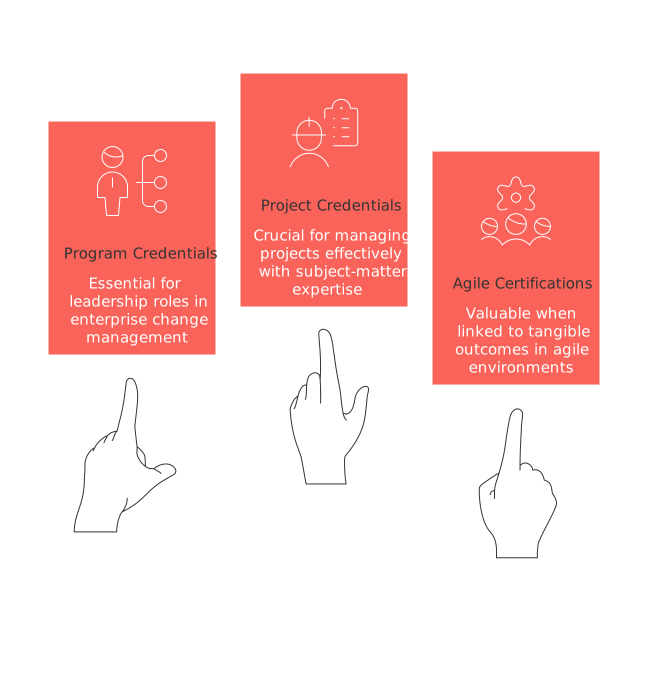
Program credentials: PgMP or PfMP certifications, along with proven enterprise change experience.
Project credentials: PMP or PRINCE2 Practitioner certifications, plus subject-matter expertise.
Scaling methods: Agile certifications can add value when they are demonstrably tied to outcomes.
Make career decisions based on the potential for business impact and personal growth, rather than being swayed solely by job titles. Explore active certification opportunities on PMI’s certification portal for program and project professionals.
Metrics and dashboards that program managers and project managers report to executives
Program managers are accountable for tracking benefits realized, the health of project dependencies, and actionable investment performance. Project managers focus reporting on predictability and the quality of delivery. Prioritize metrics that influence senior leadership decision-making.
Program metrics: benefits realization, NPV shifts, capacity allocation, strategic risk index.
Project metrics: schedule variance, cost variance, throughput, and defect escape rate.
Executive roll-ups: scenario forecasts and confidence levels, beyond basic task counts.
When to form a PMO or PgMO and how to staff it
Establish a Project Management Office (PMO) when your project volumes exceed what informal practices can sustain. Create a Program Management Office (PgMO) when multiple initiatives are aimed at the same strategic outcomes. Staff your PMO or PgMO with a lean and expert team, prioritizing quality over quantity. Focus the group on clear frameworks, robust tooling, and reliable reporting standards that add organizational value.
FAQ
What is the main difference between program management and project management?
Program management strategizes across multiple projects to achieve broad objectives, whereas project management zeros in on delivering specific outcomes within constraints like time and budget. Confusing the two can lead to strategic misalignments and reduced impact.
Why should teams not treat programs as just larger projects?
Treating programs as oversized projects risks misalignment of goals and disconnected efforts, which may waste resources and diminish value. Programs require a dynamic approach to manage shifting priorities and dependencies effectively.
How do governance structures differ between programs and projects?
Programs employ a tiered governance system to align diverse functions, while projects often rely on simpler, task-oriented check-ins. Failing to establish proper governance can derail both project outcomes and strategic initiatives.
What skills distinguish a successful program manager from a project manager?
Program managers excel in strategic planning, risk management, and stakeholder alignment, while project managers focus on detail-oriented execution and constraint management. Underestimating these specialized skills can compromise delivery.
How do the tools used in program and project management differ?
Program management tools prioritize visibility and dependency mapping across projects, while project tools focus on planning and task management. Mismatched tools can stifle productivity, so choose wisely with software like Routine.
What are the consequences of not establishing a PMO or PgMO?
Without a PMO or PgMO, organizations may struggle to coordinate efforts across multiple initiatives, resulting in inefficiencies and missed objectives. Strategic alignment, resource allocation, and performance monitoring require formal oversight.
What role does CRM play in program and project management?
CRM systems guide strategic decisions in programs and enhance stakeholder engagement in projects. Neglecting CRM integration can result in disconnected decision-making and poor customer relationship management.
Which metrics are crucial for executives from program and project managers?
For program managers, metrics like benefits realization and strategic risk index are key, while project managers report on deliverable predictability and quality. Focusing only on basic metrics won't provide the insights executives need for strategic decisions.
What career advancements can program and project managers expect?
Program managers may progress to roles like Director or Portfolio Manager, while project managers might advance to PMO Manager. Certifications add value but focus on their applicability instead of relying on titles alone.

Julien Quintard
Founder & CEO at Routine03/04/2026
