NRR Decomposition with AI: Logo, Expansion, and Contraction Explained
Why net revenue retention matters more than new logos for executives
In fast-growing companies, net revenue retention (NRR) offers the most accurate perspective on whether your revenue truly compounds over time. Unlike metrics that can be inflated by marketing spend or short-term customer acquisition, NRR measures the genuine value customers find in your product.
Executives track NRR because it reflects account loyalty and product-market fit. While new customer wins contribute to growth, robust strategic plans are mainly supported by account expansion, as this signals satisfied customers who desire more of your offerings.
NRR is the clearest signal that customers stay, grow, or shrink, each movement tied directly to real dollars.
How to decompose NRR into logo retention, expansion, contraction, and churn
To clarify NRR's underlying trends, break it into four components, ensuring each term is used consistently across finance, sales, and operations teams:
Logo retention: The number of accounts that remain active during a given period.
Expansion: Additional seats, increased usage, or adoption of new features by retained accounts.
Contraction: Reduced seats, lower usage limits, or selection of smaller plans by retained accounts.
Churn: Accounts that fully cancel their contracts; note that reactivations should be tracked separately.
Visualize these movements in a monthly or quarterly waterfall chart: begin with the starting ARR for each cohort, add expansion, subtract contraction and churn, and arrive at the ending ARR for that group.
Tip: Always account for ramp discounts and one-time credits separately to avoid skewing contraction figures.
How to compile a reliable NRR dataset from CRM, billing, and product usage data
Compile a reliable NRR dataset by integrating data from your Customer Relationship Management (CRM) system, billing reports, and product usage statistics. Consistent and accurate identifiers across these sources will improve the reliability of your NRR analysis.
Join CRM account records with billing customer entries using a stable company key.
Map each invoice line item to the correct product family for precise segmentation.
Tag every renewal, expansion, and downgrade with a specific event type and date.
Add basic product usage data to help explain changes in revenue later on.
Creating a cohesive NRR model requires the integration of different data types. If you're having difficulty merging support and sales information, consider learning how to merge support (Intercom), messaging (Front), and email data without code to build a single, streamlined customer view for your NRR model.
Common data quality concerns: Watch out for currency conversions, plan changes in the middle of a term, cancellations recorded after the fact, and merged accounts following acquisitions.
Prompt: You are a SaaS data auditor. Given columns [account_id, start_arr, end_arr, invoice_date, product_family, event_type, fx_rate], list rows that risk misclassifying expansion vs. contraction. Return a short reason per row and a proposed fix.
Apply AI to classify revenue movements and predict account-level risk
Once your data is unified, AI can help classify NRR movements and uncover early indicators of risk or growth opportunities.
Classification that explains both “what” and “why”
Summarize renewal notes, support tickets, and usage trends for each account.
Assign a movement label with a concise reason and confidence score.
Group similar reasons to identify actionable patterns and themes.
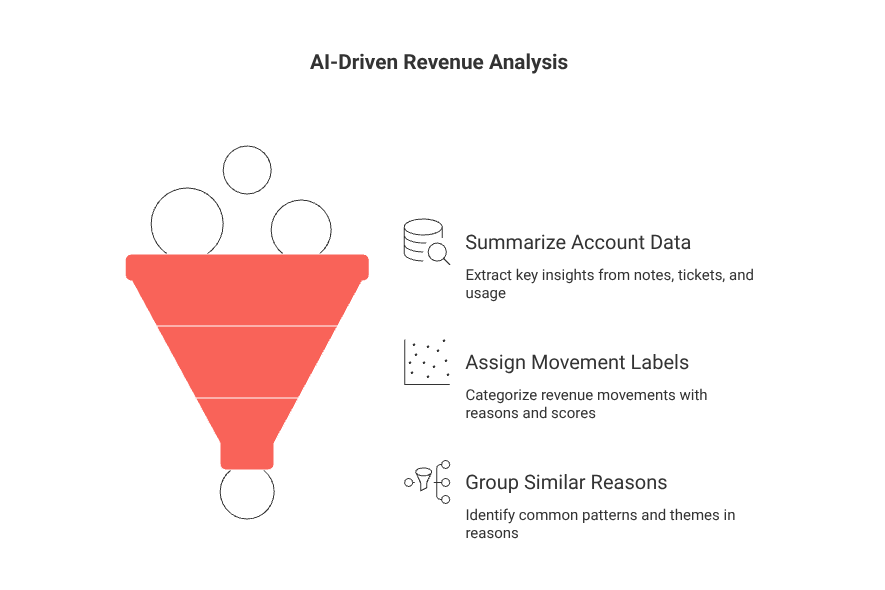
Prompt: You are a SaaS retention analyst. For each account JSON object with fields [renewal_note, last_90d_tickets, feature_usage_change], output: { movement_reason, label in [expansion, contraction, churn_risk, stable], confidence 0-1, recommended_next_step }.
Risk scoring that sales and success teams trust
Build transparent risk scores by blending simple, explainable inputs, usage declines, qualified opportunity stalls, or negative sentiment. Make sure every risk factor is easily discussed in review meetings.
Build AI-driven playbooks to accelerate expansion and manage contraction
Use the patterns surfaced by AI to design targeted interventions for each account segment this quarter:
Usage-based nudges when a feature surpasses a threshold in adoption.
Seat reviews for departments experiencing rapid workforce changes.
Plan fit checks following product packaging or pricing updates.
Executive business reviews for accounts with potential for multi-product use.
Automate supporting processes so teams can concentrate on strategic conversations. For more actionable ideas, explore a list of automations every B2B sales team should set up for timely, signal-driven outreach.
Prompt: Create a four-touch expansion sequence for an account with rising API calls but stagnant seat count. Include subject lines, value proof, and a one-line ROI calculation. Tone: concise and senior-friendly.
How to present an NRR decomposition that investors will understand instantly
Make your NRR story unmistakable with a single-slide waterfall chart and a clear legend that matches your defined terms:
Layout: starting ARR, expansion (add), contraction (subtract), churn (subtract), reactivation (add), and ending ARR, displayed from left to right.
Use distinct colors for each movement type, with concise numeric labels.
List the top three reasons for each movement, sourced from your AI-driven summaries.
Include a small cohort grid sorted by start quarter. Executives will be able to understand trends at a glance.
Common pitfalls in NRR reporting and how AI-driven analysis mitigates risk
In NRR reporting, a variety of pitfalls can undermine metrics if not properly managed. AI-driven tools can address these common issues and help teams maintain consistency and accuracy. Key pitfalls include:
Mixed pricing models: Always separate seat-based and usage-based revenue before applying labels.
Credit noise: Tag one-time credits to ensure they are not mistaken for revenue contraction.
Term shifts: Flag contracts when they change from annual to monthly mid-term to avoid timeline confusion.
Parent-child accounts: Roll up subsidiaries correctly and make all assumptions explicit in documentation.
Reactivations: Clearly define your lookback window for reactivations and keep it consistent across reporting periods.
AI solutions can process free-text reasons, identify anomalies, and propose consistent tags for movements. With these recommendations in hand, human teams can approve and further refine labeling during regular review meetings.
Tooling choices for NRR analysis: all-in-one workspaces versus a stitched stack
Centralized workspaces aid in connecting CRM, projects, and internal knowledge without the need for additional intermediary scripts or specialized integration tools. This streamlines access and makes team collaboration more efficient. Platforms like Routine and ClickUp enable teams to unify playbooks, datasets, and reviews in one place. However, when deeper analytics or strict governance is needed, dedicated tools may still be the better fit.
Before selecting your approach, be sure to map out collaboration needs, audit your data integrations, and stress-test your executive-ready presentation slide. If you need further comparison, there are resources that outline the strengths of all-in-one workspaces versus specialized tools based on company scale and compliance requirements.
Where to go next to strengthen your NRR practice
If your organization lacks a unified view of the customer, prioritize integrating your customer data systems. This guide on merging customer systems without code can help you make fast progress.
FAQ
What is net revenue retention (NRR), and why is it crucial for SaaS companies?
NRR measures the recurring revenue from existing customers and their expansions minus any downgrades or churn. It's critical because it shows genuine growth from customer satisfaction and loyalty rather than from short-term marketing pushes, offering a more sustainable business perspective.
How can a company improve its NRR?
Focusing on existing customer engagement through personalized expansions and reducing churn is vital. Tools like Routine can facilitate the unification of customer data systems to identify and act on these opportunities effectively.
What common pitfalls can affect NRR accuracy?
Issues like mixed pricing models, unmatched credits, or mid-term contract changes can distort NRR. An integrated system like Routine helps manage these inconsistencies, ensuring accurate and reliable data for decision-making.
What role does AI play in NRR analysis?
AI can automate the classification of revenue changes and predict risk, enabling proactive interventions. By identifying patterns and suggesting tags, AI reduces human error, but companies must still guide and verify AI output for optimal results.
How should companies visualize NRR for stakeholders?
Use a clear waterfall chart showing ARR movements to make trends instantly understandable. Keep the design simple and ensure accuracy in reporting, leveraging robust data integration platforms like Routine for consistency.
Why should companies decompose NRR into individual components?
Breaking down NRR into factors like retention, expansion, and churn reveals the true dynamics of customer relationships. It allows businesses to pinpoint areas for strategic improvement and tailor growth activities accordingly, avoiding over-reliance on new acquisitions.
Can AI-driven insights be fully trusted for business decisions?
While AI provides valuable insights, it is not infallible. Companies should critically evaluate AI-generated data and support its findings with human judgment to avoid costly missteps. Routine can enhance this process by integrating diverse data sources for better-informed analysis.
How do you handle currency conversions when calculating NRR?
Accurate currency conversion is crucial to avoid misreporting revenues. Ensure that all transactions are consistently converted using fixed exchange rates and reviewed regularly to prevent revenue distortion.
What are the risks if NRR data lacks integration across platforms?
Without a unified system, discrepancies and data silos can lead to incorrect NRR calculations and misguided strategies. Routine consolidates CRM, billing, and usage data to eliminate these pitfalls, ensuring strategic alignment.
Why is retaining customers often more beneficial than acquiring new ones?
Retained customers typically have higher lifetime value and lower acquisition costs, contributing more sustainably to revenue. Prioritizing retention ensures long-term growth and higher profitability, a strategy supported by tools like Routine for enhanced customer understanding.

Julien Quintard
Founder & CEO at Routine03/23/2026
